The most common question we get from founders is some version of: "How much will this cost?"
The most common answer they get from agencies is some version of: "It depends."
Both are honest. Neither is useful.
This post is an attempt to give you something more useful — real numbers, real breakdowns, and a clear framework for understanding why SaaS MVP costs vary as much as they do. I'll also tell you what's negotiable, what isn't, and what red flags to watch for when you're getting quotes.
I run a software agency. We build SaaS MVPs. So yes, I have a stake in this conversation. I'll try to be honest anyway, because founders who understand pricing make better clients, and better clients make better projects.
What "MVP" actually means in 2026
The word MVP has been stretched to mean almost anything. Founders use it to mean "the full product but faster." Agencies use it to mean "we'll build whatever you want but call it an MVP to manage your expectations." Neither is accurate.
A real MVP is the smallest version of your product that delivers core value to a specific user and generates real signal about whether anyone wants it. Not a prototype. Not a demo. Not a landing page. A working, deployable product that does one thing well.
The problem is that "smallest version that delivers core value" looks different for every product. A logistics SaaS for freight forwarders has different complexity than a simple project management tool. A B2B platform requiring integrations with enterprise ERP systems costs more to build than a standalone consumer app.
So when someone says "how much does an MVP cost," the honest answer really is: it depends on what you're building. But we can get specific about what it depends on.
The four things that actually drive MVP cost
1. Feature scope
This is the biggest variable. The number of features you ship in v1 has a roughly linear relationship with cost — more features, more time, more money.
The problem is that most founders scope their MVP at about 2–3x what it should be. Every feature that isn't core to your value proposition is either a distraction or a future v2 item. The discipline of cutting features is harder than it sounds, especially when you've been thinking about your product for months.
Practical rule: if you can't articulate how a specific feature directly helps you validate whether people will pay for your product, cut it.
2. Integrations
Third-party integrations are expensive and underestimated. Integrating with Stripe is straightforward. Integrating with a legacy ERP system, a government API, or a custom enterprise database is not.
Every integration adds:
- Discovery time (understanding the third-party API)
- Development time (building and testing the integration)
- Maintenance surface (integrations break when the third party updates their API)
If your MVP requires 5+ integrations on day one, your cost goes up significantly regardless of how simple the core product is.
3. User roles and permissions
A single user type (everyone sees the same interface) is simple. Two user types (admin and user) is manageable. Three or more user types with different permissions, different views, and different workflows adds complexity that compounds quickly.
Multi-tenant architecture — where your platform serves multiple companies, each with their own data isolation — is a meaningful engineering challenge. If your SaaS is B2B and each client company needs their own workspace, account management, and billing, that's more complex than a single-tenant product.
4. Team location and seniority
This is the most obvious variable. The same product costs very different amounts depending on who builds it.
Rough hourly rates for mid-level full-stack developers in 2026:
- US / Western Europe: $120–180/hr through agencies
- Eastern Europe: $45–80/hr
- South Asia (India, Pakistan): $25–55/hr through agencies
- Southeast Asia: $20–45/hr
Quality is not perfectly correlated with location — but it's also not perfectly uncorrelated. The right question isn't "where are the cheapest developers?" It's "where can I find developers with the right experience at a price that fits my budget?"
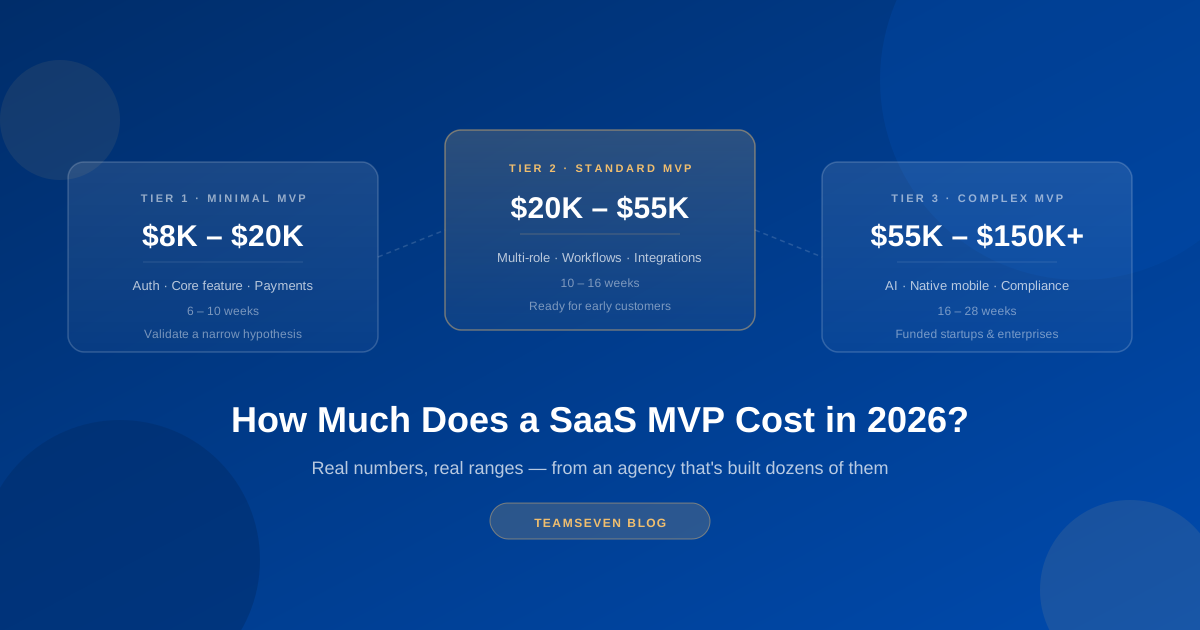
Real cost ranges by MVP type
Here's what we actually see in 2026, broken down by product type. These are ranges for agencies — not offshore freelancers, not US in-house teams.
Simple SaaS MVP (single user type, minimal integrations)
Examples: basic project management tool, simple booking platform, straightforward subscription service
- US agency: $80,000–$150,000
- Eastern European agency: $35,000–$65,000
- South Asian agency: $15,000–$35,000
Timeline: 10–16 weeks
Mid-complexity SaaS MVP (2 user types, 2–4 integrations)
Examples: B2B platform with admin and client portals, marketplace with buyer and seller flows, SaaS with Stripe + one third-party integration
- US agency: $120,000–$250,000
- Eastern European agency: $50,000–$100,000
- South Asian agency: $25,000–$60,000
Timeline: 14–20 weeks
Complex SaaS MVP (multi-tenant, multiple user types, 5+ integrations)
Examples: enterprise SaaS with company-level accounts, logistics platform integrating with multiple carriers, fintech product with compliance requirements
- US agency: $200,000–$500,000+
- Eastern European agency: $80,000–$180,000
- South Asian agency: $40,000–$100,000
Timeline: 20–32 weeks
What's included in those numbers
When you get a quote from a reputable agency, it should include:
- Discovery and architecture: Understanding your requirements, designing the system, selecting the stack
- UI/UX design: Wireframes, user flows, visual design
- Frontend development: The interface users interact with
- Backend development: Server, database, business logic, APIs
- Third-party integrations: Stripe, auth providers, any APIs you need
- QA and testing: Manual and automated testing before launch
- Deployment: Setting up servers, CI/CD, monitoring
- Post-launch support: Usually 30–60 days of bug fixes
If an agency quote doesn't include most of these, you're either getting a very narrow scope or you'll be paying for the rest separately later.
What's not included (and often surprises founders)
- Ongoing hosting costs: AWS, GCP, or Azure. Budget $100–$500/month for a small SaaS, more as you scale.
- Third-party service subscriptions: Stripe has transaction fees. SendGrid has email costs. Many APIs have usage-based pricing.
- Post-launch iteration: Your MVP will need changes after real users touch it. Budget for a v1.1 and v1.2.
- Design assets: Stock photos, custom illustrations, icon sets. Not expensive but often forgotten.
- Legal: Terms of service, privacy policy, GDPR compliance if you're serving EU users.
A realistic first-year budget for a SaaS MVP is build cost + 30–40% for everything else.
What drives cost up unnecessarily
These are the things that make projects more expensive without making the product better:
Scope creep during development. Every time you add a feature mid-project, you're paying for it twice — once in development time and once in the disruption to the existing work. Scope changes mid-sprint are the single biggest budget killer I see.
Poor requirements at the start. Agencies spend a surprising amount of time figuring out what you actually want. The better your requirements document, the less time (and money) is spent on clarification. Invest in a good discovery phase — it usually pays for itself.
Building for scale you don't have yet. I've seen founders insist on Kubernetes clusters and microservices architecture for a product with zero users. Infrastructure optimization is a real-users problem. Build for where you are, not where you hope to be.
Chasing trends. Blockchain, AI integration, Web3 — whatever the technology trend of the moment is, somebody is asking for it in their MVP even when it doesn't serve their core value proposition. Trend-driven features are usually expensive and rarely validated.
What's negotiable
Agencies have more flexibility than their initial quotes suggest. Things you can negotiate:
Payment terms. Most agencies will work with milestone-based payments rather than large upfront deposits. This is reasonable and you should ask for it.
Scope. The most effective negotiation isn't on price — it's on scope. Ask "what would this look like at $X?" rather than "can you do this for $X?" You often get 70% of the value for 50% of the cost by trimming the right features.
Timeline. Longer timelines often mean lower cost — not always, but sometimes. If you're not in a rush, say so.
Equity. Some agencies take partial equity in place of full cash for early-stage startups. This is worth discussing if you're pre-revenue. Most agencies won't do it, but some will for the right product.
What's not negotiable
Quality of architecture. If an agency quotes significantly below every other quote you've received, they're cutting corners somewhere. Usually it's architecture — shortcuts that save money now and cost 5x more to fix later. Cheap architecture is the most expensive thing you can buy.
Adequate QA. Removing QA from scope to save cost is removing the process that catches bugs before your users do. It's always a false economy.
Red flags in quotes
Things that should make you pause when evaluating agency proposals:
No discovery phase. If an agency quotes a fixed price without spending time understanding your requirements, they're guessing. Either the price will be wrong or the scope will be wrong. Usually both.
Suspiciously low quotes. If you've received quotes of $30K, $45K, $50K, and $12K for the same scope, the $12K agency is not 75% more efficient than the others. They're either missing scope, planning to cut corners, or will come back with change requests later.
No mention of architecture decisions. A good agency will tell you why they're recommending a specific tech stack for your product. If they'll "use whatever you want" without any rationale, they're not thinking about your product's specific needs.
Vague deliverables. "A working SaaS platform" is not a deliverable. "A multi-tenant web application with Stripe billing, admin dashboard, client portal, and SendGrid email integration deployed on AWS" is a deliverable.
No post-launch support clause. Every product has bugs after launch. Make sure your contract specifies a support period and what it includes.
How to get an accurate quote
The more specific your requirements, the more accurate your quote. Before approaching agencies, prepare:
- A product overview: What does it do, who is it for, what problem does it solve?
- User types: Who uses the product and what can each type do?
- Core features list: What must be in v1? What can wait for v2?
- Integration requirements: What third-party services does it need to connect to?
- Design preferences: Do you have a brand? Do you need design from scratch or do you have wireframes?
- Timeline constraints: Do you have a hard deadline?
- Budget range: Being honest about budget helps agencies scope appropriately rather than proposing the expensive version by default.
You don't need a full specification document. You need enough clarity that an agency can give you a real number rather than a range so wide it's useless.
The actual answer
So — how much does a SaaS MVP cost in 2026?
If you're working with a reputable agency in South Asia or Eastern Europe: $15,000 to $60,000 for most standard SaaS MVPs, with complex enterprise products ranging higher.
If you're working with a US or Western European agency: expect to multiply those numbers by 2.5–4x.
The right number for your product depends on the four variables I outlined at the start: feature scope, integrations, user roles, and team location. If you understand those four variables, you'll be able to evaluate any quote you receive and know whether it's realistic.
And if you want a real quote for your specific product — not a range, not a "it depends" — feel free to reach out. We'll scope it properly and give you a number you can actually plan around.
Muhammad Nabeel is the co-founder of Teamseven, a software development agency in Lahore, Pakistan. We've been building SaaS MVPs and custom software for startups and enterprises since 2017. Get in touch if you want to talk through your project.