If you're a US startup founder Googling "offshore vs nearshore software development" right now, you've probably already been burned once. Or you've read three contradicting Medium posts. Or both.
I run a software agency in Lahore, Pakistan. Over eight years, we've worked with roughly 100 clients — US startups, UK SMEs, Australian scale-ups. I've watched the offshore-vs-nearshore debate play out in real contracts, not theory. So this post is an attempt to be genuinely honest about what each option actually costs, what you actually get, and where each fails.
Fair warning: I'm biased. I run an offshore agency. But I'll tell you exactly when offshore is the wrong choice, because pretending otherwise is how agencies ruin their reputations.
The three models in plain English
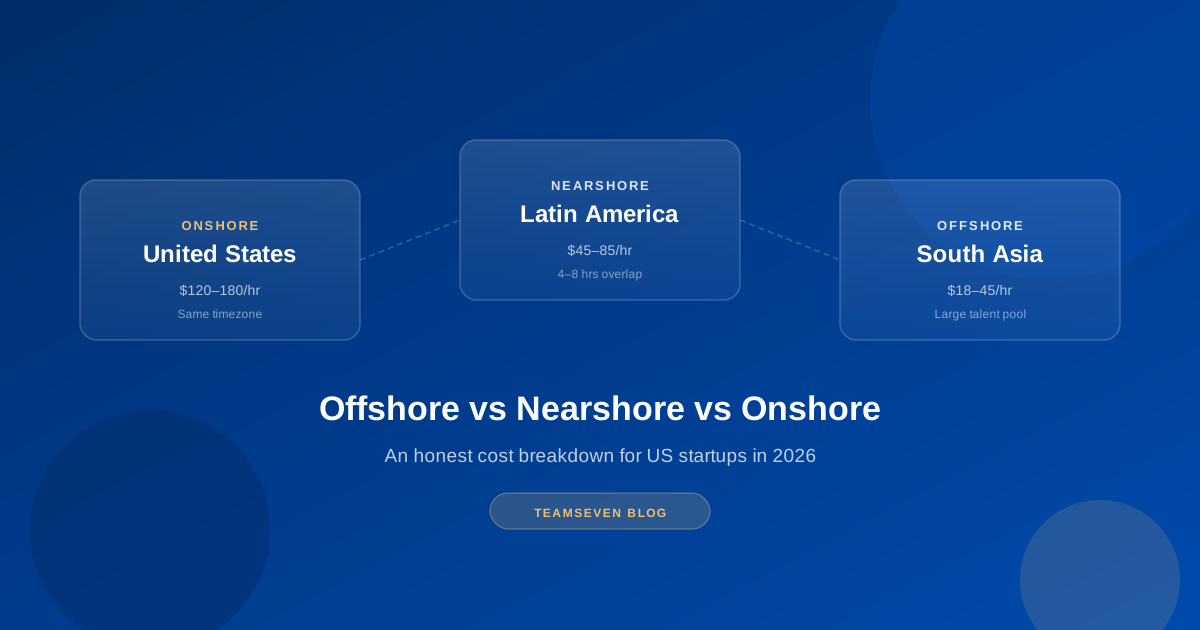
Onshore means hiring developers in the same country as your company. US founders hiring US developers. Same time zone, same culture, same (very expensive) hourly rates.
Nearshore typically means hiring developers in a country close to yours geographically. For US companies, this usually means Latin America — Mexico, Colombia, Argentina, Brazil. Time zones overlap with US working hours. Costs are 40-60% of US rates.
Offshore means hiring developers far from you geographically. For US companies, this usually means Eastern Europe (Poland, Ukraine, Romania), South Asia (India, Pakistan, Bangladesh), or Southeast Asia (Philippines, Vietnam). Time zones don't overlap meaningfully with US working hours. Costs are 15-35% of US rates.
Those are the textbook definitions. Now let's get specific.
Real hourly rates in 2026
Numbers get outdated fast, but here's what I'm actually seeing in contracts right now for mid-level full-stack developers (React/Node, 3-5 years experience):
Onshore US: $120-180/hr through agencies. $70-120/hr for independent contractors. Senior hires on W2 contracts: $150K-220K annual salary plus benefits (add 30% for total cost).
Nearshore Latin America: $45-85/hr through agencies. $35-65/hr for direct hires. Quality has improved dramatically in the last five years.
Offshore Eastern Europe: $35-65/hr. Ukrainian market is in flux but the talent pool is deep.
Offshore South Asia (including Pakistan): $18-45/hr through agencies. $12-35/hr for freelancers. This is where we operate.
Offshore Southeast Asia: $15-40/hr. Highly variable quality.
These are working rates, not bottom-of-the-barrel. You can find $8/hr freelancers anywhere. You shouldn't.
What the price actually buys you
Rate is the headline. Total cost is the story.
Onshore: What you're paying for
- Native English, zero communication overhead
- Same time zone — someone who can join a 2pm meeting
- Cultural context — they get startup urgency, American business communication
- Legal simplicity — US contracts, US tax treatment, US IP law
- The ability to meet in person when things get hard
- A developer you can fire on short notice if it's not working
What you're paying a premium for that you might not need: physical proximity, same-day meetings, and the psychological comfort of being able to sue them in a US court.
Nearshore: What you're paying for
- English proficiency that's usually strong but variable
- Time zone overlap with US (4-8 hours of shared working time)
- Cultural similarity to the US (for Latin America particularly — Western business norms)
- Lower rates than onshore with most of the convenience
What you lose: the ability to meet in person without international travel. And the talent pool is still smaller than offshore options, so the top end of quality tops out lower.
Offshore: What you're paying for
- The lowest hourly rates available for professional-grade work
- Access to genuinely large talent pools (India has 4.5 million software engineers)
- 24-hour development cycles if you're willing to work async
What you lose: real-time communication. A 12-hour time difference is not something "async workflows" magically solve. I've seen this fail hundreds of times.
The honest trade-off nobody tells you
There's a formula that's roughly true across thousands of projects I've observed:
(Developer quality) × (Hours of real-time collaboration) = Project success
You can move along either axis. Great offshore developers with 1 hour of daily overlap can succeed. Decent nearshore developers with 6 hours of overlap can succeed. But collapse either axis toward zero and projects fail.
The common offshore failure pattern: hiring cheap developers AND working full async. Both variables collapse. Project dies.
The common nearshore success pattern: decent developers with 5-6 hours of overlap. Both variables are okay. Project ships.
The common onshore waste pattern: paying premium rates for work that could have been done anywhere. No variable optimized, but money spent freely.
When onshore is actually the right choice
I'm supposed to convince you to work with us, not tell you when to hire an American. But here's when onshore is genuinely the right answer:
When the cost of communication failure exceeds the cost savings. If you're building something where a week of miscommunication wastes $50K, and you're saving $20K/month going offshore, the math inverts quickly.
When regulatory requirements are strict. HIPAA-adjacent healthcare, financial services with compliance audit trails, government contracts — the documentation overhead of offshore teams often wipes out the cost savings.
When you need same-day emergency response. E-commerce site down on Black Friday at 3pm EST. Your Pakistan team is asleep. Your Ukraine team is asleep. Your Philippines team is on a 9 hour offset. You need someone in US or Latin America on-call.
When IP is the entire company. Trade secrets, patents, defense work. You want everyone on the project in your jurisdiction.
When you've failed at offshore twice already. At some point "the third offshore agency will work" becomes magical thinking. Sometimes the lesson is that your team can't manage offshore, not that offshore can't work.
When nearshore is the right choice
When time zone overlap is more important than cost. If your PM can't function without daily standups and you won't train them to, nearshore is the right answer.
When you want the illusion of offshore without the reality. I mean that less cynically than it sounds. Nearshore lets executives say "we're offshoring" while operationally behaving like an onshore team. For some company cultures, this is worth the premium.
When Spanish or Portuguese matters. Building for Latin American markets? Nearshore is obvious.
When you want senior talent and offshore seniors are rare. The deepest nearshore benches (Argentina, Colombia) have more senior engineers than most offshore regions.
When offshore is the right choice
When budget is actually the binding constraint, and you have PM discipline. If you can only afford $25/hr and you can run an organized remote team, offshore wins.
When you're willing to work async. If your team writes detailed specs, records Loom videos, leaves thoughtful comments in tickets — the overlap deficit becomes manageable.
When the work is not novel. A well-specified React frontend or a standard CRUD API doesn't require real-time creative collaboration. Offshore shines here.
When you want a dedicated team, not a freelancer. Good offshore agencies will assign you a team that stays together across projects. Good freelancers won't.
When you've tried nearshore and it was mediocre. This happens more than nearshore evangelists admit. Latin American agencies have grown fast in the last five years, and some of that growth outran their quality control.
The Pakistan question specifically
Since I run a Pakistani agency, I should answer the thing you're really wondering: "Is Pakistan as bad as [my brother-in-law / my failed outsourcing attempt / that Reddit post] said?"
Truthful answer: Pakistan has the same quality variance as every other offshore region. There are world-class engineers here. There are scammers here. The median is somewhere in between, and the median is what you'll probably get if you pick randomly.
Pakistan's advantages: English is widely spoken (it's an official language), business culture is largely Western-aligned, salaries are low enough that top-tier engineers are accessible, and the time zone (GMT+5) gives you 3-4 hours of overlap with US East Coast.
Pakistan's disadvantages: the country has political volatility (not unique, but real), some clients have unfounded but persistent concerns about security, and the talent pool for specialized tech (ML, DevOps, cloud architecture) is thinner than India's.
I'm not going to argue you into Pakistan. What I'll argue is: if you're considering offshore at all, evaluate Pakistani agencies the same way you evaluate Indian, Ukrainian, or Filipino ones. Don't discount us harder, don't favor us. Judge on the work.
How to actually decide
Forget the region for a moment. Here's the decision tree I'd use if I were the buyer:
Question 1: Can your PM manage an async team? If no, you need nearshore or onshore. Full stop. Don't go offshore hoping it'll work out.
Question 2: Is the work well-specified or exploratory? Well-specified work (clear specs, stable requirements) suits offshore. Exploratory work (product discovery, novel features) suits onshore/nearshore.
Question 3: What's your realistic budget per month? Below $15K/month for significant engineering firepower, offshore is your only realistic option. $15-40K/month opens nearshore. $40K+/month makes onshore viable.
Question 4: How much do you need the team to understand your business deeply? Offshore teams that work with you for 18+ months get this. Short engagements won't. If your work requires deep business context and you can't commit to a long engagement, stay closer to home.
Question 5: What's your tolerance for communication overhead? Some founders thrive in written, async, thoroughly-documented environments. Others need real-time. Know which kind you are.
The answer isn't "offshore is cheaper" or "onshore is better." The answer is whichever option aligns with how your specific team operates.
What I tell clients when they ask me this directly
Here's the conversation I have with prospective clients who ask me honestly whether they should hire us:
"If your biggest constraint is budget, and your work is well-defined, we're a good fit. If your biggest constraint is iteration speed or you need someone on-call in US hours, we're probably not the right choice, and that's fine. I'd rather tell you that upfront than take the project and have you frustrated in three months."
About 30% of the prospects I have that conversation with end up working with us. The other 70% go to someone more appropriate, and a quarter of them come back two years later with a different project that actually fits. That's fine. The alternative — taking every project that walks in the door — is how agencies destroy their reputations.
The bottom line
Offshore isn't broken. Nearshore isn't a scam. Onshore isn't always worth the price. They're different tools for different situations.
If you're evaluating options right now, here's the one piece of advice that matters more than anything: don't pick the cheapest, pick the most appropriate. The money you "save" by going offshore when you needed onshore will be dwarfed by the rebuild cost when the offshore project fails. And the money you "save" by going onshore when you could have gone offshore is money you didn't have to spend in the first place.
Pick the right tool. Not the cheapest one.
Muhammad Nabeel is the co-founder of Teamseven, a software agency in Lahore, Pakistan that's been building custom software for startups and SMEs since 2017. You can reach him at teamseven.ltd@gmail.com or on LinkedIn.