
There's a conversation I've had with logistics business owners more times than I can count. It goes roughly like this:
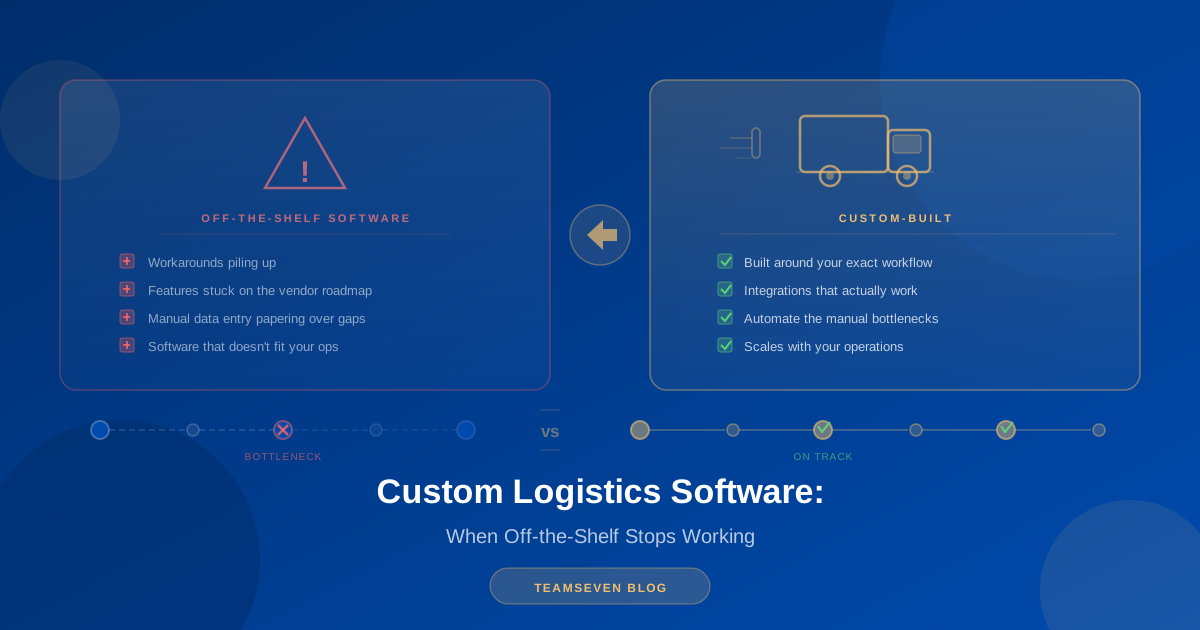
They've been using the same software for 3–5 years. It worked fine at the start. But somewhere along the way — as the business grew, as operations got more complex, as clients started demanding things the software wasn't built for — the tool stopped being an asset and started being a bottleneck.
They've tried workarounds. Spreadsheets running in parallel. Manual processes papering over gaps. Staff spending hours doing data entry that should happen automatically. They've called the software vendor's support line and been told "that feature is on the roadmap" — which, in vendor-speak, means sometime between next quarter and never.
And now they're sitting across from me asking whether custom software is the answer.
Sometimes it is. Sometimes it isn't. This post is an honest attempt to help you figure out which situation you're in — and if custom software is the right answer, what building it actually involves.
The problem with off-the-shelf logistics software
Off-the-shelf logistics software is built for the average logistics business. If your operations are average, it works fine. The problem is that no logistics business thinks of itself as average — and more importantly, the businesses that grow and differentiate are precisely the ones whose operations diverge from the average.
Generic logistics software makes a set of assumptions about how your business works:
- Your warehouse is organized a certain way
- Your carriers integrate in a standard way
- Your clients want standard documentation
- Your pricing model follows standard rules
- Your reporting needs are standard reporting needs
When your business fits those assumptions, the software is great. When it doesn't — and most established logistics businesses don't, in at least some critical areas — you spend enormous energy forcing your operations to fit the software rather than the other way around.
That's the core problem. And it compounds over time.
Seven signs your logistics software is holding you back
1. You're running parallel spreadsheets
If your team maintains spreadsheets alongside your logistics platform — to track things the platform doesn't track, to calculate things the platform can't calculate, to generate reports the platform doesn't produce — that's a sign the software isn't covering your actual workflow. It's also a data integrity risk. Two sources of truth eventually become two different truths.
2. Your team has developed workarounds with names
When staff refer to "the Tuesday workaround" or "the way we handle UK shipments" — informal processes that everyone knows but nobody has documented — those are symptoms of software that doesn't fit your operations. Workarounds are technical debt paid in human time.
3. You can't give clients the visibility they're asking for
Modern logistics clients — especially enterprise clients — want real-time visibility into their shipments, inventory, and exceptions. If your software doesn't support the level of visibility your clients are asking for, you're either losing contracts to competitors who can provide it, or you're manually producing reports that should be automated.
4. New carrier or partner integrations take months
If adding a new carrier, warehouse partner, or third-party service to your operations requires significant IT work or vendor involvement, your software's integration layer is a constraint on your growth. Every new partner should be a business decision, not an IT project.
5. Your pricing and billing has outgrown your software
Logistics pricing is complex — dimensional weight, fuel surcharges, accessorials, zone-based pricing, contract rates, spot quotes. If your billing team is doing manual calculations or running pricing through external tools because your software can't handle your rate structures, you have a problem that grows with every new client.
6. You can't get the operational data you actually need
Every logistics operation generates enormous amounts of data. If your reporting gives you standard metrics but not the specific KPIs that matter to your business — carrier performance by lane, warehouse utilization by shift, exception rates by client — you're flying partially blind.
7. The software vendor's roadmap doesn't match your needs
You've submitted feature requests. You've been on calls with the account team. The answer is always some version of "we're working on it" or "that's not something we're currently planning." When a vendor's product direction is consistently misaligned with where your business needs to go, no amount of waiting will fix the gap.
When custom software is the right answer
Not every frustration with off-the-shelf software justifies building custom. Custom software is a significant investment — in money, in time, and in organizational attention. It's the right answer when:
The operational gap is core to your business, not peripheral. If the limitation is in a function that's central to how you create value — your routing logic, your warehouse management, your carrier integration layer — then fixing it has a direct impact on your competitiveness and margin. If the limitation is in something peripheral, like report formatting, the ROI calculation is different.
You have stable, well-understood processes. Custom software is built around how your business works. If your processes are still evolving rapidly, building custom software now means rebuilding it again in 18 months. The right time to build custom is when you understand your operations well enough to specify what you actually need.
The workaround cost exceeds the build cost. Add up the hours your team spends on manual processes, parallel spreadsheets, and error correction. Multiply by their hourly cost. If that number, over 2–3 years, approaches or exceeds the cost of building a custom solution, the economics favor building.
Your clients or growth require it. Sometimes custom software isn't optional — it's what enterprise clients require for integration, or it's the capability that lets you win a market segment you couldn't serve before. Growth-enabling software has a different ROI calculation than efficiency-improving software.
When custom software is the wrong answer
You haven't exhausted configuration options. Most off-the-shelf platforms are significantly more configurable than users realize. Before concluding the software can't do what you need, invest time in understanding its full configuration capabilities — or hire someone who knows it deeply to do that assessment.
Your processes aren't defined well enough. If you can't write down exactly how you want the software to work, you're not ready to build it. Custom software development is a process of translating operational requirements into code. If the requirements are vague, the software will be too.
You're in rapid growth mode. When your operations are changing every 90 days, software struggles to keep pace regardless of whether it's custom or off-the-shelf. Stabilize your operations first, then build custom software around what you've stabilized.
Budget is the primary constraint. Custom logistics software is not cheap. If cash is tight and operations are functional, the better investment might be optimization of what you have rather than replacement.
What custom logistics software actually involves
If you've concluded that custom software is the right answer, here's what building it actually looks like.
Discovery and requirements definition
This is the most important phase and the most commonly underinvested. Before writing a line of code, a good development team will spend significant time understanding how your operations actually work — not how you think they work, but how they actually work at the floor level.
This typically involves:
- Interviews with operations staff, not just management
- Process mapping — documenting every workflow end to end
- Integration audit — cataloging every system the new software needs to talk to
- Exception analysis — understanding how edge cases are handled today
- Data architecture — defining what data needs to be captured, stored, and surfaced
Discovery for a mid-complexity logistics system typically takes 2–4 weeks. Skipping it or rushing it is the single most common cause of failed software projects in this space.
Core modules in a logistics software build
Depending on your specific operations, a custom logistics platform might include any combination of:
Order and shipment management: The core of most logistics systems. Order capture, shipment creation, status tracking, exception management, proof of delivery.
Warehouse management: Inventory tracking, receiving, putaway, picking, packing, dispatch. If you operate warehouses, this is often the most complex module.
Carrier integration layer: API connections to your carrier partners for rate shopping, booking, tracking, and invoice reconciliation. The number and complexity of carriers determines how complex this is.
Route optimization: For last-mile or distribution operations, algorithmic route planning based on delivery windows, vehicle capacity, driver availability, and geographic constraints.
Client portal: Real-time visibility for your clients — shipment tracking, inventory levels, reporting, document access. Increasingly a requirement rather than a differentiator.
Pricing and quoting engine: Rate card management, quote generation, spot pricing, contract rate handling. How complex this is depends entirely on your pricing model.
Billing and invoicing: Automated invoice generation based on actual services delivered, including complex accessorial charges, fuel surcharges, and special handling fees.
Reporting and analytics: Operational dashboards, KPI tracking, exception reporting, client-specific reporting.
Not every build includes all of these. A focused MVP might cover order management, carrier integration, and a basic client portal — then expand from there as the business validates what it actually needs.
Technology choices
Custom logistics software is typically built as a web application — accessible from any browser, no local installation required. Modern logistics platforms are generally built on:
Backend: Node.js, Python, or .NET for the server layer and business logic. The choice depends on team expertise and specific performance requirements.
Frontend: React or Angular for the user interface — both are well-suited for the data-heavy, dashboard-style interfaces that logistics software requires.
Database: PostgreSQL for relational data (orders, shipments, inventory), sometimes combined with a time-series database for tracking data or a document database for flexible carrier data formats.
Infrastructure: AWS or GCP for hosting, with proper environment separation (development, staging, production) and monitoring.
Integrations: REST APIs for most modern carrier and partner connections. EDI for legacy integrations where partners haven't moved to modern APIs yet.
Timeline and cost
Honest ranges for a mid-complexity custom logistics platform built by a professional agency:
Focused MVP (core order management + 2–3 carrier integrations + basic portal):
- Timeline: 16–24 weeks
- Cost range: $40,000–$80,000 at South Asian agency rates
Full platform (warehouse management + multi-carrier + client portal + pricing engine + reporting):
- Timeline: 28–40 weeks
- Cost range: $80,000–$180,000 at South Asian agency rates
These numbers assume well-defined requirements going in. Poorly defined requirements add 20–40% to both timeline and cost.
What makes logistics software projects fail
Having built logistics systems for clients across freight forwarding, last-mile delivery, warehousing, and supply chain visibility, here's where we've seen projects go wrong:
Underestimating integration complexity. Carrier APIs are inconsistent, poorly documented, and prone to breaking changes. A freight forwarding platform with 10 carrier integrations has 10 external dependencies that can fail independently. Budget for integration maintenance, not just integration build.
Building for ideal processes instead of real ones. Software built around the process as management describes it rather than the process as operations actually runs it will be rejected by the users who have to use it daily. Get operations staff involved in requirements definition.
Skipping the data migration plan. If you have years of historical data in your existing system, getting it into the new system is a project in itself. This is almost always underestimated.
No change management plan. New software requires new behaviors. Without a proper rollout plan — training, a parallel running period, clear escalation paths for problems — adoption suffers regardless of how good the software is.
Scope expansion mid-project. Logistics operations are complex enough that stakeholders will keep thinking of new requirements throughout the build. A disciplined change management process — formally evaluating and pricing scope changes rather than absorbing them — is essential.
The questions to ask before you build
Before committing to a custom build, work through these:
Can you document your current process end to end? If you can't describe exactly how an order moves from placement to delivery in your system today, you're not ready to specify what the new system should do.
Who owns this project internally? Custom software projects fail without a dedicated internal owner who has authority to make decisions, access to the right people, and time to manage the relationship with the development team.
What does success look like in 12 months? Define specific, measurable outcomes — not "better software" but "reduce manual billing time from 40 hours/week to 5 hours/week" or "enable self-service tracking for 100% of client shipments."
What's your plan if the build takes 30% longer than quoted? It might not. But it might. Having a contingency plan — for budget, for operations during the transition — is basic risk management.
Have you talked to your team about it? The people who will use the software daily have the most important perspective on what it needs to do. And their buy-in on the change is essential for adoption.
One honest thing
We've built logistics software. We're good at it. Logistics and supply chain is one of our strongest verticals — we've worked on freight forwarding platforms, warehouse management systems, last-mile delivery apps, and supply chain visibility tools.
But we've also told logistics companies that they didn't need custom software yet. That their off-the-shelf platform had configuration options they hadn't explored. That their processes weren't stable enough to build around. That the ROI didn't justify the investment at their current scale.
We'd rather lose a project than take one where custom software isn't actually the right answer. If you're not sure which situation you're in, talk to us — we'll tell you honestly.
Muhammad Nabeel is the co-founder of Teamseven, a software agency in Lahore, Pakistan specializing in custom logistics and supply chain software. We've been building logistics systems since 2017. Get in touch if you want to talk through your specific situation.
We work with logistics businesses in the US, UK, and Australia
If you're evaluating offshore development for your logistics software project, we have specific information for your market: