
How to Hire a Dedicated Development Team: A Practical Guide for 2026
What hiring a dedicated development team means, what it costs, how it differs from freelancers and agencies, and how to evaluate the right team.

Most guides about hiring a dedicated development team are written by companies selling dedicated development teams.
I run one. So this is also written by someone selling dedicated development teams.
The difference is that I'm going to tell you when it's the right model and when it isn't, because the founders and CTOs who get the best results from dedicated teams are the ones who understood what they were hiring before they hired it. The ones who get poor results almost always hired the wrong model for their situation.
This guide assumes you've already decided the dedicated team model is the right fit and goes deep on hiring one: cost by region, team composition, onboarding, evaluation criteria. If you're still deciding between engagement models, see dedicated team vs fixed price vs time and materials first.
What is a dedicated development team?
A dedicated development team is a group of software engineers, and often a designer and QA engineer, who work exclusively on your product for a sustained period: typically six months or longer.
The key word is exclusively. This is not a team allocated to multiple client projects simultaneously. It's a team that spends their full working hours on your product, builds deep knowledge of your codebase, and functions operationally like an extension of your in-house team.
You set the priorities. You direct the work. You decide what gets built and in what order. The agency manages employment, payroll, HR, and operational infrastructure, but the team works to your direction, not the agency's.
This is different from other engagement models in important ways:
Different from a project-based engagement. Project-based engagements have a defined scope and end when the scope is delivered. A dedicated team has no defined scope. It's ongoing capacity that you direct toward whatever your product needs.
Different from hiring freelancers. Freelancers work independently on tasks you assign. A dedicated team works collaboratively as a unit. They share codebase ownership, conduct peer code review, coordinate on architecture, and build shared understanding of your product over time. A team of three dedicated developers produces more than three independent freelancers working in parallel.
Different from staff augmentation. Staff augmentation places individual contractors into an existing team structure. A dedicated team is a complete team unit, often deployed alongside a small in-house team or as the primary engineering function.
When dedicated teams work
The dedicated team model works well in specific situations:
You have a product and need sustained engineering capacity. You've launched, you have users, and you need to keep building. A project-based agency builds what's in scope and moves on. A dedicated team stays and continues building.
You need to move fast without hiring. In-house hiring for senior engineers takes 3–4 months in most markets. A dedicated offshore team can be deployed in 2–4 weeks. If your competitive situation requires speed that hiring can't provide, dedicated teams are the practical alternative.
Your product requires deep codebase knowledge. Some products are complex enough that shallow engagement doesn't produce good results. A developer who has worked on your product for 12 months makes better decisions than a developer who just joined. The accumulated context has real value.
You want team continuity. Project-based agencies allocate whoever is available. A dedicated team gives you the same people, sprint after sprint. They know your architecture, your decisions, your edge cases. Onboarding a new developer to a dedicated team costs a week. Onboarding an agency team to a mid-project codebase costs a month.
Your budget is structured as monthly operational cost rather than project budget. Dedicated teams are priced as monthly retainers. If your finance structure accommodates recurring operational costs more easily than large project budgets, dedicated teams fit better.
When dedicated teams don't work
The model is wrong for your situation when:
You need a fixed-scope project with a defined end. If you know exactly what you need built, have a deadline, and don't need ongoing engineering capacity after delivery, a project-based engagement is more appropriate. A dedicated team without ongoing direction is expensive and unproductive.
You can't provide consistent direction. Dedicated teams require a product owner or CTO who can set clear priorities, review work, and give direction consistently. If your team doesn't have the bandwidth for weekly sprint reviews and regular communication with the development team, the model doesn't work.
You're still figuring out what to build. The discovery and early product definition phase benefits from intensive short-term collaboration, not from a dedicated long-term team. Define the product first, then bring in a dedicated team to build it.
Your budget doesn't support minimum engagement. Dedicated teams have a minimum viable size. You can't get useful output from less than one full-time developer, and most products benefit from at least two (frontend and backend) plus QA. A minimum viable dedicated team from a Pakistani agency has a monthly cost that reflects that headcount. If your budget is significantly below that, project-based development is more appropriate.
What a dedicated development team looks like
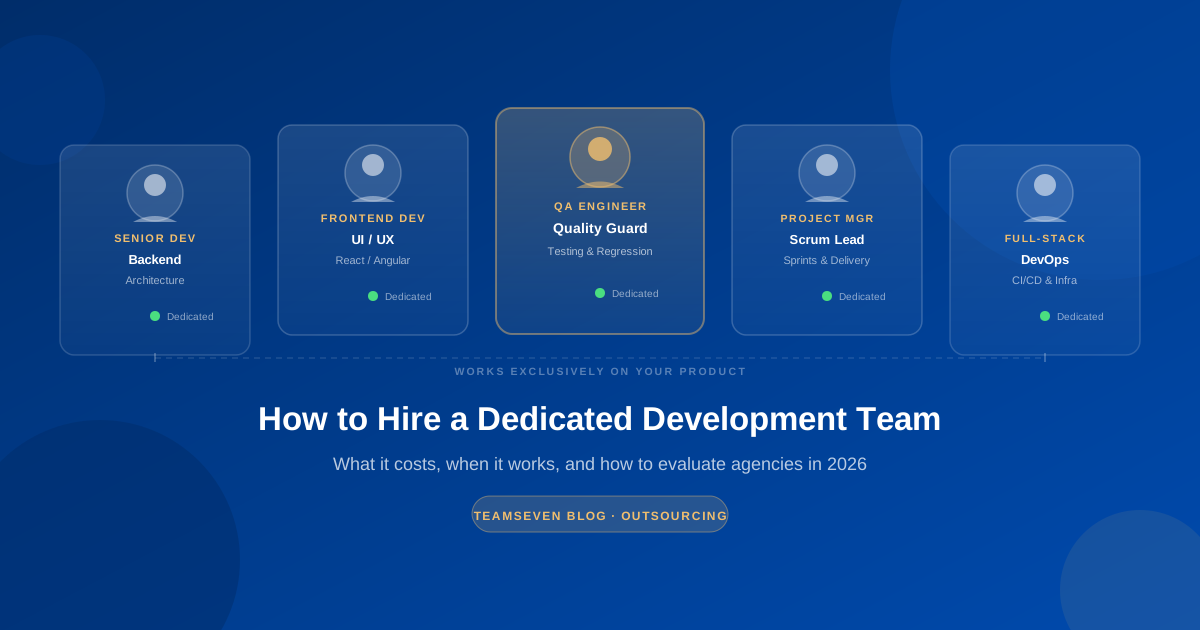
A typical dedicated team for a SaaS product or web application:
Core team (most common):
- 1 senior full-stack or backend developer: core product architecture and backend
- 1 frontend developer: UI, UX implementation, frontend architecture
- 1 QA engineer: testing, quality assurance, regression testing
- 1 project manager / scrum master (sometimes included, sometimes the client provides this)
Extended team (for larger products):
- Additional senior developer for complex backend work
- Mobile developer if iOS/Android is in scope
- DevOps/infrastructure engineer for complex deployment requirements
- UX/UI designer if design is not handled in-house
The right composition depends on your product's technical requirements. An API-heavy B2B platform needs more backend depth. A consumer-facing mobile-first product needs more frontend and mobile capability.
What does a dedicated development team cost?
Cost varies significantly by region. The monthly cost for a core dedicated team (2 developers + QA):
| Region | Monthly cost | Daily rate equivalent |
|---|---|---|
| United States | Scoped after a call | Scoped after a call |
| Western Europe | Scoped after a call | Scoped after a call |
| Eastern Europe (Poland, Romania) | Scoped after a call | Scoped after a call |
| Pakistan, India | Scoped after a call | Scoped after a call |
The quality of developers at each price point varies as widely as the price. Price is a signal, not a guarantee. A well-priced Eastern European team can be significantly better or worse than a similarly-priced Pakistani team depending on the specific agency and developers involved.
The total cost of a dedicated team engagement includes more than the monthly rate. Factor in:
- Onboarding time (2–4 weeks of reduced productivity while the team learns your codebase)
- Management overhead (your team's time communicating with and directing the dedicated team)
- Tool licenses (GitHub, Jira, Slack, deployment infrastructure, who pays for what)
- Minimum engagement terms (most agencies require 3–6 month minimum commitments)
How to evaluate agencies offering dedicated teams
The dedicated team model is particularly susceptible to misrepresentation. These are the evaluation criteria that matter:
Ask for the specific developers before signing. Not "we'll assign a senior developer": ask for the CV, GitHub profile, and portfolio of the specific person who will be your lead developer. Interview them directly. The quality of the individual matters more than the agency's brand.
Ask for references from clients on long-term engagements. References from project clients tell you about delivery on a defined scope. References from clients who have had a dedicated team for 12+ months tell you about the model that matters for your engagement. Ask specifically: did the team stay consistent? How were team changes handled? How did the relationship evolve over time?
Understand the bench and team change policy. What happens if your lead developer leaves? How quickly can they be replaced? What's the quality of the bench? An agency with a large talent pool can replace team members quickly. An agency with a small team may struggle to replace a key person without significant disruption.
Clarify the management structure. Who manages the developer day-to-day: the agency or you? What reporting do you receive? What are the communication SLAs? The best dedicated team engagements have a clear division: you set product priorities, the agency handles employment and operational management, and there's a clear point of contact for escalation on both sides.
IP and data handling in a dedicated team context. In a project engagement, IP transfers at completion. In a dedicated team engagement, IP transfers continuously: every commit the team makes belongs to you. This should be documented explicitly in your contract, along with data handling, confidentiality obligations, and what happens to code access when the engagement ends.
The onboarding process that works
The first month of a dedicated team engagement determines whether the next twelve months are productive. The clients who invest in onboarding consistently have better long-term results.
Effective onboarding for a dedicated development team:
Week 1: Architecture walkthrough: the team learns the existing codebase, infrastructure, and deployment pipeline. Documented. Questions answered. No new development.
Week 2: First small scope: a well-defined, low-risk feature that lets the team get familiar with the codebase through contribution rather than just reading. Review their code carefully. This is the calibration sprint.
Week 3–4: Normal sprint pace, with more intensive review than you'll maintain long-term. You're building confidence in the team's judgment while they're building confidence in your codebase.
End of month 1: Retrospective. What's working? What communication or process adjustments are needed? What does the team need from you to be more effective?
The onboarding investment pays back over the full engagement. A team that's well-onboarded in month one outperforms a team that was rushed into production in week one for the entire subsequent engagement.
Teamseven's dedicated team model
Our dedicated teams typically comprise 2–4 engineers depending on project scope, with a dedicated project manager handling sprint coordination and communication. We work in two-week sprints with a sprint review call at the end of each sprint, daily async standups, and response commitments within our working hours.
We require a 3-month minimum engagement. Most of our dedicated team clients have been with us significantly longer: the average dedicated team engagement at Teamseven runs 11 months. That number reflects what happens when the onboarding is done well and the working relationship is productive: clients don't leave because there's no reason to.
We're transparent about team composition, provide CVs and portfolios for every developer before engagement, and allow direct interviews with the team before signing. If a developer on your team leaves, we discuss replacement candidates with you before making the change.
If you want to see how we work before committing to a dedicated team engagement, the right starting point is a 4-week fixed-scope project on a defined module. That engagement tells both parties whether the working relationship is right before committing to something longer.
"The average dedicated team engagement at Teamseven runs 11 months. Clients don't leave because there's no reason to."
Related reading
Stay connected
Build notes, launches, and new articles from the Teamseven team.