
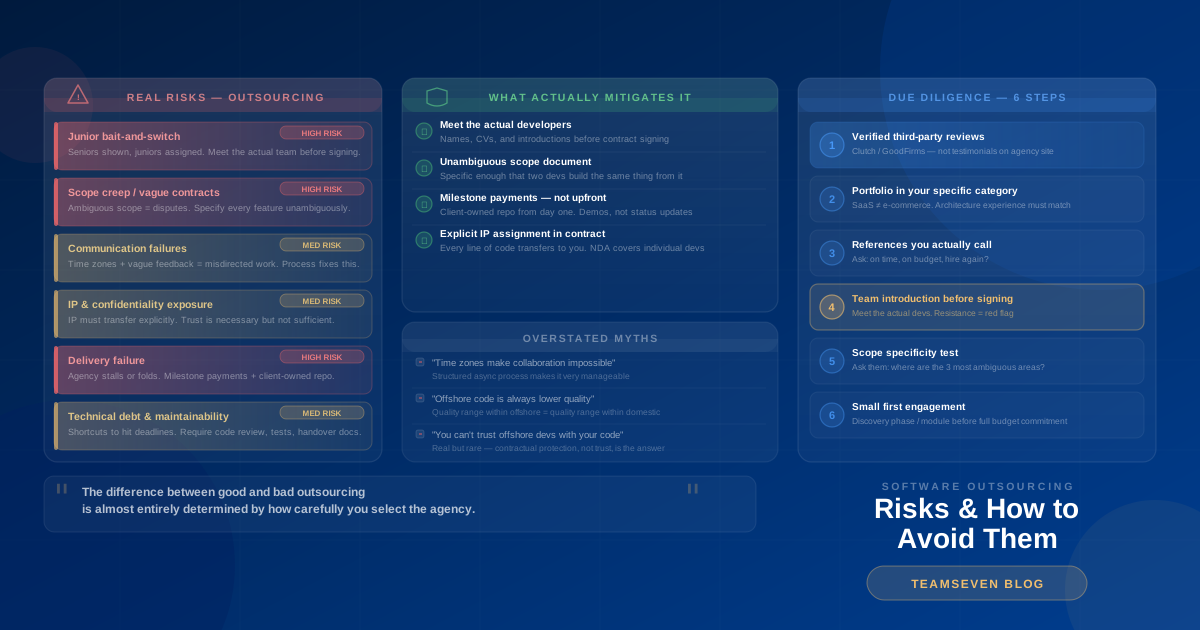
I run a software outsourcing agency. Writing a guide to outsourcing risks is a strange thing to do from a business perspective — I'm essentially telling you everything that could go wrong when you hire someone like me.
I'm writing it anyway because the founders who understand the risks make better clients, and because most of the content about outsourcing risks is written either by people trying to scare you away from offshore development entirely or by agencies minimising real concerns to close a sale. Neither is useful.
This is the honest version: what the real risks are, which ones are overstated, and what actually mitigates them versus what just sounds reassuring.
The risks that are real
Risk 1: You get the junior team, not the senior team
The most common outsourcing failure mode.
An agency presents impressive credentials, shows you portfolio work built by their senior developers, quotes a competitive rate — and then assigns junior developers to your project while the seniors work on higher-margin or more prestigious engagements.
This is not universal, but it's common enough to be the first thing you protect against.
What makes this risk real: Agencies have incentives to staff projects with the cheapest available developers. Senior developers cost more per hour, junior developers cost less — and if a client can't tell the difference until the end of the project, the margin difference goes to the agency.
What actually mitigates it: Meet the specific people who will work on your project before signing. Ask for the CVs of the developers assigned. Ask what other projects they're currently working on and whether your project will be their primary engagement. Ask what happens if one of them leaves mid-project.
An agency that resists introducing you to your actual team before the contract is signed is telling you something important.
What doesn't mitigate it: A promise that "our team consists of senior developers." Generic assurances without specific names and introductions are meaningless.
Risk 2: Scope creep through vague contracts
You sign a contract for one thing and end up paying for something larger — or you sign a contract for one thing and receive something smaller than you expected.
Both happen. Both stem from the same cause: vague scope definition.
What makes this risk real: Software scope is genuinely hard to define precisely. Natural language descriptions of functionality are almost always ambiguous in ways that only become apparent during development. "Users can manage their profile" means something different to every person who reads it.
From the client side, vague scope means legitimate change requests get billed as extras. From the agency side, vague scope means the client keeps adding features that weren't budgeted.
What actually mitigates it: A scope document specific enough that two independent developers would build essentially the same thing from reading it. Not "user authentication" but "email/password registration with email verification, Google OAuth login, password reset via email link, and remember-me functionality lasting 30 days."
Every feature described with enough specificity to be unambiguous. Every exclusion explicitly listed — what's out of scope matters as much as what's in scope.
Have a lawyer or technical advisor review the scope document before signing. The investment is small relative to the contract value.
What doesn't mitigate it: A fixed price. Fixed-price contracts don't prevent scope disputes — they relocate the argument. When the scope is ambiguous, fixed-price agencies charge change orders; time-and-materials agencies bill the extra hours. Both outcomes come from ambiguous scope. Only better scope prevents it.
Risk 3: Communication failures
The project stalls because of miscommunication — requirements misunderstood, feedback not received, questions unanswered, progress invisible.
What makes this risk real: Time zone gaps, cultural communication differences, language nuance, and the inherent difficulty of describing software requirements in words all create communication friction. When that friction goes unaddressed, work gets done in the wrong direction — and correcting it is expensive.
What actually mitigates it: A structured communication process agreed before development starts. Specifically: how will progress be reported (daily written updates? weekly video calls? both?), what tool is used for project management and issue tracking, what's the expected response time on each side for questions, and what's the escalation process when something is going wrong.
The agencies that manage communication well don't do it by accident — they have a defined process and they insist on it even when clients initially resist the overhead.
Clear, detailed written requirements. The time zone gap that causes a 12-hour delay on every question is the same gap that causes a 12-hour delay on correcting a misunderstood requirement. Reducing the number of clarifications needed reduces the impact of the time zone gap.
What doesn't mitigate it: Assurances that the team "communicates openly" or "is responsive." Every agency says this. Ask specifically: what does daily progress reporting look like? Can you show me an example update from a current project? What project management tool will you use?
Risk 4: IP and confidentiality exposure
Your ideas, your code, and your business processes are in the hands of a third party. What happens to them?
What makes this risk real: Software development agencies have access to your codebase, your architecture decisions, your business logic, and sometimes your data. Without proper agreements, that information has unclear legal protection — especially across international jurisdictions.
What actually mitigates it: A properly drafted contract with explicit IP assignment language. Every line of code written for your project should transfer to you on final payment. This must be stated explicitly — in some jurisdictions, work created by an independent contractor belongs to the contractor by default.
An NDA that covers your business information and covers the specific team members working on your project, not just the agency entity.
Segregation of environments: developers should work with anonymised or synthetic data during development, never with live production data containing real personal information unless the project specifically requires it.
For particularly sensitive products: staged code access where developers receive only the components relevant to their work rather than access to the entire codebase.
What doesn't mitigate it: Trust. I say this as someone running an agency — trust is necessary but not sufficient. Proper legal agreements give you recourse if trust breaks down. Most agencies will not steal your idea or leak your code. But "most agencies won't" is not a substitute for contractual protection.
Risk 5: Delivery failure
The project simply doesn't get delivered. The agency runs out of capacity, goes under, loses key people, or takes on more work than they can handle and your project becomes deprioritised or abandoned.
What makes this risk real: Software agencies fail. Developers leave. Agencies take on too many clients and run out of bandwidth. Small agencies are particularly vulnerable — the departure of one or two key people can significantly impair delivery capacity.
What actually mitigates it: Milestone-based payment tied to deliverables, not to calendar dates. If you've paid 30% upfront and 0% more until a working product exists, the agency has financial incentive to deliver. If you've paid 70% upfront, the incentive structure is different.
Code ownership from the start. The code should be in a repository you own, not a repository the agency owns. You should have admin access to that repository from day one. If an agency goes under or you need to switch teams, you need to be able to hand your code to someone else without negotiation.
Escrow arrangements for large projects — payments held by a third party and released on delivery milestones verified by both parties.
Regular working software demos rather than status updates. A demo of working software is evidence of progress. A status update saying "development is on track" is not.
What doesn't mitigate it: Upfront payment. Paying significant amounts before deliverables exist creates the wrong incentive structure for both parties.
Risk 6: Technical debt and maintainability
The project delivers on schedule, works initially, and then becomes increasingly difficult to maintain, extend, or hand off to another team.
What makes this risk real: Shortcuts taken during development to meet deadlines or reduce costs create technical debt — code that works but is poorly structured, undocumented, or built on architectural decisions that don't scale. This debt compounds over time and eventually costs more to fix than it would have cost to avoid.
What actually mitigates it: Code quality standards agreed before development starts. Asking for automated test coverage. Requiring code documentation. Asking specifically about their approach to code review — is it peer-reviewed before merging?
A technical review of delivered code by an independent developer before final payment. This doesn't have to be comprehensive — a competent developer can assess overall code quality in a few hours.
Post-project support terms — not just bug fixing, but actual knowledge transfer. Can the agency provide documentation of the architecture? A handover session where they walk through the codebase? Is there a transition period if you're moving to an in-house team?
What doesn't mitigate it: Fixed-price contracts. Fixed prices create incentives to deliver quickly, which creates incentives to take shortcuts. The fastest code and the best code are almost never the same code.
The risks that are overstated
Time zones will make collaboration impossible.
Time zones create friction. They don't make collaboration impossible. The agencies that handle time zone gaps well invest in structured async communication, deliberate overlap windows, and thorough sprint planning that reduces the need for real-time coordination. After the first sprint, most clients report that the time zone stops being a day-to-day concern.
The time zone gap is worse for some working styles than others. If you need to make product decisions in real-time throughout the development day, offshore development is genuinely harder. If you can batch your reviews and direction-giving, it's very manageable.
Language barriers will cause constant miscommunication.
Most professional offshore agencies have strong English communication. The communication failures I've seen in outsourcing engagements were almost never caused by language — they were caused by vague requirements, unclear feedback, and poor process on both sides. A client who gives clear, specific, written feedback gets clear, specific results regardless of the development team's location.
You can't trust offshore developers with your code.
Code theft and IP misappropriation happen but are genuinely rare in professional agency engagements. The risk is real — it should be covered by contract — but it's not the dominant risk. The dominant risks are the ones listed above.
Offshore development is always lower quality.
The quality range within offshore development is enormous — from genuinely excellent agencies with experienced developers and rigorous process to body-shopping operations that supply warm bodies without engineering oversight. The same is true of domestic agencies. Quality correlates more with agency selection rigor than with geography.
The due diligence process that actually works
The difference between successful and unsuccessful outsourcing engagements is almost entirely determined by how carefully the agency is selected. The due diligence process:
Step 1: Verified third-party reviews. Not testimonials on the agency's own website — verified reviews on Clutch or GoodFirms where clients are interviewed by the platform. Look for volume, recency, and reviews describing projects similar to yours.
Step 2: Portfolio work in your specific category. Has this agency built SaaS products? Web applications? Mobile apps? The category matters. An agency with 50 e-commerce builds may not have the architecture experience for a complex B2B SaaS.
Step 3: References you actually call. Ask for two or three references from similar projects. Call them. Ask specifically: did the project deliver what was scoped, on time and on budget? Would you hire them again? What would you do differently?
Step 4: Team introduction before signing. Meet the specific developers who will work on your project. Assess their technical communication. Ask about their experience with similar problems.
Step 5: Scope specificity test. Send the agency your requirements document and ask them to identify the three areas where scope is most ambiguous. An agency that finds genuine ambiguities is reading carefully. An agency that says the scope is clear and comprehensive isn't.
Step 6: Small first engagement. Before committing to a large project, consider a smaller, well-defined first engagement — a technical specification, a discovery phase, a specific module. It lets you assess the agency's process quality before the full budget is on the table.
What honest outsourcing looks like
I've tried to be honest about what can go wrong. Here's what it looks like when outsourcing goes right:
The client has clear requirements, a realistic budget, and the communication bandwidth to give regular feedback. The agency has relevant experience, introduces the actual team before signing, uses a milestone-based payment structure, maintains code in a client-owned repository, and has a defined communication process. Both parties treat it as a professional engagement with clear accountability.
In that context — which is achievable with the right selection process and the right contract — the risks described above are manageable. Not zero, but manageable.
The founders who have bad outsourcing experiences almost always skipped one or more of the due diligence steps above. The ones who have good experiences almost always did all of them.
Muhammad Nabeel is the co-founder of Teamseven, a software development agency based in Lahore, Pakistan. We've been building software for US, UK, and Australian clients since 2017. If you want to evaluate us against the standards in this post, we welcome it.