
I'm going to write this from a perspective most guides on this topic don't have: I run an offshore development team.
I'm not a founder who hired an offshore agency and wants to share what worked. I'm the person on the other side of that relationship — the one who has worked with hundreds of clients over eight years, delivered 600+ projects, and watched clients succeed and fail at managing offshore development teams.
I've seen clients who treat their offshore team like a vending machine and get vending machine results. I've seen clients who invest in the relationship like they'd invest in a senior hire and get extraordinary output. I know exactly what the difference is.
This guide is the honest version — written from inside the agency, not from a business school case study.
The fundamental misunderstanding that kills offshore projects
Most offshore development failures aren't technical failures. They're management failures that show up as technical problems.
When a project is late, the client says "the developers missed the deadline." When software doesn't match requirements, the client says "the developers didn't build what I asked for." When quality is poor, the client says "the offshore team isn't good enough."
Sometimes that's accurate. Often it isn't.
The developers missed the deadline because requirements changed three times mid-sprint without anyone acknowledging the impact. The software didn't match requirements because the requirements were ambiguous and the client wasn't available to clarify. The quality is poor because there was no review process, no feedback loop, and no consequence for cutting corners.
The root cause is almost always a management gap — usually on the client side — that gets attributed to the developers.
I'm not saying this to protect bad agencies. I'm saying it because if you understand where offshore projects actually fail, you can prevent it. And the prevention is almost always on your side of the relationship, not ours.
What makes offshore development different from hiring locally
When you hire a developer in your city, proximity compensates for a lot of management deficiencies. You can tap someone on the shoulder when something is unclear. You can see whether someone is working or stuck. You can have a five-minute conversation that resolves an ambiguity that would otherwise cost two days of wrong development.
None of those compensations exist with an offshore team. You have:
Time zone separation. We're typically 5–11 hours ahead of our US and Australian clients. By the time you've reviewed our work and have feedback, we're already four hours into the next day's work. Ambiguity that would take 30 seconds to resolve locally costs a full day offshore.
Communication overhead. Everything that happens between you and an offshore team happens through text, which is slower, more easily misread, and more likely to create misalignment than a face-to-face conversation. Written communication disciplines that would be nice-to-have with a local team are non-negotiable with an offshore one.
Cultural context gaps. We're a Pakistani agency building software for US, UK, and Australian clients. Our developers are highly technically skilled — but they don't have your intuitive understanding of how a US insurance company works, what a UK council website needs to do, or what an Australian retail customer expects. That context has to be explicitly communicated, not assumed.
Visibility gaps. You cannot see whether a developer is working, thinking, or stuck. You cannot tell from their silence whether they understood your requirements or didn't. Without active communication processes, you're flying blind.
None of these are reasons not to work with an offshore team. They're reasons to manage differently than you would a local team.
The management framework that works
Eight years of delivering projects from Lahore to clients in New York, London, and Sydney has taught me what management behaviours consistently produce good outcomes. Here's the framework we see work across every project type.
1. Front-load clarity, radically
The single most common cause of offshore project problems is starting development before requirements are genuinely clear.
I understand the temptation. You want to see progress. You have a deadline. You think the requirements are clear enough to get started. They almost never are.
Every requirement has edge cases. What happens when a user tries to do X when they're not authorized to do X? What does the system do when an API call fails? What happens when two users edit the same record simultaneously? What's the loading state while data is fetching?
These questions seem minor. They're not. Each one is a decision that needs to be made either by you during requirements definition or by a developer during development — in a timezone you're not in, without the context you have, based on their best guess.
Before a sprint starts, requirements should be specified at the story level, not the feature level:
Feature level (insufficient): "Users can manage their profile"
Story level (sufficient): "As an authenticated user, I can update my display name, email address, and profile photo. Email changes require verification via a link sent to the new email. Photo uploads are limited to JPG, PNG, and GIF under 5MB. Changes save immediately with a confirmation toast. If the email is already in use by another account, show an error message: 'That email is already associated with an account.'"
The story-level requirement takes ten minutes to write. It saves three days of wrong development and two rounds of revision.
The practical test: could your developer build the feature correctly without asking you a single question? If not, the requirement isn't ready.
2. Establish a communication rhythm and never break it
Consistency in communication is more valuable than volume. An offshore team that knows when to expect feedback and direction can plan their work around those expectations. A team that receives unpredictable bursts of communication — nothing for three days, then twenty messages at once — loses the ability to plan and often loses motivation.
The rhythm that works for most client-offshore relationships:
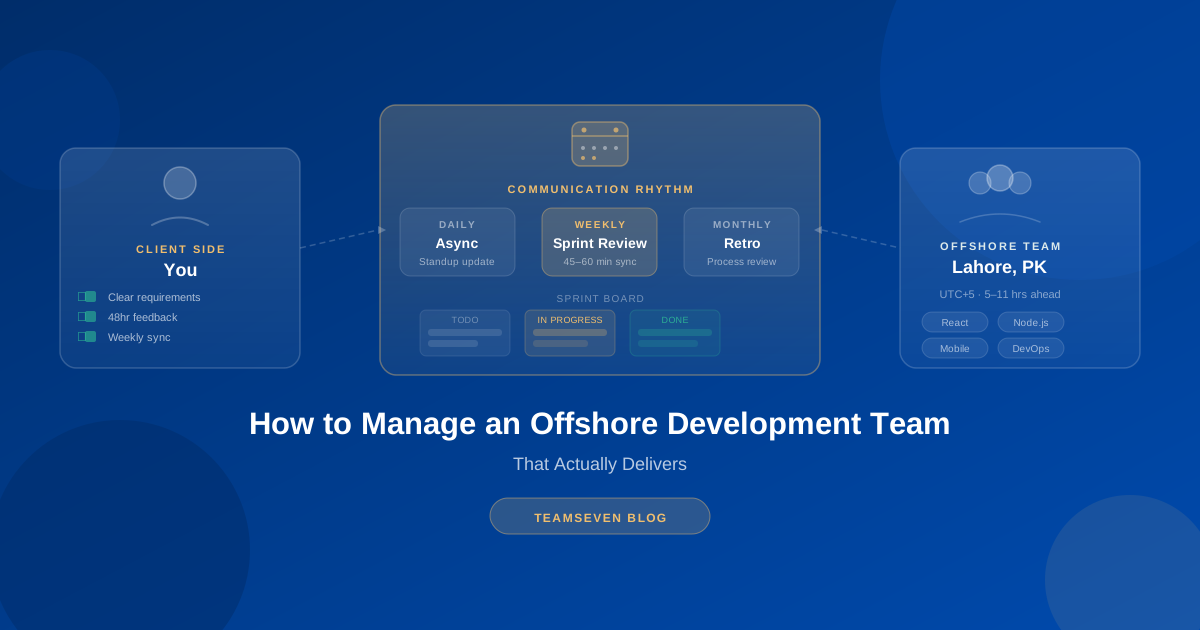
Daily (async, 5 minutes per side): End of developer day → written standup update posted to Slack or project tool. Format:
- What was completed today
- What's planned for tomorrow
- Any blockers or questions
Client reviews these updates in their morning, responds to any questions, gives direction. This takes five minutes and replaces the need for daily video calls across time zones.
Weekly (sync, 45–60 minutes): Sprint review and planning call. Developers demo what was built. Client reviews against requirements. Scope for next sprint is confirmed. Questions that accumulated during the week are resolved in real time.
This is the one call per week where both sides are present simultaneously. It's non-negotiable. Clients who skip weekly reviews consistently have worse outcomes than clients who attend consistently, regardless of the underlying team quality.
Fortnightly or monthly (sync, 30 minutes): Retrospective. What's working, what isn't, what should change. This is not a status call — it's a process improvement call. Both sides contribute.
The rhythm sounds simple. Maintaining it when you're busy is where most clients fail. Every skipped weekly review is a week where misalignment compounds without correction.
3. Treat feedback as a professional obligation
When an offshore developer ships work for your review, the clock starts. Every day that passes without feedback is a day they cannot progress.
I've watched clients review work for three weeks before responding. During that time, the developer has been working on other things, has lost context on your project, and now faces a revision request that requires re-immersion into work they've mentally moved on from. The revision takes twice as long as it would have if feedback came within 48 hours.
The standard we expect from serious clients: feedback on delivered work within 48 hours. Not full sign-off — feedback. "This is approved," "here are three things to change," or "I need more time to review this part, but the rest is good." All of these move the project forward. Silence doesn't.
When you're too busy to review for a week, your project stops for a week. That's a choice, and it's yours to make — but it should be conscious, not accidental.
4. Be specific in feedback, not impressionistic
"This doesn't look right" is not feedback. "The button is too far from the input field — it should be directly beneath it, not in the footer" is feedback.
Impressionistic feedback — "it feels off," "something isn't right," "it's not quite what I imagined" — forces developers to interpret what you mean, implement their interpretation, and wait for your response. Usually their interpretation is wrong. You go through three rounds of revision to arrive at something you could have described precisely in one sentence.
The feedback format that works:
What: The specific element — "the header on the invoices page" What's wrong: "The client name is truncated after 30 characters" What should happen: "It should show the full name, wrapping to a second line if necessary"
Three sentences. Actionable immediately. No interpretation needed.
For UI feedback, annotated screenshots are more efficient than written descriptions. A tool like Loom, Markup.io, or even a screenshot with arrows drawn on it eliminates entire back-and-forth cycles.
5. Protect the scope, or own the consequences
Scope creep kills offshore projects more reliably than any other single factor.
Adding features mid-sprint isn't free. Every addition displaces something else. It disrupts the developer's mental model of what they're building. It creates dependencies that were't anticipated. It often invalidates work that was already completed.
Offshore projects feel particularly vulnerable to scope creep because the developers are less likely to push back. A local developer in the same office might say "if we add that, we'll need to push the deadline." An offshore developer in a different culture and power dynamic is more likely to say "yes" and quietly work overtime, deprioritize testing, or cut corners on the implementation.
The discipline of scope management is entirely on the client side. Here's how to apply it:
When a new requirement occurs to you mid-project, write it down somewhere other than the current sprint backlog. A "v2 ideas" list. An "after launch" doc. Anywhere that acknowledges the idea without injecting it into active development.
At the weekly sprint review, bring your accumulated new ideas and evaluate them: which ones are genuinely essential for launch? Most aren't. The discipline of categorizing ideas as "essential for v1" vs "good for later" is the entire practice of scope management.
When something genuinely is essential and wasn't in the original scope, acknowledge it explicitly: "This needs to be added, and I understand it affects the timeline. Let's discuss the impact before proceeding." That conversation — which most clients avoid — is what separates projects that stay on track from projects that drift indefinitely.
6. Create visible accountability without micromanagement
Micromanagement of offshore developers — constant check-ins, demanding to see code, questioning every decision — produces resentment and turnover, not better outcomes.
Accountability without micromanagement looks like:
A shared project board where both sides can see what's in progress, what's completed, and what's blocked. Not as surveillance — as shared visibility. When you can see that a story has been "in progress" for five days, you can ask a question rather than wondering why things feel slow.
Sprint commitments that are taken seriously. At the start of each sprint, the team commits to a set of stories. At the end of the sprint, you review what was and wasn't completed. If things weren't completed, the question is why — not as an accusation but as a problem-solving exercise. Velocity data accumulates over time into an accurate picture of what your team can actually deliver.
A clear escalation path. If you're concerned about progress, who do you talk to? If a developer is stuck, how do they raise it without feeling like they're admitting failure? Clear escalation paths — "if X is blocked for more than 24 hours, flag it in this channel" — create psychological safety that produces faster problem resolution.
7. Invest in the relationship, not just the output
The best client-developer relationships I've seen over eight years have one thing in common: the client treats the offshore team as people, not as a service.
This sounds obvious. It isn't universally practiced.
It means: learning the names of the people building your product. Acknowledging good work, not just flagging problems. Understanding that the people on the other end of your Slack messages have careers, ambitions, and preferences about how they work.
It doesn't mean: being friends, socializing outside of work, or being lenient about standards.
It means: being the kind of client that a developer wants to do their best work for. In my experience, developers go significantly above minimum viable effort for clients who treat them well. They do minimum viable effort — or leave for another project — for clients who treat them as anonymous code generators.
This is not a moral argument. It's a practical one. Developer motivation is a real variable in software quality. The clients who consistently get our best work are the ones who make us feel like partners, not vendors.
The checklist: what good offshore management looks like
Use this before you engage an offshore team and during the first month:
Before development starts:
- ☐ Requirements specified at story level, not feature level
- ☐ Acceptance criteria defined for every story
- ☐ Design completed and approved before development begins
- ☐ Communication tools agreed (Slack, Jira, GitHub, Loom)
- ☐ Weekly sync time agreed and recurring invite sent
- ☐ Escalation path documented
During development:
- ☐ Daily async standup received and reviewed each morning
- ☐ Feedback on delivered work given within 48 hours
- ☐ Weekly sprint review attended without exception
- ☐ Scope changes documented and assessed before implementation
- ☐ New ideas captured in backlog, not injected into active sprint
Monthly:
- ☐ Retrospective completed — process improvements identified
- ☐ Velocity reviewed — is sprint commitment realistic?
- ☐ Relationship health assessed — is the team engaged?
The management mistakes that are hardest to recover from
Going dark. Clients who disappear for days or weeks without explanation leave their offshore team in an impossible position. Work that was in progress becomes ambiguous. Developers don't know whether to continue or wait. They continue on their best assumptions, which are frequently wrong. When the client resurfaces, the mismatch between what was built and what was wanted is often significant enough to require a restart.
Changing the goal mid-project. Not adding features — changing the fundamental purpose or direction of the product. This happens when founders discover something through the build process that changes what they're building. It's understandable. It's also effectively a new project. Treat it as one — acknowledge the change, reset the scope, replan the project, and adjust the budget accordingly.
Treating the first sprint as a trial. Some clients approach the first sprint testing whether the agency can be trusted before fully committing to the communication process. This creates a self-fulfilling prophecy: the communication process doesn't work because the client doesn't commit to it, which "proves" the agency can't be trusted, which justifies continued withholding.
The first sprint is when the communication rhythm is established. It requires more investment from the client, not less. The clients who put in the most effort in sprint one have the smoothest projects. The clients who hold back in sprint one rarely catch up.
Not doing the weekly call. Of all the management failures I see, skipping the weekly sync is the most consistently predictive of poor outcomes. It seems like a small thing. It compounds into a large one.
What good looks like
For context: our best-running client relationships look like this:
- Weekly sprint review, every week, 45 minutes, never skipped
- Daily async standup reviewed by the client every morning
- Feedback on delivered work within 24–48 hours as standard
- Scope additions documented and discussed before implementation
- Developers know the client's name, company, and what the product is for
- The client knows the developers by name and remembers context from previous conversations
These aren't unusually demanding requirements. They're professional standards that any serious engagement should meet. The projects running this way consistently deliver on time, within scope, and to quality standards that make the client come back for the next project.
That's the entire model. It's simple in description and requires discipline in practice. The discipline is the work.
Muhammad Nabeel is the co-founder of Teamseven, a software development agency based in Lahore, Pakistan. We've delivered 600+ projects for US, UK, and Australian clients since 2017. If you want to understand how we work before engaging us, get in touch.