Building a SaaS product in 2026 is more accessible than it has ever been. The tooling is better, the cloud infrastructure is cheaper, the development ecosystem is mature, and AI has genuinely accelerated certain parts of the build process.
It is not, however, easy. The lower barrier to building means more competition, higher user expectations, and a market that rewards genuine product-market fit over technical novelty. The founders who succeed are not the ones who build fastest — they're the ones who understand their problem deeply, scope their solution carefully, and build a product that users actually want to pay for.
This guide covers the complete process of how to build a SaaS product — from idea validation through architecture and MVP development to launch — based on what we've learned building SaaS products for founders across the US, UK, and Australia over eight years.
What is a SaaS product?
Before the how, the what — because founders sometimes confuse different types of software products.
Software as a Service (SaaS) has three defining characteristics:
Subscription-based revenue. Users pay a recurring fee — monthly or annually — rather than a one-time purchase. The revenue model drives architecture decisions because the business depends on retention, not acquisition alone.
Multi-tenancy. Multiple customers (tenants) use the same instance of the software, with their data isolated from each other. This is what makes SaaS economically viable — one codebase and one infrastructure serving many customers, rather than a separate deployment per customer.
Cloud-hosted. The software runs in the cloud and is accessed through a browser or API. Users don't install anything. Updates deploy automatically to all users.
If you're building something without these three characteristics — a one-off custom platform for a single client, an installed desktop application, or a service business supported by custom tools — you're not building SaaS. You might still be building something valuable, but the approach is different.
Step 1 — Validate the problem before writing a specification
The most common and expensive mistake in SaaS development is building a solution before validating whether the problem is real, significant, and present in enough potential customers to generate viable revenue.
Validation is not market research. It is direct, specific conversations with the exact people you expect to be your customers — not your friends, not your network broadly, but the specific job title at the specific company size in the specific industry that your product is built for.
The conversation you're trying to have:
- Tell me about how you currently handle [the problem your product solves].
- What does that process look like in practice?
- What goes wrong with it?
- How much time does your team spend on it weekly?
- What have you tried to solve it with?
- If this were solved reliably, what would that be worth to you?
You are not pitching your product in these conversations. You are listening. The answers to these questions tell you whether the problem is real (people have it), significant (they feel pain from it), widespread (enough people have it to build a business), and monetizable (people would pay to have it solved).
After 15–20 conversations, patterns emerge. If 12 of 15 people describe the same specific pain and say they'd pay to solve it, you have something worth building. If people acknowledge the problem but say "we've worked around it" or "it doesn't really cost us much," the pain isn't sufficient to drive purchasing.
The minimum validation bar: 5–10 people in your target customer profile who say, clearly and specifically, "yes, I have this problem, here's what it costs me, and I would pay [specific amount] to have it solved."
Step 2 — Define your ICP before defining your product
Ideal Customer Profile (ICP) is the specific type of customer your product is built for. Not "small businesses" — that's a category. Your ICP is something like: "Series A B2B SaaS companies with 15–50 employees, a Customer Success team of 3–5 people, and a customer base of 200–2,000 accounts."
The ICP drives every product decision:
Feature scope. What does your specific ICP need? A 3-person startup has different requirements from a 50-person scaleup, even if they're in the same industry.
UX complexity. Is your user technical or non-technical? Do they use the product daily or weekly? Are they a power user or an occasional visitor?
Pricing. What can your ICP afford? What budget do they have? What's the approval process for software purchases at their company?
Integrations. What tools does your ICP already use? Your product needs to work with their stack, not replace it.
Defining the ICP precisely before specifying the product prevents a common failure mode: building a product that's too generic to be anyone's first choice because it was designed for everyone.
Step 3 — Define your MVP with brutal discipline
The MVP (Minimum Viable Product) is the smallest version of your product that delivers your core value proposition to your ICP and allows you to validate whether they'll pay for it.
The word "minimum" is the hard part. Every founder wants to add features. More features feel like more value. They are not. More features mean:
- Longer development timeline before launch
- More complexity for users trying to understand the product
- More things that can break
- More development budget consumed before you have any revenue
- Less clarity about what's actually driving adoption
The brutal discipline of MVP scoping asks one question about every proposed feature: does this feature directly deliver the core value proposition to the ICP, or does it support a different use case?
If a feature doesn't directly deliver the core value, it is not MVP. It goes on the roadmap for v2.
What a well-scoped B2B SaaS MVP includes:
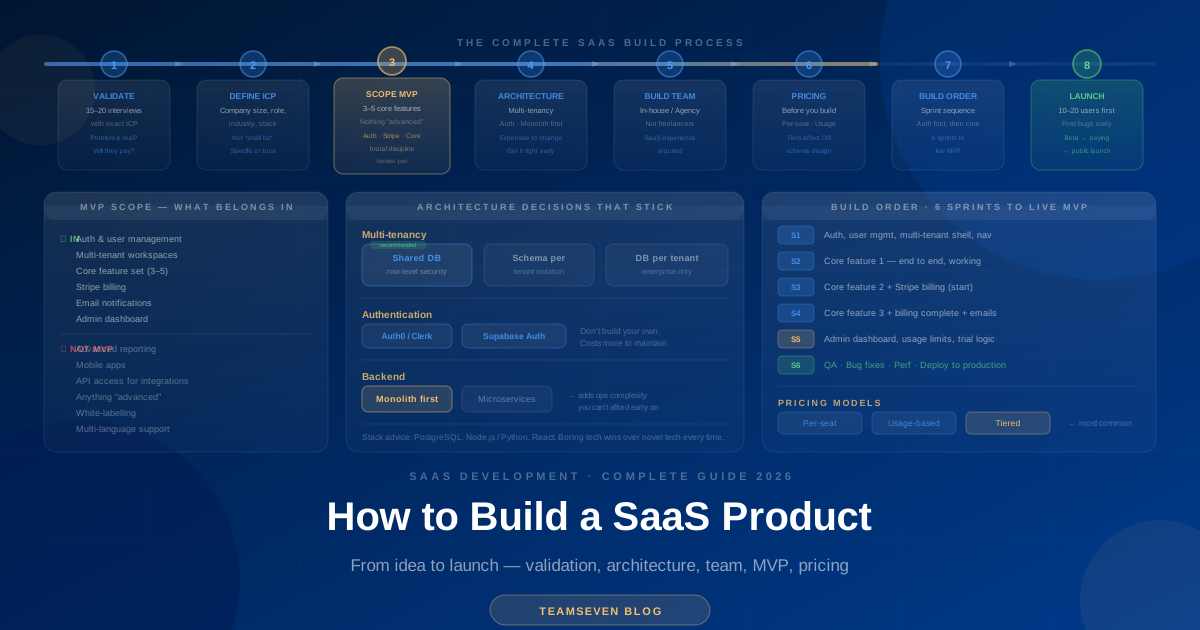
Authentication and user management — users need to log in and manage their account. Multi-tenant workspace isolation if B2B — each company has its own environment. The core feature set — 3–5 features that deliver the primary value proposition. Basic admin dashboard — usage visibility and account management. Stripe billing — subscription plans, trial period, basic invoicing. Email notifications for critical events. Deployment to production — not just localhost.
What does not belong in an MVP:
Advanced reporting and analytics. Mobile apps (unless mobile is the core value proposition). API access for integrations. Team management and role-based permissions beyond basic admin. White-labelling. Multi-language support. Advanced customisation. Anything prefixed with "advanced."
The question to ask about each proposed MVP feature: "If we launched without this, would our target users refuse to try the product?" If the answer is no, it's not MVP.
Step 4 — Choose the right technical architecture from the start
SaaS architecture decisions made early are expensive to change later. The three most consequential early decisions:
Multi-tenancy model. There are three approaches: database per tenant (fully isolated, expensive to scale), schema per tenant (isolated but complex), and shared database with tenant identifier (most common, requires careful query design to prevent data leakage). For most B2B SaaS at early stage, shared database with row-level security is the right starting point — it's cost-effective, scalable to thousands of tenants, and well-understood.
Authentication approach. Build your own or use a managed service (Auth0, Cognito, Clerk). For most early-stage SaaS products, a managed auth service is the right choice — it handles email verification, password reset, MFA, SSO, and security updates without your team having to maintain it. The cost is worth the reduced security risk and development time.
Backend architecture — monolith vs microservices. Start with a monolith. Every successful SaaS started as a monolith. Microservices add operational complexity that early-stage products can't afford — deployment pipelines, service discovery, distributed tracing, inter-service communication. Build a well-structured monolith that can be decomposed into services later, not a microservices architecture that requires a team of engineers to operate from day one.
The technology question most founders get wrong: they choose technologies based on what they've heard of rather than what fits the project. The right question is not "should we use React or Vue?" — it's "what technology will let us build this reliably, hire competently, and maintain sustainably?" Usually the answer is the boring, proven choice. PostgreSQL over a novel database. Node.js or Python over an exotic framework. React over a newer alternative. Boring technology that works beats interesting technology that doesn't.
Step 5 — Build the team or find an agency
Three options for building a SaaS product:
Build an in-house team. Suitable when you have the time to hire (3–6 months), the budget to pay competitive salaries ($120,000–$180,000/year per senior engineer in the US), and a long-term commitment to maintaining the team. The right choice when the product is your core business and you expect to need sustained engineering capacity for years.
Hire freelancers. Suitable for well-defined, short-duration work. Not suitable for a complex SaaS MVP where you need a coordinated team across frontend, backend, and QA. Freelancer teams lack the coordination and shared codebase ownership that produce quality SaaS products.
Work with a development agency. Suitable for founders who need to move fast without hiring, who want a team with relevant SaaS experience, and who can define requirements clearly. The right choice for MVP development and for startups that need to validate product-market fit before committing to an in-house team.
When evaluating a development agency for SaaS work specifically:
Ask whether they have built multi-tenant SaaS products before. Ask to see live SaaS products they've built. Ask about their experience with Stripe billing integration, multi-tenancy architecture, and subscription management — these are the technically specific skills that separate agencies that understand SaaS from agencies that build websites.
We built Parkezi — a smart parking automation SaaS now deployed at NSW Ambulance, Quest Hotels, and Mercure Hotels across Australia. We built Mebag — an AI-powered SaaS platform for shopping. We built i-mve — a full-featured SaaS serving hundreds of UK companies. These aren't portfolio pieces. They're live products with real users and real recurring revenue. That kind of portfolio matters when choosing an agency for SaaS development.
Step 6 — Plan your pricing before you build
Most founders plan pricing after they've built the product. This is backwards. Pricing decisions affect product decisions — what features go in which tier, what usage limits exist, how the billing infrastructure needs to be built.
The two most common B2B SaaS pricing models:
Per-seat pricing. $X per user per month. Simple to understand, scales predictably with company size. Works well when the product's value increases with number of users. Examples: Slack, Notion, Figma.
Usage-based pricing. $X per [unit of value — API calls, documents processed, reports generated]. Aligns cost with value, lowers barrier to adoption (no seat commitment), but makes revenue harder to predict. Works well when value is clearly tied to a specific action. Examples: Stripe, Twilio, AWS.
Tiered pricing. Starter/Growth/Enterprise tiers with increasing features and limits. The most common model for B2B SaaS. Works well when different customer sizes have meaningfully different needs.
Before building, decide: which model fits your product and ICP? What does each tier include? What are the limits? What's the upgrade trigger — the moment when a customer on a lower tier needs to move up?
These decisions affect database schema design, billing integration complexity, and feature flag implementation. Discover them in planning, not during development.
Step 7 — Build in the right order
The order of development matters. The pattern that works:
First sprint: Authentication, user management, multi-tenant workspace creation, basic navigation. No features. Just the shell of the application that logged-in users can move through. This is the foundation everything else sits on.
Second sprint: Core feature 1 — the single most important thing the product does. Nothing else. Just the primary value proposition, working end to end, for a real user.
Third sprint: Core feature 2, and beginning of Stripe billing integration. Not finished billing — just the subscription model and plan selection.
Fourth sprint: Core feature 3, billing completion, email notifications for critical events.
Fifth sprint: Admin dashboard, usage limits, trial period logic.
Sixth sprint: QA, bug fixing, performance optimisation, deployment to production.
By sprint six, you have an MVP that real users can pay for and use. Everything after that is iteration based on real usage data.
Step 8 — Launch to a small group first
Launching to a small group of 10–20 early users before a public launch is consistently underutilised by founders who want to launch to as many people as possible.
The small group launch achieves three things:
Real usage data before public launch reveals the bugs and usability problems that inevitably exist in any first release. Better to discover that your onboarding flow is confusing with 15 users than with 1,500.
Direct feedback from engaged users who want to help you succeed tells you what to build next. These users become your advisory board, your reference customers, and your early case studies.
Evidence of value before broader marketing gives you something to say. "We've been in closed beta with 20 companies, 15 of whom are paying customers" is a better launch story than "we just built this and hope you like it."
The most important thing I've learned about SaaS
Eight years and hundreds of SaaS-related projects later, the pattern that separates the products that succeed from the ones that don't has almost nothing to do with technology.
The products that succeed have founders who understand their users deeply and make product decisions based on what users actually do, not what they say they want. They have founders who ship and iterate rather than refining forever. They have founders who stay narrow on ICP and resist the pressure to expand the target market before the core market is well-served.
The products that fail have founders who built what they thought users wanted rather than what users actually need. They built too much before validating. They changed direction based on one user conversation rather than a pattern across many.
The technology is the easy part. The discipline is the hard part.
Muhammad Nabeel is the co-founder of Teamseven, a SaaS development agency based in Lahore, Pakistan. We've built SaaS products for US, UK, and Australian founders since 2017 — from first MVP to production platforms serving thousands of users. Talk to us about your SaaS project.