
Los Angeles is a city of founders. The entertainment industry's entrepreneurial culture — where you're always building the next project, pitching the next idea, forming and reforming teams around opportunities — has created one of the most active startup ecosystems in the United States.
LA's startup scene spans a distinctive range: media and content technology, creator economy platforms, e-commerce and DTC brands, healthcare technology, logistics and supply chain (the Port of Los Angeles is one of the world's busiest), and a growing enterprise software sector that has expanded significantly as companies have relocated or opened offices here.
For all of these founders and businesses, the software development landscape in Los Angeles presents the same challenge as every major US tech hub: local talent is expensive, local agencies are expensive, and the gap between what you need to build and what you can afford to build it for is significant.
The Los Angeles software development market
Senior software developers in Los Angeles command salaries comparable to San Francisco — $130,000–$190,000 annually — without the same concentration of large tech employers that can absorb those costs.
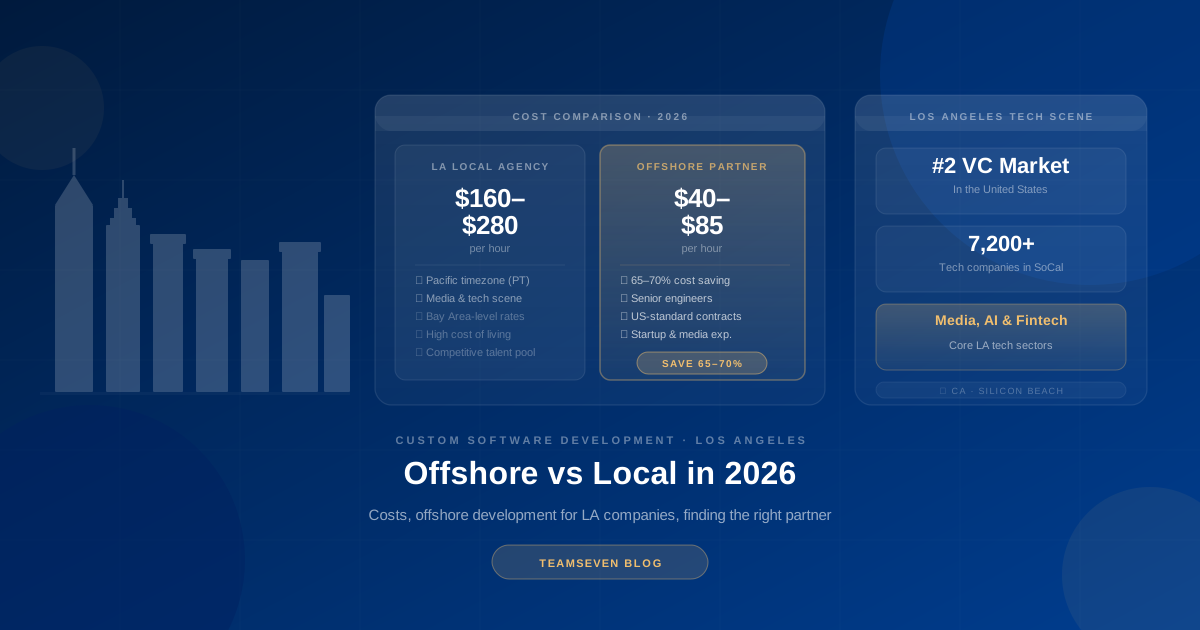
Los Angeles software development agencies range from boutique creative-technology shops charging $150–250/hr to larger full-service agencies charging comparable rates. A custom web application or mobile app from a mid-tier LA agency costs $100,000–$400,000 depending on complexity. A startup building a SaaS product from scratch is looking at $200,000–$500,000 at local rates for a production-ready MVP.
This creates the same dynamic that exists in New York, Boston, and other high-cost markets: offshore development has moved from a last resort to a mainstream strategic option for LA founders who need to be capital-efficient.
Los Angeles's startup sectors and their software needs
Media and content technology. LA is the global center of entertainment, and the technology layer of that industry is increasingly custom-built. Streaming platforms, content distribution systems, rights management software, production tools, and creator economy platforms all require serious custom engineering. Many of the companies building this software work with offshore development agencies on specific products and features.
E-commerce and DTC brands. LA's strength in consumer brands — fashion, beauty, lifestyle, health — has produced a significant e-commerce technology layer. Custom Shopify development, headless commerce platforms, subscription management systems, and logistics technology for DTC fulfillment are all active areas of custom software development for LA companies.
Creator economy. Los Angeles is the creator economy capital. Platforms for creators — content management, monetization tools, audience analytics, brand partnership software — are being built here. These products require complex backend systems that off-the-shelf tools don't provide.
Healthcare technology. LA's massive and diverse population creates significant healthcare technology demand. Patient platforms, telehealth infrastructure, healthcare analytics, and clinical management tools are being built by LA-based healthtech companies.
Logistics and supply chain. The Port of Los Angeles, LA's position as a major freight hub, and its proximity to Pacific Rim trade routes make logistics technology a significant sector. Custom freight management systems, customs software, and supply chain visibility tools are frequently commissioned by LA-based logistics companies.
Proptech and real estate. LA's significant real estate market has produced PropTech companies building everything from property management platforms to real estate transaction tools to short-term rental management software.
What offshore development looks like from Los Angeles
Los Angeles is in the Pacific Time Zone — making it the furthest US city from Pakistan's time zone. Pakistan is 12–13 hours ahead of LA PST/PDT.
This is the widest time zone gap of any US major city, and it's worth being honest about what that means.
In practice:
A 7am LA call is a 7–8pm Pakistan call. This is the outer limit of reasonable working hours for a Pakistani team but workable for once-weekly sprint reviews.
Day-to-day collaboration is predominantly asynchronous. LA founders work their day, send direction and feedback at end of day. Pakistan team works through what is LA's nighttime. LA founders wake up to completed work and updates.
What makes this work: Clear, well-written communication. Detailed sprint briefs that don't require immediate clarification. A discipline of batching questions and feedback rather than expecting real-time responses.
What makes this hard: Founders who need instant answers throughout the day. Rapidly changing requirements that can't be communicated effectively in writing. Projects where the "figuring out what to build" phase and the "building it" phase are happening simultaneously.
The LA time zone reality means it works best for founders who can operate with a longer feedback cycle. If you need same-day turnaround on direction changes, Eastern European agencies (6–9 hours ahead of LA) have much more workable overlap.
The alternative for close overlap: Eastern Europe
For LA founders where the Pakistan time zone genuinely doesn't work — founders who need more real-time availability — Eastern European agencies (Poland, Romania, Ukraine) at UTC+1 to UTC+3 offer a 9–12 hour difference from LA. A 9am LA call is a 6–9pm Eastern European call. Afternoons in LA overlap with the first few hours of the Eastern European workday.
The cost difference: Eastern European senior developers typically run $50–80/hr versus $30–55/hr from Pakistan. For a six-month project with three people, this difference is $50,000–$100,000. Meaningful, but less than local rates either way.
Industries where LA specifically benefits from offshore development
Creator economy platforms: These products require backend complexity — recommendation systems, payment splits, content delivery infrastructure — that's expensive to build locally but well within the capability of professional offshore agencies.
E-commerce custom development: LA's DTC brands need custom Shopify integrations, subscription management, and custom checkout flows. This work is highly suited to offshore development — it's well-defined, specification-heavy, and doesn't require real-time creative collaboration.
Logistics software for port-adjacent businesses: Companies operating in or adjacent to the Port of LA ecosystem — freight forwarders, customs brokers, 3PLs — need operational software that off-the-shelf products don't provide. This is exactly the type of well-defined operational software that offshore development handles well.
Healthcare apps: LA healthtech startups building patient-facing applications and clinical tools can leverage offshore development for mobile and web application development while keeping product strategy and clinical advisory local.
Finding the right software development agency from LA
The process from Los Angeles is the same as any other US city, with one additional consideration: given the time zone gap, communication quality is even more important than usual.
Prioritize agencies with demonstrated US client experience. Agencies that have worked with US clients understand async communication expectations, documentation standards, and the legal/contractual norms US companies expect. Ask explicitly how many of their clients are US-based and what their communication process looks like for US clients.
Test response time and quality before hiring. Send a detailed brief. Evaluate how long they take to respond and how thoroughly they engage with what you wrote. An agency that responds in 4 hours with generic questions that show they skimmed your brief tells you something important about how they'll communicate once they have your money.
Check for LA or California-specific client experience. Media, entertainment, and creator economy clients have different project characteristics than enterprise clients. An agency with relevant portfolio experience in your sector is more valuable than one with high volume in unrelated areas.
Be explicit about time zone expectations. Tell every agency you evaluate: "I'm in LA. What does your communication process look like for Pacific Time clients?" The answer — specific or vague, honest about constraints or dismissive of them — tells you a great deal.
Before you contact any agency
The quality of your initial brief determines the quality of proposals you receive. For LA founders, where the time zone gap puts extra weight on written communication:
Write a product brief that answers: what are you building, who uses it, what are the three things they absolutely must be able to do, what do you have today (designs, specs, existing code or nothing), and what does success look like in six months.
This document takes two hours to write and saves weeks of back-and-forth. It also signals to agencies that you're a serious client who has thought through the project — which correlates directly with the quality of the team they assign.
Muhammad Nabeel is the co-founder of Teamseven, a software development agency based in Lahore, Pakistan. We've been building custom software for US businesses — including LA-based startups and enterprises — since 2017. Talk to us about your project.