Software Development for Startups: How to Build Your First Product Without Wasting Your Runway
A practical guide to software development for startups: scope your MVP, choose a technical partner, and get to launch without blowing your runway.

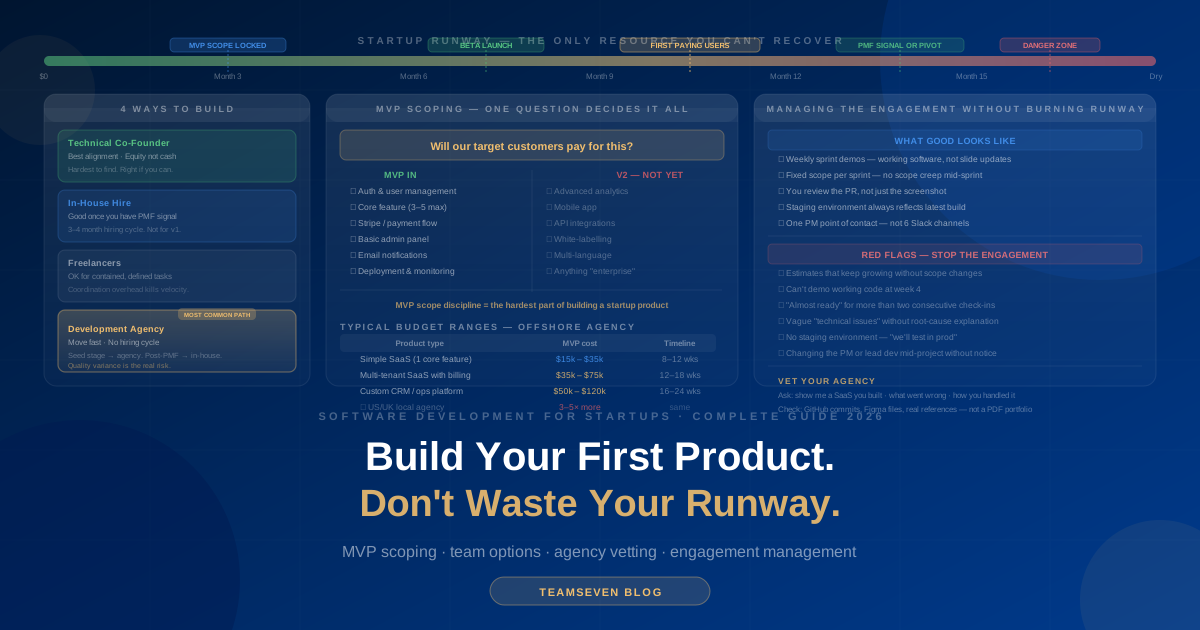
Runway is the only resource a startup can't recover once it's gone.
Every dollar spent on software development that doesn't move the needle (overbuilt features, wrong technical decisions, poor agency choices, insufficient management) is runway that isn't coming back. In a funded startup working off a fixed seed round, the difference between a well-run and poorly-run development engagement is often the difference between reaching product-market fit and running out of money before you get there.
This guide is written specifically for startup founders evaluating software development options: how to think about build vs buy, how to scope an MVP properly, how to choose between technical co-founder, freelancers, and agencies, how to manage a development engagement without becoming a full-time project manager, and how to avoid the specific mistakes that drain startup runway without producing value.
The startup software development landscape in 2026
The economics of startup software development have shifted substantially over the past few years.
AI-assisted development has accelerated certain work. Boilerplate code, standard integrations, documentation, and test writing are all faster with AI tooling. A good developer using modern AI tools produces more output per hour than the same developer without them. This hasn't reduced the cost of software development proportionally, experienced developers' judgment is still the scarce resource, but it has compressed certain timelines.
The quality floor for software has risen. Users in 2026 expect software that is fast, well-designed, and reliable from day one. The tolerance for rough MVPs with poor UX has decreased. "Good enough for a first version" in 2026 is significantly more polished than it was in 2018.
Offshore development has matured. The stigma that offshore development means poor quality has largely dissolved among sophisticated founders. The agencies, tools, and communication infrastructure for successful remote development engagement have matured significantly. US, UK, and Australian startups routinely build their first product with offshore teams and don't see this as a compromise.
The talent market remains expensive locally.
| Market | Senior developer salary (annual) |
|---|---|
| United States | Significantly above offshore market rates |
| London | Significantly above offshore market rates |
| Sydney | Significantly above offshore market rates |
For a seed-stage startup, a two-engineer team in a major market is one of the largest line items in the budget before overhead is even counted. That arithmetic drives the offshore development conversation.
The four options for startup software development
Technical co-founder. A co-founder who leads technical development. The highest-alignment option: a technical co-founder is fully invested in the product, builds institutional knowledge, and takes equity rather than cash. The hardest to find. The right choice if you can find the right person. The wrong choice if you hire someone technical to fill the role without genuine co-founder commitment and alignment.
In-house early engineering hire. Hiring your first full-time engineer. Suitable when you have product-market fit signal and need sustained engineering capacity. Not suitable at the idea stage: hiring takes 3–4 months, and the person you hire to build v1 may not be the right person to build v5.
Freelancers. Individual contractors hired for specific tasks. Suitable for well-defined, contained work: a landing page, a specific integration, a design pass. Not suitable for building a complete product that requires multiple disciplines working together coherently. Freelancer coordination overhead at product scale is significant.
Development agency. A team that builds your product for a fixed price, time-and-materials, or dedicated team arrangement. Suitable for startups that need to move fast, don't have time to hire, and want to separate the "build the first version" problem from the "staff a permanent team" problem. The risk is quality variance between agencies: the difference between a good and bad agency engagement is enormous.
Most startups at the pre-seed or seed stage use a development agency for their initial build, then hire in-house engineers once they have revenue and product-market fit signal. This is the most capital-efficient path when executed well.
How to scope an MVP for a startup
The MVP is the most consequential product decision a startup founder makes. The MVP that's too large takes too long and costs too much. The MVP that's too small doesn't generate real signal about product-market fit. The MVP that's poorly scoped wastes the most important learning opportunity in the product's existence.
The MVP exists to answer one question: will our target customers pay for this?
Every feature in the MVP should contribute to answering that question for your specific target customer. Features that serve a different customer type, a different use case, or a future version of the product are not MVP.
The practical scoping process:
Start with your core value proposition: the one sentence that describes why your customer will pay for this. Example: "B2B sales teams use our product to build personalised outreach sequences at scale."
For every proposed feature, ask: does this feature directly enable or support the core value proposition for the target customer? If yes, it might be MVP. If no, it's v2.
For every feature that passes the first filter, ask: is this the minimum implementation that delivers the value, or are we adding polish and edge case handling that we could add post-launch? The minimum implementation goes in the MVP. The polish goes in the next sprint after you have paying users.
What a startup MVP typically includes and doesn't include:
Includes: core feature set (3–5 features), authentication, basic UX that isn't embarrassing, 1–2 critical integrations, basic analytics, production deployment.
Does not include: advanced reporting, mobile app, API access, white labelling, admin super-powers, enterprise features, multi-language support, advanced customisation.
How to choose a development agency for your startup
For startup founders, the wrong agency choice is one of the most expensive mistakes available. The criteria that matter:
SaaS or startup experience specifically. An agency that primarily builds marketing websites, e-commerce stores, or bespoke internal tools for enterprises has different competencies from an agency that builds SaaS MVPs. The architecture decisions, the billing integrations, the multi-tenancy patterns: these are skills you only develop by building SaaS products. Look for agencies with live SaaS portfolio work, not just web development work.
Working live products, not screenshots. Ask for portfolio items you can use. Create an account. Go through the onboarding flow. Test core features. Live software tells you more about code quality, performance, and UX craft than any case study document.
Realistic estimation. An agency that quotes a fraction of what a product should reasonably cost is not a bargain. They're telling you something about how they work. Either they'll deliver a fraction of the product you need, or they'll run into scope disputes partway through when the budget runs out and the work isn't done. Realistic agencies estimate realistically, even when that means losing projects to competitors with lower quotes.
Communication quality during the sales process. The way an agency communicates before they have your money is the best available signal for how they'll communicate after. Slow responses, vague answers, failure to engage with the specifics of your brief: these behaviours don't improve once you're a client. Agencies that ask good questions, respond quickly, and give specific answers are demonstrating the behaviour that makes a development engagement work.
References from startup founders specifically. Ask for references from other startup founders who used the agency for their initial MVP. The questions that matter: did the estimate hold? Was the team proactive about surfacing problems? Did the final product match expectations? Would you use them again for v2?
Managing a development engagement without becoming a project manager
Most startup founders are not professional project managers. Managing a development engagement shouldn't require becoming one. But it does require specific behaviours that founders sometimes underinvest in:
Weekly sprint reviews, without fail. Forty-five minutes per week to see what was built and give direction for the next sprint. Missing these is the most common founder mistake in development engagements. Every missed review is a week of potential drift.
48-hour feedback turnaround. When the agency delivers work for review, give feedback within 48 hours. Development velocity depends on feedback loops being closed. Delays compound.
Written requirements before each sprint. Before a sprint starts, the founder should be able to answer: what are we building this sprint, what does done look like, and what decisions might come up that I should weigh in on? This takes 30 minutes before each sprint and saves hours of back-and-forth during the sprint.
A single point of contact. The agency communicates with one person on the founder's side. Multiple stakeholders with different opinions communicating directly with the development team creates conflicting direction and slows development.
A no-scope-creep policy. New ideas go in a backlog. The sprint that's running is the sprint that's running. This is the discipline that consistently separates startups that ship on time from startups that drift.
The specific mistakes that drain startup runway
These are the mistakes I see startup founders make with development budgets repeatedly:
Optimising for cost at the wrong stage. At the idea stage, optimising for speed and learning beats optimising for cost. A well-built MVP that launches in 12 weeks and gets you real users is more valuable than a cheaper MVP that takes 20 weeks and teaches you the same things. Runway spent faster on a better build is better than runway spent slower on a cheaper build.
Building what you think users want rather than what the validation says. Every conversation with a potential user is a data point. Every feature added based on one data point without pattern-confirmation is a waste of runway. Build based on consistent patterns, not individual conversations.
Solving for scale before you have users. Founders worry about whether their architecture can handle 100,000 users before they have 100 users. The architecture decisions that matter at 100,000 users are different from the ones that matter at 100 users, and you'll understand them better at 100 users anyway. Build for where you are, not where you hope to be.
Not shipping until it's perfect. Every week of extra development before launch is a week of feedback you're not getting. Imperfect software in the hands of real users beats perfect software that hasn't shipped yet, every time.
Choosing the wrong agency and not cutting losses. If an agency engagement is clearly failing (deliverables consistently poor quality, communication broken, project behind schedule with no credible recovery plan) the longer you stay, the more runway you burn. The decision to end an engagement and find a better partner is painful and expensive. It is almost always less expensive than continuing a failing engagement.
What startup-focused development looks like
The founders who get the most out of development agencies are consistent in their approach:
They come to the engagement with clear validation: they've talked to customers, they know the problem is real, they have a specific ICP and a specific core value proposition.
They scope the MVP with genuine discipline: they've cut every feature that doesn't directly serve product-market fit validation, and they've accepted that some things they want won't be in v1.
They treat the agency like a technical partner, not a vendor. They explain business context, share customer conversations, and give direction that comes from user understanding rather than personal preferences.
They show up to sprint reviews consistently. They review actual working software, give specific feedback, and make decisions promptly.
They ship. They launch when the product is good enough to generate real signal, not when it's perfect.
This isn't a complicated formula. It's professional discipline applied to a high-stakes situation. The startups that get it right don't have a secret. They just do the basic things consistently.
Runway is the only resource a startup can't recover once it's gone.
FAQ
What are the options for a startup building software? Broadly four: hire in-house, work with an agency, use freelancers, or build it yourself with no-code. Each fits a different stage and risk profile: the right answer depends on whether the software is your product or a tool supporting it, and how much runway you have.
How much should a startup spend on its first build? Less than founders usually plan to. The purpose of the first version is learning, not completeness, so the money is best spent getting something real in front of users quickly and keeping budget in reserve for what you discover afterwards.
How do I choose a development agency as a startup? Ask to speak to the engineers who'd do the work, ask what they'd cut from your scope, and check they'll commit to fixed scope after a discovery phase. An agency that tries to shrink your first build is usually a better sign than one that agrees to everything.
What drains startup runway fastest in software development? Building too much before validating, changing direction without changing scope, and treating the first version as a final product. All three spend money on assumptions rather than evidence.
Do I need to become a project manager to run an agency engagement? No, but you do need to make decisions quickly and be available for questions. The main cost of an absent client is ambiguity: an agency waiting on an answer either stalls or guesses, and both are expensive.
Stay connected
Build notes, launches, and new articles from the Teamseven team.