
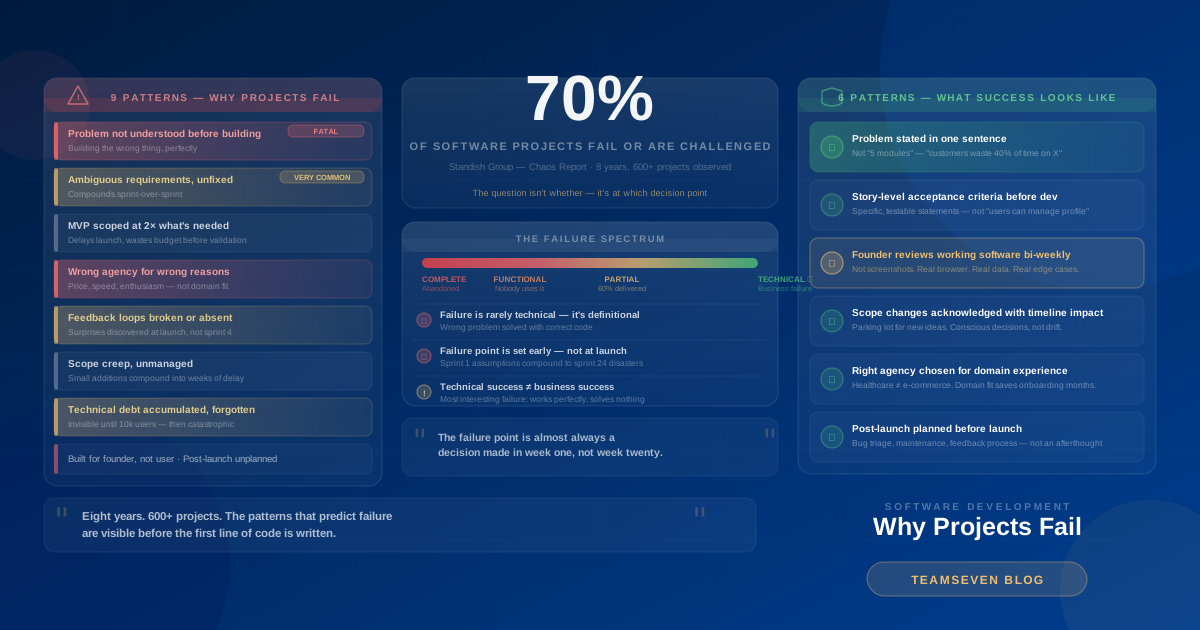
Eight years. 600+ projects. Clients across the United States, the United Kingdom, and Australia. Industries including healthcare, logistics, proptech, edtech, AI, and enterprise software.
From that vantage point, I've watched software projects succeed and fail with a consistency that makes certain patterns unmistakable.
This isn't a theoretical analysis of software project failure drawn from academic research or industry surveys. It's what I've personally observed — in project retrospectives, in client conversations, in code I've inherited from failed projects built by other agencies, and in the specific decisions that separated the projects that delivered real value from the ones that didn't.
The numbers people cite about software project failure rates — Standish Group's Chaos Report has historically reported that 70% of software projects fail or are challenged — are real. What those reports often don't cover is the specific mechanism of failure. Not that projects fail, but why, and at exactly which decision point the failure was determined.
That's what this post covers.
What "failure" actually means
Software project failure isn't binary. It exists on a spectrum:
Complete failure: The project is abandoned before launch. Money spent, nothing delivered. This is rarer than the statistics suggest but genuinely devastating when it happens.
Functional failure: The software is delivered and launched, but nobody uses it. It solves a problem nobody had, or solves a real problem so poorly that users abandon it. This is more common than complete failure and more expensive — you pay for delivery and then pay again to fix or replace it.
Partial success: The project delivers something usable but significantly below the original ambition. Timeline ran over. Budget exceeded. Features were cut. The client got 60% of what they needed and called it done.
Technical success, business failure: The software works perfectly as specified but doesn't achieve the business outcome it was built for. This is the most interesting failure category — the engineering was competent but the problem definition was wrong.
The patterns below apply across all four categories. Some predict complete failure. Some predict functional failure. Some predict technical success with business failure. Understanding which is which matters for your specific situation.
Pattern 1: The problem wasn't understood before the solution was built
Frequency: Very common. Severity: Fatal.
The most consistent predictor of software project failure isn't technical — it's definitional. Projects built to solve the wrong problem, or built without genuine understanding of the problem, fail regardless of technical quality.
This sounds obvious. It's remarkably easy to violate.
Founders come to us with a product vision they've been developing for months. They know exactly what they want to build. The danger is that "knowing what you want to build" and "understanding the problem you're solving" are not the same thing.
A logistics company wanted a custom route optimization system. They knew exactly what they wanted — algorithms, maps, time windows, vehicle capacity. We spent two weeks in discovery before starting development. During that process, we discovered that their actual problem wasn't route optimization. It was that their drivers ignored the existing routing software because the interface was unusable on a phone in a moving van. The solution wasn't a better algorithm. It was a better mobile UI on top of their existing system — a 6-week project instead of a 6-month one.
The projects that start with "here's what I want to build" are higher risk than the projects that start with "here's the problem I'm trying to solve." The former locks in a solution before validating the problem. The latter keeps options open until the problem is genuinely understood.
What to do: Before writing a line of specification, write a problem statement. One paragraph answering: who has the problem, what exactly is the problem, what do they do today instead, and what would they do differently if the problem were solved? If you can't write that paragraph without guessing, you're not ready to specify a solution.
Pattern 2: The requirements were ambiguous and nobody fixed them
Frequency: Extremely common. Severity: Moderate to severe.
In eight years, I've never seen a software project fail because the technology was impossible. I've seen dozens fail because the requirements were ambiguous enough that the technology was built to solve a subtly different problem than the one the client had.
Ambiguous requirements are everywhere. They're in the phrase "users can manage their profile" — which means different things to the founder who wrote it and the developer who reads it. They're in "the system should be fast" — which has no meaning without a specific performance target. They're in "it should look professional" — which is entirely in the eye of the beholder.
Ambiguity isn't always the client's fault. Sometimes it comes from stakeholders having different visions of the product that were never reconciled. Sometimes it comes from requirements that were clear to everyone at the start but evolved as the project progressed without being documented. Sometimes it comes from feature requests added mid-sprint that weren't fully specified because they seemed simple.
The damage from ambiguous requirements compounds. An ambiguous requirement in sprint one gets built as the developer's best interpretation. That interpretation becomes the foundation for features in sprint two. By sprint four, you're building on a foundation of assumptions that were never validated, and the cost of correction has multiplied.
What to do: For every feature, write acceptance criteria — specific, testable statements of what "done" looks like. Not "users can search for products" but "users can search the product catalogue by name and category; search results appear within 2 seconds; no results shows a message 'No products found for [search term]' with a link to browse all products." If you can't write acceptance criteria because the feature is still fuzzy, the feature isn't ready for development.
Pattern 3: The MVP wasn't minimal
Frequency: Very common in startup projects. Severity: Moderate.
The most common scope mistake isn't building the wrong thing — it's building too much of the right thing.
Founders scope their MVPs at approximately twice what they need to validate their core hypothesis. Every feature that gets added to the MVP is a feature that delays launch, costs additional development budget, and may turn out to be something users don't need.
The specific pattern I see repeatedly: a founder has a core value proposition — let's say a B2B SaaS that automates invoice reconciliation. The core feature is the reconciliation engine. But by the time they've finished specifying the MVP, it also includes: a comprehensive dashboard, multi-user teams with role management, integrations with six accounting platforms, a mobile app, a reporting module, and a white-label option.
None of those additional features validate whether anyone will pay for automated invoice reconciliation. They add four months to the development timeline and double the budget — and if the core product doesn't work for users, all of that investment is wasted.
The MVP exists to answer one question: does this solve a real problem well enough that people will pay for it? Every feature in the MVP should contribute to answering that question. Everything else is v2.
What to do: For every feature in your MVP specification, ask: "If this feature wasn't in the MVP, could I still validate whether the core product works?" If the answer is yes, the feature is not MVP. Move it to the roadmap. Build it when you have users who ask for it.
Pattern 4: The wrong team was hired for the wrong reasons
Frequency: Common. Severity: Severe.
Software development agencies and developers are not interchangeable. An agency that builds excellent e-commerce platforms is not automatically the right choice for a healthcare data platform. A developer who is outstanding at frontend React work is not the same as a developer who is outstanding at database architecture.
The most common wrong-reason hiring decisions:
Price. The cheapest quote is rarely the best value. I know this sounds self-serving coming from an agency, but the evidence from projects we've inherited is consistent: cheap development almost always produces code that costs more to maintain, extend, or fix than it would have cost to build properly in the first place.
Speed of response. Agencies that respond to enquiries in under an hour are not necessarily more capable than agencies that respond in 24 hours. Response speed is a sales behaviour, not a delivery behaviour.
Enthusiasm. Every agency is enthusiastic at the pitch stage. Enthusiasm correlates with sales motivation, not delivery quality.
Portfolio that looks right. A beautiful portfolio website with impressive-looking screenshots tells you about design quality and marketing investment. It doesn't tell you about code quality, project management discipline, or what happens when something goes wrong.
What actually predicts delivery quality: verified third-party reviews (Clutch, GoodFirms), references from clients with similar project types who you can actually call, portfolio work you can test in production rather than just view in screenshots, and the quality of their questions during the sales process.
What to do: Evaluate agencies against project type, not just technical stack. An agency that has delivered three projects for healthcare companies understands HIPAA, clinical workflows, and the specific complexity of healthcare data — without you having to teach them. That domain experience is worth a meaningful cost premium.
Pattern 5: Feedback loops were broken or absent
Frequency: Very common. Severity: Moderate to severe.
Software development is an iterative process. The specification you write before development starts will be imperfect — not because you wrote it badly, but because building software reveals ambiguities and edge cases that weren't apparent in the specification phase. The only way to catch these issues before they become expensive is through regular review of working software.
Projects with broken feedback loops — where the client doesn't see working software until the project is "complete" — consistently deliver surprises. Sometimes positive. Usually negative.
The specific failure mode: a client reviews the final delivery of a six-month project and discovers that a core workflow doesn't match how their business actually operates. The developer built it exactly as specified. The specification was technically correct but missed a nuance that was obvious to the client and not obvious to the developer. In a project with regular review cycles, this would have been caught in week four and fixed in week five. In a waterfall project with no intermediate reviews, it's discovered in week twenty-four and becomes a scope dispute.
I've also seen the inverse: clients who review work every sprint but don't give substantive feedback — approving everything without actually using the software — and discover at launch that they didn't review carefully enough to catch problems.
What to do: Review working software, not screenshots or demos. Every sprint should end with you actually using the feature — logging in, clicking through, inputting real data, testing edge cases. The five minutes it takes to genuinely test a feature in sprint three saves the five days it takes to fix it at launch.
Pattern 6: Scope was not managed
Frequency: Very common. Severity: Moderate.
Scope creep is the background radiation of software projects. It's present in almost every project, to some degree, and it accounts for a significant portion of budget overruns and timeline extensions.
The specific pattern: individual scope additions each seem small. "Can we add a filter to this table?" "Can we send an email notification when this happens?" "Can we add an export button here?" Each one takes a few hours. Collectively, they add weeks to the project.
The damage from scope creep isn't just timeline extension. It's that additions mid-sprint were never specified, never reviewed against the overall architecture, and never tested against the rest of the application. Hastily added features are disproportionately likely to introduce bugs, create architectural debt, and conflict with other features.
There's also a morale dimension. Developers who consistently have scope added to their sprints without timeline adjustment are being asked to do more work in the same time — which means either cutting quality or working overtime. Neither is sustainable, and both produce worse outcomes.
What to do: Create a "parking lot" for new ideas that occur to you during the project. When something new comes to mind, it goes on the list — not into the current sprint. At each sprint review, evaluate the parking lot: what needs to be added to the project scope, and what can wait for v2? When scope is added, explicitly acknowledge the timeline impact.
Pattern 7: Technical debt was accumulated deliberately, then forgotten
Frequency: Common in projects under time pressure. Severity: Moderate to severe.
Technical debt is a useful concept and a dangerous one. The useful part: sometimes taking a shortcut now is the right decision — moving fast to validate something before investing in the "right" solution. The dangerous part: shortcuts taken explicitly get forgotten, and shortcuts taken without acknowledgment are invisible.
The pattern I see repeatedly: under deadline pressure, a developer takes a shortcut — hardcodes a value that should be configurable, skips writing tests for a module, uses a simple implementation where a more robust one is needed. If this shortcut is documented ("TODO: replace this with a proper implementation before launch"), it has a chance of being addressed. If it isn't documented, it becomes invisible debt that accrues interest until it causes a production incident.
The most expensive form of technical debt is architectural debt — shortcuts in the fundamental structure of the application rather than in individual features. Architectural shortcuts are hard to see, hard to attribute to a specific decision, and extremely expensive to fix. You don't notice them when the application has 100 users. You notice them when the application slows to a crawl at 10,000 users and the diagnosis reveals that the database schema needs to be restructured from the ground up.
What to do: Require a technical debt register — a document maintained by the development team that lists every known shortcut, when it was taken, why, and what the proper solution would look like. Review this quarterly. Budget for debt repayment in each sprint alongside feature development.
Pattern 8: The product was built for the founder, not the user
Frequency: Common in first-time founder projects. Severity: Moderate to severe.
Founders know their domain. They have strong intuitions about what the product should do. Those intuitions are often correct — and occasionally completely wrong in ways that only become apparent when real users interact with the product.
The specific failure mode: a product built to the founder's exact specification is launched, and users consistently try to do something the product wasn't designed for. The founder's mental model of how users would interact with the product was wrong — not maliciously, but because their expertise makes them atypical. They understand the domain so well that they use the product differently than a typical user would.
This is a real phenomenon with a name in UX research: the curse of knowledge. When you know something deeply, it's difficult to imagine not knowing it. A logistics platform built by someone who has worked in logistics for 20 years may be optimised for expert users in ways that make it impenetrable for the operations coordinator who needs to use it on day one.
What to do: User testing before launch is not optional — it's the only reliable way to catch this failure mode. Five users doing a structured task test of core workflows will reveal more about usability problems than 50 hours of internal review. The users don't need to be a representative sample; they need to be people who are not the founder and have not been intimately involved in building the product.
Pattern 9: Post-launch was not planned
Frequency: Common. Severity: Moderate.
Software doesn't stop requiring attention at launch. It requires ongoing maintenance, bug fixes, performance optimisation, dependency updates, and feature iteration based on real user feedback. Projects that plan for development but not for post-launch consistently struggle in the months after they go live.
The specific failure modes:
Launch bug paralysis. Every software launch has bugs. Projects without a documented bug triage and response process freeze when bugs are discovered — nobody knows who should fix what, how urgently, or how to communicate with affected users.
Dependency rot. Software dependencies update regularly. Security vulnerabilities are discovered and patched. Frameworks release new major versions. An application without ongoing maintenance accumulates vulnerability risk over time.
Feedback loop closure. Users of a real product have opinions and requests. Without a process for capturing, evaluating, and actioning user feedback, the product doesn't improve in response to real usage — it improves only in response to the founder's intuitions, which may or may not match user reality.
What to do: Before launch, define: who is responsible for monitoring and responding to production issues? What's the response time for critical bugs? How will user feedback be collected and reviewed? Who decides which feedback becomes development priority? These decisions are easier to make before launch than in the middle of a production incident.
The patterns that predict success
Eight years of watching failure has also clarified what consistently produces good outcomes. The successful projects share most of these characteristics:
The founder could articulate the problem in one sentence. Not the solution — the problem. "Our customers are spending 40% of their administrative time on manual invoice reconciliation" is a problem. "We need a dashboard with five modules" is a solution assumption.
Requirements were written to story-level specificity before development started. Not everything had to be specified upfront — but the current sprint's stories had clear acceptance criteria.
The founder reviewed working software every two weeks. Not descriptions of software. Working software in a browser, on a device, with real data.
Scope changes were acknowledged and their impact was accepted. When something was added, someone said "that adds two weeks to the timeline" and the decision was made consciously.
The right agency was chosen for the right reasons. Not the cheapest, not the fastest to respond, but the one with demonstrated experience in the relevant domain.
Post-launch was planned as part of the project, not as an afterthought.
None of these are sophisticated. They're basic professional practices that are remarkably often not followed.
An honest note about Teamseven's own failures
It would be dishonest to write about software project failure without acknowledging that we've contributed to some.
We've had projects run over timeline. We've had features that didn't meet the client's expectations on first delivery. We've had communication gaps that created misalignment we had to work to correct.
What I can say honestly: we've never had a project fail for reasons we weren't aware of. Every problem we've had, we've acknowledged and addressed. We've refunded clients when the outcome wasn't what we promised. We've stayed on engagements beyond the contracted period to fix our own mistakes.
The patterns in this post apply to us too. We're better at some than others. The ones we're best at are requirements clarity and feedback loops — because eight years of seeing what happens when these are weak has made us uncompromising about them. We push back when requirements aren't ready. We insist on sprint reviews even when clients are busy. We flag scope changes before acting on them.
That's what learning from 600 projects looks like.
Muhammad Nabeel is the co-founder of Teamseven, a software development agency based in Lahore, Pakistan. 8 years, 600+ projects, clients across the US, UK, and Australia. Get in touch if you want to talk through a project before committing to it.