
Australia has a genuine software development talent shortage. The country has strong universities, a growing tech sector, and rising demand for digital products — but not enough senior developers to meet that demand locally. The result is a market where experienced developers are expensive, booked out months in advance, and competitive to hire even at high salaries.
Australian businesses building software products — whether it's a startup's first SaaS MVP or an enterprise's operational platform — are increasingly looking offshore to bridge that gap. This post is an honest assessment of why, what works, what doesn't, and how to approach offshore development from an Australian context.
I run a software agency in Lahore, Pakistan that has worked with Australian clients since 2017. I'll give you the honest version of this, including the cases where offshore development isn't the right answer.
The Australian software development market in 2026
A few data points that explain why offshore is gaining traction in Australia:
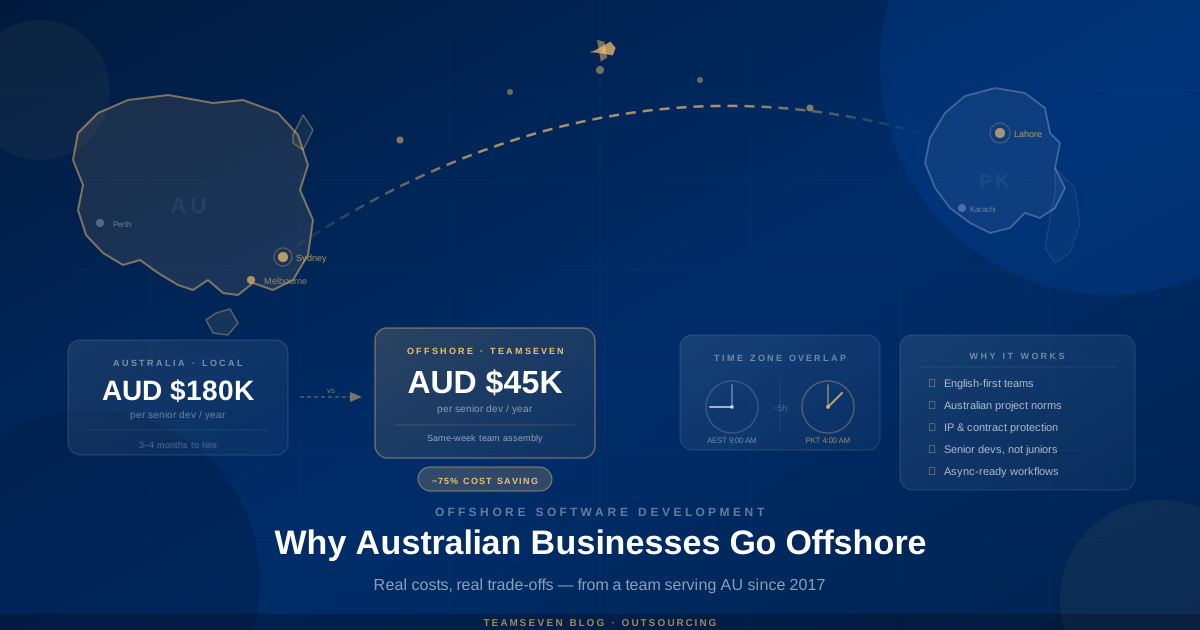
Developer salaries are high and rising. A senior full-stack developer in Sydney or Melbourne typically earns AUD $130,000–$180,000 per year. With on-costs (superannuation, leave, insurance), the total cost to an employer is closer to AUD $160,000–$220,000. For a startup that needs three senior developers, that's over AUD $500,000 per year just in engineering salaries — before any other costs.
Good developers are hard to find. The tech talent pool in Australia, while growing, can't keep pace with demand. Companies compete hard for senior developers, and the best ones often have multiple offers. Time-to-hire for a senior developer position in Sydney or Melbourne is typically 3–4 months.
Agency rates are high. Australian development agencies charge AUD $1,200–2,500 per day for senior developers. A 6-month project with a 3-person team from an Australian agency costs AUD $500,000–$1,000,000+. Most SMEs and startups don't have that budget.
Against that backdrop, offshore development at AUD $300–600/day — with equivalent technical quality — is genuinely attractive.
Why Australian businesses specifically choose offshore
Australian businesses have several characteristics that make offshore development particularly relevant:
Startup culture is strong but funding is more limited than in the US. Australian startups are building ambitious products on budgets that wouldn't cover six months of developer salaries in Sydney. Offshore development is often not a preference but a financial necessity for early-stage Australian founders.
The time zone is actually workable with parts of Asia. Australia's time zone (AEST GMT+10) is only 5 hours ahead of Pakistan (GMT+5), which means morning overlap is real. This is significantly better than the US-offshore experience, where the time difference is 12+ hours with no natural overlap. Australian businesses working with Pakistani agencies can have genuine morning standups.
Australian businesses are internationally minded. Australia's geographic isolation has historically made Australian businesses comfortable with remote relationships — with suppliers, partners, and clients. The leap to a remote development team in another country is culturally smaller than it might be for some European markets.
The quality of offshore development has improved materially. Five years ago, the quality gap between offshore and local development was real and significant. It's still present in some cases, but the best offshore agencies today — particularly in Pakistan and Eastern Europe — are delivering work that competes on quality with local alternatives.
The honest trade-offs
I said I'd be honest, so let me be direct about where offshore development from Australia creates real challenges.
Time zone: better than the US, not perfect
Pakistan is 5 hours behind AEST. That means if your team in Sydney starts at 9am, your Lahore-based developers are at 4am. Not ideal for a morning standup.
The practical solution is a late-morning sync from the Australian side — 11am AEST / 6am PKT — which gives you an hour of overlap before the Australian lunch break and gives the Pakistan team a reasonable start time. This works, but it requires flexibility on both sides.
For Australian businesses in earlier time zones (AWST, Perth at GMT+8), the overlap is even better — only 3 hours difference from Pakistan.
Don't believe any offshore agency that says time zones "don't matter with modern tools." They matter. The question is whether the overlap you can get is sufficient for your communication style and project type.
Communication overhead is real
Every communication that would take 30 seconds in a co-located office takes longer with an offshore team. This isn't unique to overseas teams — any remote team has this challenge. But international remote teams have additional layers: different cultural communication norms, occasional language nuance, and the knowledge that a miscommunication will take 24 hours to resolve rather than being cleared up immediately.
Good offshore agencies compensate with:
- Thorough written communication and documentation
- Clear sprint planning so work is well-defined before execution begins
- Loom videos for complex explanations
- Explicit confirmation of understanding ("Here's what I understood you to mean — is that correct?")
The best Australian-offshore relationships are ones where the Australian client also invests in communication quality — writing clear briefs, giving detailed feedback, making decisions promptly.
Contractor legal framework
Australian businesses working with offshore agencies should be clear about contractor arrangements. The typical engagement is a service contract with an overseas company — not an employment relationship. This means no superannuation obligations, no WorkCover, no leave entitlements. It also means less regulatory protection if things go wrong.
The mitigation is a well-drafted contract covering: IP assignment, confidentiality, payment milestones, scope change process, termination rights, and governing law. Australian law can govern an international contract if both parties agree to it.
Data sovereignty
Australian businesses in regulated sectors — healthcare, financial services, government — need to think carefully about data sovereignty. If your application processes personal health information or financial data, you need to understand where that data lives and whether offshore developers have access to it.
The standard approach is to ensure that:
- Production data stays on Australian-based servers (AWS Sydney, Azure Australia East, GCP Sydney)
- Developers work with anonymised or synthetic data for development and testing
- Production access is restricted and audited
- Any data processing agreements comply with the Australian Privacy Act
A professional offshore agency will have clear processes for this. If an agency is vague about data handling, that's a red flag.
What works well for Australian-offshore engagements
Having worked with Australian clients across startups, SMEs, and enterprise organisations, here's where offshore development consistently delivers value:
Greenfield product development. Building a new product from scratch — an MVP, a new platform, a new service — is well-suited to offshore development. The requirements are defined at the start, the codebase is clean, and there's no legacy complexity to navigate.
Well-specified projects with stable requirements. The less requirements change during a project, the better offshore development works. If you can invest in a thorough discovery and specification phase before development starts, offshore execution of that specification is efficient.
Sustained product development with a consistent team. A dedicated offshore team that works on your product consistently over 12+ months develops deep product knowledge that makes them increasingly effective. The ramp-up cost is a one-time investment; the ongoing velocity is the return.
Technology-specific work. If you need specific expertise — Node.js, React, Angular, Python, Flutter — offshore teams in Pakistan and Eastern Europe have deep talent pools in modern web and mobile technology stacks.
What doesn't work well
Highly exploratory or ambiguous projects. If you're still figuring out what you're building, you need development partners who can participate in that discovery process in real time. Offshore teams work best when there's clarity about what's being built. Ambiguity multiplies the communication challenges.
Projects requiring constant rapid iteration based on user feedback. If your process is "deploy to users Monday, collect feedback Tuesday, change direction Wednesday," the communication and time zone friction of offshore development will slow you down. This type of work benefits from tight in-person or same-time-zone collaboration.
Projects where cultural context matters deeply. Building a product for the Australian market — an app for Australian consumers, a platform for Australian businesses — requires understanding Australian user behaviour, Australian regulations, and Australian business norms. A development team without that context can still execute technically, but product decisions need clear guidance from someone with the relevant context.
How to make offshore development work from Australia
Practical recommendations from 8 years of working with Australian clients:
Invest in a discovery phase. Before any development starts, define requirements thoroughly — user stories, workflows, integrations, edge cases. The better your requirements, the better your offshore execution. Discovery is cheap relative to the cost of fixing misunderstood requirements in code.
Choose an agency with Australian client experience. Not all offshore agencies have worked with Australian clients. Agencies that have understand the time zone dynamics, the legal context, the communication expectations. Ask specifically whether they've worked with Australian businesses before and ask for references.
Set up a regular async communication rhythm. Daily written standup updates (what was done, what's next, any blockers) sent at end of Pakistan business day — which is your early morning — mean you wake up to current project status every morning without a 6am video call.
Be decisive. The biggest friction point in offshore engagements from Australia is slow decision-making on the client side. When a developer has a question at 9am PKT and you don't respond until 3pm AEST, that's most of a working day lost. Commit to same-day responses for project questions during active development.
Start with a smaller, lower-risk project. Before committing to a major offshore build, test the relationship with something smaller. A well-specified 6-week project tells you everything you need to know about an agency's communication quality, technical capability, and delivery reliability.
An Australian product we built
Parkezi is a smart car park automation system built for the Australian market — proudly Australian-owned and operated. We built the software platform that powers their product: cloud-based management, ANPR camera integration, contactless payment processing, real-time dashboards, and automated access control.
The product is now deployed at commercial parking stations, shopping centres, hotels, and enterprise sites across Australia — including NSW Ambulance, Quest Hotels, and Mercure Hotels. Rated 5.0 on Google.
That's what a well-executed Australian-offshore development engagement looks like. An Australian founder with a clear product vision, working with an offshore team over an extended period, producing a platform that serves national enterprise clients.
Is offshore development right for your Australian business?
It depends — and I mean that genuinely, not as a hedge.
If you have a defined product to build, a realistic budget, the communication bandwidth to manage a remote team, and a willingness to invest in clear requirements — offshore development is likely to deliver genuine value for your Australian business.
If you need constant real-time collaboration, if your project is still exploratory, or if your data sovereignty requirements create complications that an offshore arrangement can't cleanly solve — offshore development may not be the right fit, and it's better to know that before you start.
We've told Australian prospects when offshore wasn't right for them. We'd rather do that than take a project we can't deliver on well.
Muhammad Nabeel is the co-founder of Teamseven, a software development agency in Lahore, Pakistan. We've been working with Australian clients since 2017. We built Parkezi — now deployed nationally across Australia. Get in touch to discuss your project.
Working with an Australian business?
We have a dedicated page for Australian clients with specific information on time zones, contracts, Privacy Act compliance, and our Australian client work: