
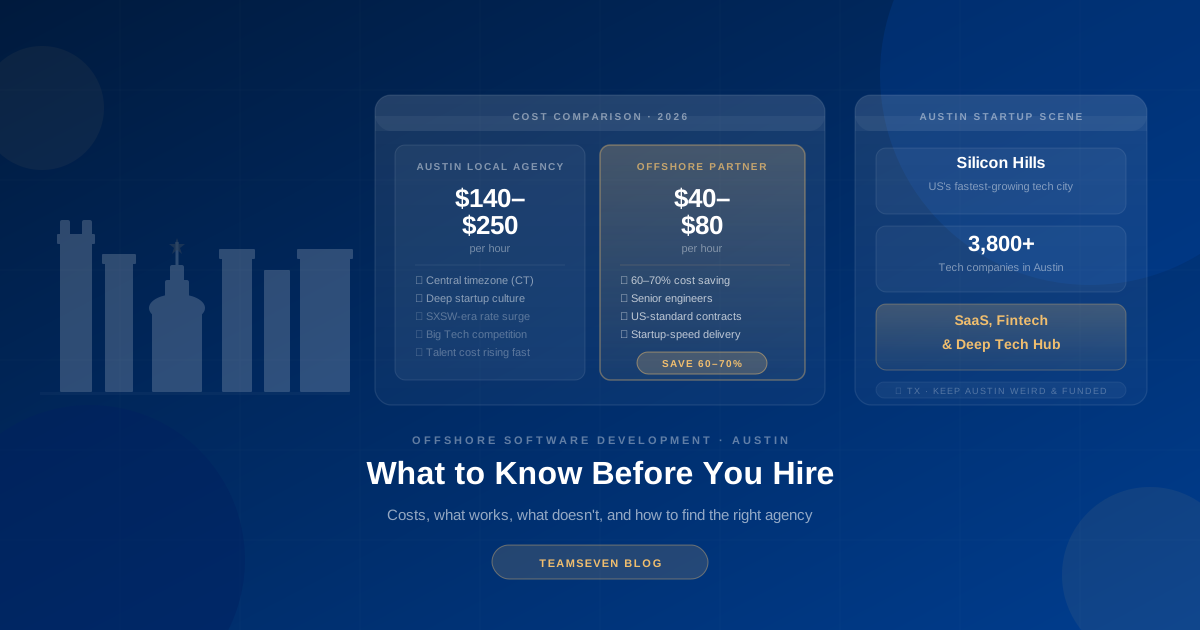
Austin has become one of the most important startup cities in the United States. The relocation of major tech companies — Tesla, Oracle, Apple, Google — has created a talent ecosystem that's drawing founders from Silicon Valley, New York, and internationally. Austin's startup scene is producing serious companies across SaaS, fintech, healthcare technology, and enterprise software.
It's also producing a familiar problem: the gap between what founders need to build their product and what they can afford to build it with locally. Austin's tech boom has driven developer salaries and agency rates up significantly. Senior developers command $130,000–$180,000 annually. Mid-size Austin software agencies charge $120–160/hr.
This guide is specifically for Austin founders — first-time builders, experienced operators moving from corporate to startup, and growth-stage companies scaling engineering — who are evaluating offshore development as a serious option.
Why Austin founders specifically are a good fit for offshore development
Austin has a cultural characteristic that makes offshore development work particularly well here: founders and operators are comfortable with remote, distributed work in a way that some other markets aren't.
Austin's tech community is heavily shaped by companies that have always been remote-first or have normalized remote culture. The startup ecosystem here doesn't have the same bias toward co-located, in-office teams that characterizes New York finance or traditional Boston enterprise culture.
This cultural comfort with remote work translates directly to offshore development. Austin founders who are already managing remote contractors, distributed teams, and async communication are well-positioned to run an offshore development engagement effectively.
Additionally, Austin's startup ecosystem skews toward capital-efficient building. The lean startup ethos — build the smallest thing that validates the idea, then scale — fits naturally with offshore development. You're not trying to build Google's infrastructure. You're trying to build a working SaaS product that demonstrates market demand.
The Austin startup software landscape
Austin's strongest startup sectors for software development:
SaaS and enterprise software. Austin is one of the top three US cities for SaaS company formation. Companies like BigCommerce, WP Engine, HomeAway, and dozens of growth-stage SaaS businesses are headquartered here. The city's startup ecosystem is deeply familiar with SaaS architecture, subscription billing, and the product-led growth motion.
Fintech. Austin's financial technology scene has grown significantly. Payment processing, banking infrastructure, expense management, and financial data companies are all active in the Austin ecosystem.
Healthcare technology. Texas's large and complex healthcare market generates consistent demand for healthcare technology. Austin-based health tech startups are building patient platforms, clinical tools, and health data infrastructure.
Logistics and supply chain. Texas is a major freight hub. Austin-based logistics technology companies are building freight management, fleet tracking, and supply chain visibility tools for the broader Texas market and beyond.
Real estate technology. Texas's real estate market — one of the most active in the US — is generating PropTech companies building everything from property management platforms to transaction tools.
What offshore development actually costs for Austin startups
Austin founders typically enter conversations about offshore development with one of two mental models: "it'll be cheap and probably low quality" or "it's risky and I should just pay local rates."
Both are wrong in useful ways.
Offshore development from professional agencies in Pakistan or India for an Austin SaaS startup:
MVP development (12–20 weeks, 2 developers + QA):
- South Asian agency: $35,000–$90,000
- Eastern European agency: $80,000–$150,000
- Austin local agency: $180,000–$320,000
Dedicated development team (monthly retainer, ongoing):
- South Asian agency: $8,000–$15,000/month
- Eastern European agency: $15,000–$25,000/month
- Austin local agency: $25,000–$50,000/month
For an Austin seed-stage startup with $500,000 in funding, the difference between a local agency and an offshore agency for a six-month MVP build is $100,000–$200,000. That money either funds six months of runway or doesn't. It's a real decision.
The quality question: professional offshore agencies — vetted, with verified reviews, portfolio work you can evaluate, and references you can call — deliver production-quality work that's indistinguishable from local agency work in the final output. The difference is in the process: more async communication, more deliberate sprint planning, less real-time back-and-forth.
The SaaS MVP specifically
Austin's startup ecosystem is heavily SaaS-focused, so it's worth being specific about what offshore development looks like for a SaaS MVP.
A well-scoped SaaS MVP for an Austin B2B startup typically includes:
- Authentication and user management (email/password, Google OAuth, email verification)
- Core feature set (3–5 key features that deliver the primary value proposition)
- Multi-tenant architecture (separate workspaces per company if B2B)
- Stripe billing integration (subscription plans, trial period, basic invoicing)
- Admin dashboard (basic reporting and user management)
- Deployment (AWS or GCP, CI/CD pipeline, staging and production environments)
Timeline with a professional offshore team: 14–20 weeks depending on feature scope.
Cost with a professional offshore agency: $40,000–$90,000 depending on complexity.
This is the product that lets you demo to investors, onboard first customers, and validate whether the market wants what you're building. It's not a prototype — it's production-ready software that real users can use.
The alternative for this scope in Austin: $180,000–$280,000 at local agency rates, or 12–18 months of hiring (if you can find and close candidates in a competitive market).
What Austin founders consistently get wrong
Having worked with US startup founders for eight years, here are the specific mistakes Austin founders make with offshore development:
Treating the agency like a vending machine. The founders who get the best results from offshore development treat it like a technical partnership — they invest in clear communication, they give detailed feedback, they make decisions promptly. The founders who get poor results treat the agency like a service they've purchased and wait for things to appear.
Underspecifying the MVP. Austin startup culture celebrates moving fast and iterating. Applied to offshore development, this sometimes means starting development before the MVP is well-defined. Every requirement clarified in a Notion doc before development starts costs a fraction of what it costs to change mid-sprint. Invest two weeks in specification and save six weeks in rework.
Choosing on price alone. The cheapest offshore quote is almost never the right choice. Price signals quality in this market. An agency quoting $15,000 for a 16-week SaaS MVP is either planning to cut corners or doesn't understand the scope. Professional agencies with track records, reviews, and portfolio work have a floor below which they can't deliver quality work.
Not calling references. Ask for references. Call them. Ask specifically: did the project deliver what was scoped? On time? Would you hire them again? A 10-minute reference call is the highest-ROI due diligence activity available before signing a software development contract.
Assuming the first agency they talk to is the right one. Evaluate three to five agencies. The process of comparing proposals teaches you what questions to ask and what red flags look like. The Austin startup community is well-networked — ask other founders who they've used and what the experience was like.
Working with an offshore agency from Austin
Austin Central Time is 10–11 hours behind Pakistan (UTC+5). The working rhythm for Austin founders:
Your day ends, you send end-of-day feedback and direction to the offshore team. The team works through their day — your night. You wake up to updates, completed work, and questions for your review. Your morning review takes 30 minutes. The cycle repeats.
Weekly sprint reviews happen via video call at 7–8am Austin time (5–6pm Pakistan time) — workable for both sides.
This rhythm works for Austin founders who can batch their agency communication rather than needing constant real-time availability. It doesn't work for founders who need to make real-time product decisions with the development team throughout the day.
How to find the right offshore agency
For Austin founders, the evaluation process:
Start with Clutch. Filter by service type (custom software, SaaS, mobile), minimum project size ($10,000+), and rating. Read the actual review text — not the star rating. Look for reviews describing projects similar to yours.
Check their portfolio for SaaS specifically. An agency that has built SaaS products understands multi-tenancy, billing integration, and the product architecture decisions that define a SaaS MVP. An agency whose portfolio is entirely e-commerce or marketing sites may not.
Evaluate communication quality during the sales process. Send them a brief. How long did they take to respond? Did they ask clarifying questions that show they read your brief? Did they explain their process clearly? Communication quality before hiring predicts communication quality during the engagement.
Ask about Texas and US clients specifically. An agency with US client experience has navigated the time zone, the communication expectations, and the contractual requirements of US engagements before. This matters.
Muhammad Nabeel is the co-founder of Teamseven, a software development agency based in Lahore, Pakistan. We've been building SaaS products and custom software for US startups since 2017. If you're an Austin founder evaluating your options, we'd like to talk.