
Chicago is one of the most operationally complex business cities in the United States. The city's economy is anchored by industries — logistics, manufacturing, financial services, healthcare, and professional services — that run on custom software more than almost any other sector.
It's also a city where the gap between what businesses need and what they can afford locally is significant. A mid-size Chicago logistics company that needs a custom freight management system isn't a candidate for a Big Four consulting engagement. But a $25,000 offshore build is too small to interest a downtown Chicago agency that primarily serves enterprise clients.
This guide is for that gap — Chicago businesses that need serious custom software and are evaluating their options honestly.
Chicago's software development market
Chicago has a strong but expensive local software development ecosystem. The Loop and River North are home to numerous development agencies, many of which specialize in enterprise clients, large financial institutions, and Fortune 500 companies.
For businesses outside that tier — logistics companies, manufacturers, healthcare practices, professional services firms, and mid-size enterprises — local options tend to be either too expensive or too large to give your project the attention it needs.
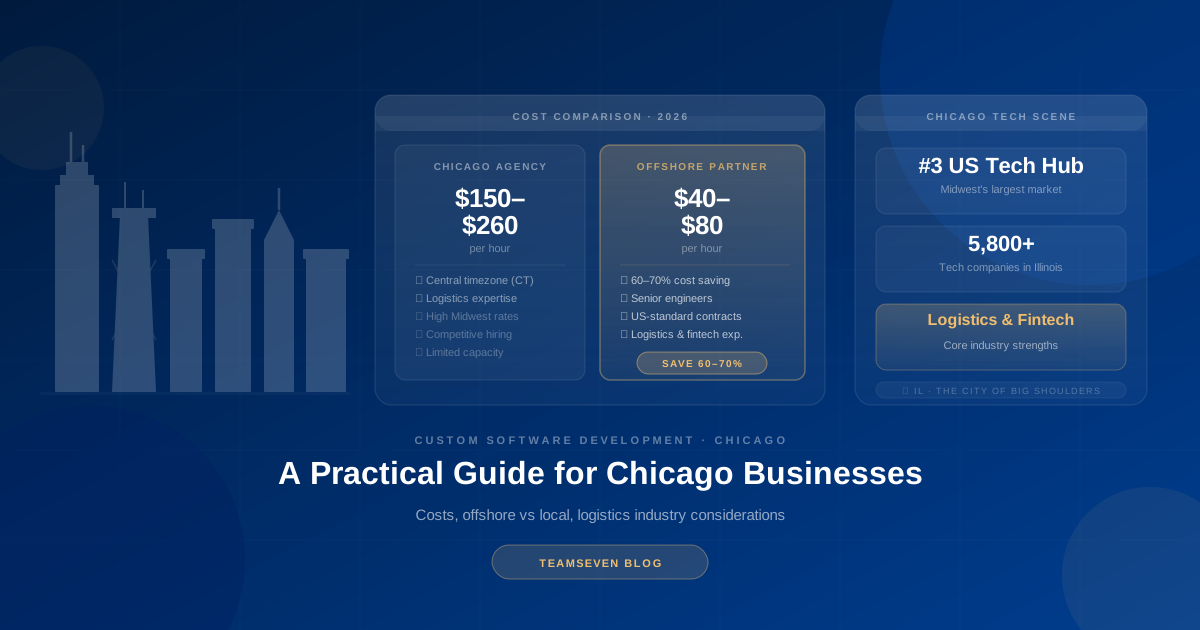
Senior developer rates at Chicago agencies run $120–180/hr. A custom software project that would take 20 weeks with a team of three costs $290,000–$430,000 at these rates. For a logistics company replacing spreadsheets with a custom dispatch system, those numbers don't work.
This is why Chicago businesses across logistics, supply chain, manufacturing, and healthcare are increasingly working with offshore development agencies — not because they're compromising on quality, but because the economics of local agencies don't fit the scope of work they actually need.
Chicago's industries and their software needs
Chicago's business composition shapes the software that Chicago companies need:
Logistics and supply chain. Chicago is one of the largest freight and logistics hubs in North America. O'Hare handles more cargo than almost any other US airport. The city's position as a rail hub means dozens of freight forwarders, 3PLs, and supply chain companies operate here.
These businesses consistently need: custom freight management systems, warehouse management software, carrier integration layers, last-mile delivery platforms, and supply chain visibility tools. The off-the-shelf solutions exist, but they were built for the average logistics operation — not for the specific rate structures, carrier relationships, and client requirements of a Chicago-based forwarder.
Financial services. Chicago is home to the CME Group, CBOE, and a significant financial technology ecosystem. Fintech startups, trading infrastructure companies, and financial data businesses all need custom software — often with specific performance, security, and compliance requirements.
Manufacturing. Chicago's manufacturing sector runs on operational software — production tracking, quality management, supply chain coordination, and ERP systems. Custom manufacturing software is frequently more cost-effective than enterprise platforms at mid-market scale.
Healthcare. Chicago is home to major hospital systems, healthcare startups, and medical research institutions. Custom clinical tools, patient management systems, and healthcare data platforms are regularly commissioned by Chicago-area organizations.
Professional services. Law firms, accounting practices, consulting firms, and professional services businesses across Chicago need custom client management tools, document automation systems, and practice management software that off-the-shelf products don't quite cover.
What custom software development costs for Chicago businesses in 2026
For a Chicago business evaluating custom software, here's an honest cost comparison:
Local Chicago agency:
- Senior developer rate: $120–180/hr
- Typical 16-week MVP project (2 developers + QA): $180,000–$300,000
- Ongoing monthly retainer for a dedicated team: $25,000–$50,000/month
Eastern European agency:
- Senior developer rate: $50–80/hr
- Same 16-week project: $80,000–$130,000
- Ongoing monthly retainer: $12,000–$20,000/month
South Asian agency (Pakistan, India):
- Senior developer rate: $25–55/hr
- Same 16-week project: $40,000–$90,000
- Ongoing monthly retainer: $8,000–$15,000/month
For a Chicago logistics company that needs a custom freight management system — a project that might run 20 weeks with 3 people — the difference between a local Chicago engagement and a professional offshore agency is $200,000–$350,000. That's real money that can fund business growth, additional hiring, or the next product iteration.
The question isn't whether offshore is cheaper — it clearly is. The question is whether the quality difference justifies the price difference. For the right agency and the right type of project, the quality difference is minimal or nonexistent.
The logistics software opportunity specifically
If your Chicago business is in logistics, freight, or supply chain, I want to address this specifically because it's where we see the most consistent need and the most consistent gap in available solutions.
The major logistics software vendors — CargoWise, Magaya, Descartes — built their products for specific segments of the market. CargoWise is excellent for large freight forwarders willing to spend heavily on implementation and licensing. Magaya serves mid-market forwarders reasonably well. But there's a substantial segment of Chicago logistics businesses — regional 3PLs, specialized freight forwarders, mid-size trucking companies, last-mile operators — for whom neither the enterprise platforms nor the generic SME tools fit well.
Custom logistics software built for how your operation actually works, rather than how a vendor thinks it should, is often cost-competitive with enterprise platform licensing when you account for implementation, configuration, ongoing fees, and the cost of workarounds.
A custom freight management system for a Chicago forwarder — covering shipment management, carrier booking, document generation, and client portal — typically runs $50,000–$120,000 with a professional offshore agency. That's often within the same range as the first year's cost of implementing an enterprise platform, with the added benefit that the custom system is specifically built for your workflows.
Time zone considerations for Chicago businesses
Working with an offshore agency from Chicago is essentially the same time zone experience as from the rest of the US. Pakistan is 10–11 hours ahead of Chicago CST/CDT.
The practical approach that works: morning syncs from the Pakistan side (8–9am PKT) land at 9–10pm CST the previous evening in Chicago — too late for real-time calls. The working rhythm is therefore predominantly async:
- End-of-Pakistan-day updates arrive in Chicago inboxes early morning
- Chicago feedback and direction is sent first thing, is actioned during the Pakistan workday
- Weekly or biweekly video calls for sprint review and planning happen at 7–8am CST (4–5pm PKT)
This rhythm works well for Chicago businesses with a project manager or technical lead who can give clear direction and review work efficiently. It works less well for businesses that need constant real-time back-and-forth to define what they're building.
How to choose between local, nearshore, and offshore
For Chicago businesses the decision framework is straightforward:
Choose a local Chicago agency when: Your budget comfortably supports local rates, your project requires constant real-time collaboration, or you have compliance requirements that restrict where development can happen.
Choose a nearshore agency (Eastern Europe) when: Cost is a factor but real-time overlap matters significantly for your working style. 6–8 hour time difference gives meaningful same-day overlap.
Choose an offshore agency (Pakistan, India) when: Cost matters significantly, you can invest in clear requirements and async communication, and you're looking for a long-term development partnership rather than a single sprint.
The honest observation after eight years of working with US clients including Chicago-area businesses: the time zone concern is almost always smaller in practice than it sounds in theory. The first sprint is the adjustment. After that, the rhythm works.
What to prepare before approaching any agency
Chicago businesses that get the best results from software development engagements — local or offshore — tend to have done this preparation:
A written product brief. Two to three pages covering what you're building, who uses it, what the most important three features are, what you have today, and what success looks like in six months. This document separates serious prospects from tire-kickers and helps agencies give you accurate estimates.
A realistic budget range. State it in your first communication. Agencies that know your budget can scope appropriately — a $60,000 project looks different from a $150,000 project, and both can be valid depending on scope.
A clear picture of your current process. Custom software should reflect how your operation works. The better you can document your current workflow — even informally — the faster a development team can build something that fits.
References from your network. If you know other Chicago businesses that have done custom software development — especially in your industry — their experience is invaluable. The Chicago logistics community in particular tends to be well-networked; someone you know has probably been through this.
Muhammad Nabeel is the co-founder of Teamseven, a custom software development agency specializing in logistics, supply chain, and enterprise software. We've been building software for US businesses since 2017. Get in touch if you want to talk through your project.