
I run a custom software agency. My entire business depends on companies choosing to build rather than buy. You should factor that in when reading this post.
I'm telling you this because the honest answer to "custom software vs off-the-shelf" is that off-the-shelf is often the right choice — and an agency that won't tell you that isn't one you should trust to build your software.
This post is a genuine attempt at an honest framework for making this decision. I'll explain when off-the-shelf wins, when custom wins, how to calculate the actual costs of both, and the specific questions that determine which applies to your situation.
The question nobody asks first
Most "custom vs off-the-shelf" discussions start with technology. They should start with business operations.
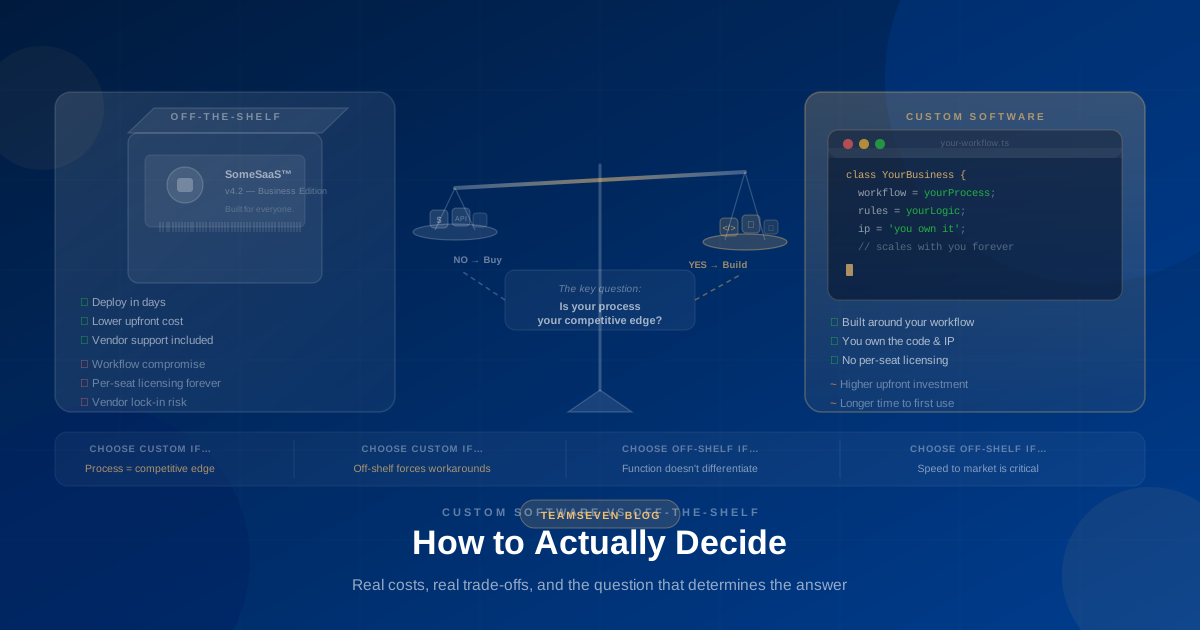
The real question is: does your competitive advantage depend on how you do the thing this software supports?
If the answer is yes — if the specific way you run your operations, serve your customers, or manage your workflows is part of why clients choose you over competitors — then off-the-shelf software will constrain that advantage. It will make you operate like the average company in your industry, because that's who it was built for.
If the answer is no — if the function is a necessary back-office process that doesn't differentiate you — then off-the-shelf software is almost certainly the right choice. You don't need competitive advantage in your accounting software. You need accounting software that works.
Hold that principle while we go through the rest.
What off-the-shelf software actually is
Off-the-shelf software (also called COTS — Commercial Off-The-Shelf) is built for a broad market of customers with similar needs. Salesforce, SAP, Xero, HubSpot, Shopify, Zendesk — these are products built for the average version of the business problem they solve.
This is genuinely powerful. Salesforce has invested billions of dollars solving CRM problems. HubSpot has solved marketing automation for hundreds of thousands of companies. The accumulated product decisions, edge cases handled, and integrations built into these products represent an enormous amount of work you get for a subscription fee.
The trade-off is that you get the average solution to the average version of your problem. If your problem is average, that's great. If your problem has specific dimensions that diverge from the average, you'll spend significant time and energy working around limitations.
What custom software actually is
Custom software is built specifically for your business, your workflows, and your requirements. You define what it does. A development team builds it to that definition.
The advantages are real: the software fits your operations exactly, you own it completely, and no competitor can use the same tool to replicate your operational approach.
The disadvantages are also real: it costs more upfront, it takes time to build, you're responsible for its maintenance, and if your requirements were wrong — if you built the wrong thing — you've paid for a system that doesn't serve you.
Custom software is not inherently better than off-the-shelf. It's better when the specific characteristics of your situation make it the right tool. Identifying whether your situation has those characteristics is what this post is about.
The true cost of off-the-shelf software
Off-the-shelf software is almost never as cheap as the subscription fee suggests. The full cost has several components that are easy to underestimate.
Subscription cost at scale
Entry-level pricing is designed to get you in the door. Enterprise pricing for mature SaaS products can be dramatically different.
Salesforce's entry plan is around $25/user/month. A team of 50 using the Sales Cloud Enterprise edition is $175/user/month — $8,750/month, or $105,000/year. Add professional services, implementation, and customisation fees, and the first year cost for a mid-size Salesforce deployment is commonly $150,000–$300,000. That's before ongoing annual costs.
This doesn't mean Salesforce is the wrong choice — for many businesses it's clearly the right one. But "we'll just use Salesforce" is not automatically the cheaper option when you run the full numbers.
Implementation and configuration cost
Off-the-shelf software for complex business functions requires significant implementation work. The software doesn't arrive ready to use — it arrives ready to configure for your specific setup.
HubSpot, NetSuite, SAP, Salesforce, and most enterprise software vendors have entire ecosystems of implementation partners because the configuration work is substantial. Implementation fees for enterprise software commonly equal or exceed the first year's subscription.
Training and adoption cost
New software requires training. Complex software requires extensive training. When the software doesn't map cleanly to how your team currently works — because it was built for the average workflow, not yours — training takes longer and adoption is slower.
Lost productivity during the transition is a real cost. Teams often run old and new systems in parallel for months. This is expensive time.
Customisation and integration cost
Most off-the-shelf software is extensible — you can configure it, build on its APIs, and integrate it with other systems. This work is not free.
A Salesforce customisation project can cost $50,000–$200,000. A complex Shopify integration with custom functionality can cost $30,000–$80,000. Every time your business has a requirement that the standard product doesn't meet, you either adapt your process to the software or pay to extend the software.
The workaround cost
This is the cost nobody calculates but every business with software that doesn't quite fit is paying.
Workarounds look like:
- Staff maintaining parallel spreadsheets to track things the software can't
- Manual processes running alongside automated ones for specific edge cases
- Staff learning convoluted ways of entering data because the software doesn't handle your workflow naturally
- Regular exports and imports between systems that don't talk to each other
- Time spent in monthly reconciliation because the software produces reports that don't match how your business categorises things
A team of 10 spending an average of 30 minutes per day on software workarounds is 5 staff-hours per day. At a fully-loaded cost of $40/hour, that's $52,000 per year in hidden workaround cost. Most businesses don't measure this because it's diffuse — it's not a line item, it's just how things work.
Vendor dependency and price risk
When your business is built on off-the-shelf software, you're dependent on the vendor's pricing, product direction, and continued existence.
Vendors raise prices. They discontinue features. They get acquired and the acquiring company changes the product. They go out of business. Any of these events creates a disruption that you can't control.
This isn't an argument against off-the-shelf software — it's a risk to understand and factor into the decision.
The true cost of custom software
Custom software has its own full-cost picture that's easy to underestimate in the other direction.
Build cost
This is the number people focus on — the development agency quote. For typical business software, this ranges from:
- Simple internal tool: $15,000–$40,000
- Mid-complexity business application: $40,000–$100,000
- Complex operational platform: $80,000–$250,000+
(Ranges vary significantly by team location — see our mobile app cost post for a full breakdown of how geography affects development costs.)
Time cost
Custom software takes time to build. A mid-complexity system takes 16–28 weeks from project start to deployment. During this time, you're operating without the system, using whatever workaround currently exists.
If the problem is urgent, this timeline cost is real. If you have an existing system that works adequately while you build a better one, it's manageable.
Maintenance cost
Custom software doesn't maintain itself. Operating systems update, security vulnerabilities get patched, integrations break when third parties change their APIs, and your business requirements evolve.
Budget 15–20% of your initial build cost per year for ongoing maintenance. A system that cost $80,000 to build needs $12,000–$16,000 per year in maintenance budget. This is not optional — unmaintained software degrades and eventually fails.
Evolution cost
Custom software built for your current operations needs to evolve as your operations change. When you add a new service, enter a new market, or change a workflow, the software needs to change with it.
This is an advantage over off-the-shelf software in one sense — you're not waiting for a vendor to prioritise your request. But it's a cost in another — every change requires development time and budget.
The wrong-requirements risk
This is the unique risk of custom software: if you built the wrong thing, you've paid full price for a system that doesn't work for you.
Wrong requirements happen when: the problem isn't well-understood before development starts, key stakeholders aren't involved in defining the system, or requirements change significantly during development.
Good agencies mitigate this through thorough discovery phases, iterative development with regular client review, and honest pushback when requirements seem wrong. But it's a real risk that off-the-shelf software doesn't have in the same way — if Xero doesn't work for your accounting needs, you stop subscribing. If the custom accounting system you built doesn't work, you've spent the budget and need to figure out what to do next.
The decision framework
With full-cost pictures for both options, here's the framework for making the decision:
Question 1: Does a suitable off-the-shelf solution exist?
Before building anything, do a thorough market search. For many business functions, there are 5–20 competing products with mature feature sets.
"Suitable" means it covers your core requirements without significant customisation. If making it work for your business requires 6 months of configuration and $80,000 in implementation fees, you're no longer buying off-the-shelf software — you're buying a platform and building on top of it.
If a suitable off-the-shelf solution exists: continue to Question 2. If one doesn't exist: custom software is likely the answer.
Question 2: Does your process need to conform to the software, or does the software need to conform to your process?
Every off-the-shelf software implementation requires some process adjustment. The software has opinions about how things should work, and you'll adapt your workflow to match those opinions in some areas.
The question is whether that adaptation is:
Acceptable: "We'll need to change how we categorise expense types to match Xero's categories. That's fine, the categories are equivalent."
Unacceptable: "We'd need to completely restructure how we manage jobs and billing to fit this system. Our current approach is central to how we deliver our service and we can't change it."
If the required process adaptation is in peripheral areas that don't affect how you serve clients or operate your core business, off-the-shelf wins.
If the required adaptation would change something central to your operational approach — how you price, how you schedule, how you manage client relationships, how you deliver your service — custom software wins.
Question 3: What does the 3-year total cost of ownership look like for each option?
Run the numbers honestly, including:
Off-the-shelf 3-year TCO:
- Year 1: Implementation + configuration + training + subscription
- Years 2–3: Subscription + maintenance + customisation + estimated workaround cost
- Vendor risk factor: what would switching cost if required?
Custom software 3-year TCO:
- Year 1: Build cost + deployment
- Years 2–3: Hosting + maintenance + evolution/new features
- Staff efficiency gain: what is the workaround cost you're eliminating?
In many cases, the 3-year TCO comparison is closer than the initial build cost comparison suggests. When you account for implementation fees, enterprise subscription costs, and workaround cost elimination, custom software often becomes cost-competitive within 2–3 years.
Question 4: What is the cost of the current situation?
This is the question most decision frameworks miss.
If you're considering new software, it's because your current situation is inadequate. What is that inadequacy costing you?
- Manual work that could be automated: what is the staff cost?
- Errors and rework from process gaps: what is the cost per incident?
- Client experience limitations: what is the cost in client retention?
- Operational constraints: what growth are you unable to pursue?
- Competitive disadvantage: what contracts are you losing?
If the current situation costs $150,000 per year in aggregate and a custom system costs $100,000 to build with $20,000/year in maintenance, the payback period is under 12 months. That's a straightforward decision.
If the current situation costs $5,000 per year in inefficiency and a custom system costs $100,000 to build, the payback period is 20 years. Off-the-shelf wins unless there are other factors.
Question 5: Is your business ready to be a software client?
This is the question nobody in our industry talks about but almost everyone thinks about.
Custom software development is a collaborative process. It requires:
- Someone on your side who can make decisions and give clear feedback
- The ability to define what you need (not just what you don't like about what you have)
- Time investment from your team during discovery and review cycles
- The capacity to manage change across your organisation when the new system arrives
If you don't have these things — if your organisation isn't ready for this kind of project — off-the-shelf software with its established implementation playbook is probably a better fit for right now.
The cases where off-the-shelf almost always wins
Accounting and finance: Xero, QuickBooks, Sage. The problem is well-defined, the solutions are mature, and accounting software doesn't differentiate businesses. Unless you have truly unusual financial workflows, use what exists.
CRM for standard sales processes: If your sales process is standard — prospect, nurture, propose, close — HubSpot or Salesforce does this well. Custom CRM is warranted only when your client relationship management is genuinely unlike the standard model.
HR and payroll: The compliance requirements for payroll are complex and jurisdiction-specific. Off-the-shelf payroll software has already solved the compliance problems. Building custom payroll from scratch is almost never justified.
Email and marketing automation: Mailchimp, HubSpot, ActiveCampaign. Mature, feature-rich, cheap. Custom email infrastructure is for companies operating at a scale where the economics of third-party services break down.
Standard e-commerce: Shopify handles most e-commerce needs with a large ecosystem of extensions. Custom e-commerce platforms make sense for unusual requirements — complex B2B pricing models, custom manufacturing workflows, unusual checkout requirements. Standard D2C retail: use Shopify.
The cases where custom software almost always wins
Your core operational workflow is your differentiator. If how you manage jobs, schedule resources, price services, or deliver outputs is the reason clients choose you, software that forces you to change that workflow is software that erodes your competitive advantage.
Your industry has specific requirements no off-the-shelf product addresses. Niche industries with specific regulatory requirements, unusual data models, or unique workflow patterns often don't have suitable off-the-shelf options. We've built logistics platforms for freight forwarders, compliance tools for regulated industries, and clinical software for healthcare research — not because custom was the fashionable choice, but because nothing suitable existed.
You're building a software product to sell. If your business model is selling software to other businesses, you're building a product — off-the-shelf is your competition, not your solution.
Integration requirements that no off-the-shelf product supports. If your business depends on tight integration with systems that existing products don't connect to — legacy enterprise systems, industry-specific platforms, custom hardware — custom software is often the only viable option.
The long-term cost of workarounds exceeds the build cost. When you run the 3-year TCO and the workaround cost elimination makes custom software clearly cost-competitive, the economics favour building.
The hybrid approach most businesses miss
Custom software and off-the-shelf software aren't mutually exclusive. Many businesses use a combination:
Off-the-shelf for peripheral functions, custom for core operations. Use Xero for accounting, HubSpot for marketing, but build a custom operations management system for the core workflow that differentiates you.
Off-the-shelf as a foundation, custom on top. Some platforms are designed to be extended — Salesforce, Shopify, Zendesk. Building custom functionality on top of an established platform gives you the maintenance and compliance benefits of off-the-shelf with the specificity of custom in the areas that matter.
Custom integration layer between off-the-shelf systems. If you use three off-the-shelf systems that don't integrate natively, a custom integration layer can connect them without replacing any individual system.
The question isn't always build or buy — it's often build and buy, in the right combination.
A note on timing
Off-the-shelf software is often the right choice at the start of a business and custom software becomes the right choice as the business grows.
At the start, your processes are still being defined. Custom software built around processes that aren't yet stable will need to be rebuilt when those processes evolve. Off-the-shelf software lets you validate your operational model before encoding it in custom code.
As the business grows, processes stabilise, volume increases, and operational differentiation becomes clearer. At this point, the limitations of off-the-shelf software become more apparent and the ROI of custom software improves.
The businesses that benefit most from custom software are typically those that have been operating for 2–5 years, have a clear understanding of their core workflows, and have reached a scale where the cost of workarounds is significant.
The honest bottom line
If you're asking "custom or off-the-shelf?" the right answer usually isn't one or the other. It's:
Use off-the-shelf for everything that doesn't differentiate you. Invest in custom software for the operational core that does.
If you're not sure which category something falls into, the workaround test is a reliable proxy: if your team has developed workarounds for your current software, and those workarounds are in functions central to how you serve clients, that's a strong signal the software doesn't fit your operation — and the cost of fixing that is probably worth calculating properly.
We tell this to prospects regularly. Sometimes they go find an off-the-shelf solution we recommended. That's fine. The clients who come to us having genuinely evaluated both options and concluded that custom is the right answer are the ones who get the most value from the work we do together.
Muhammad Nabeel is the co-founder of Teamseven, a custom software development agency based in Lahore, Pakistan. We've been building bespoke software for businesses since 2017. If you want an honest assessment of whether your situation warrants custom software, get in touch — we'll tell you honestly either way.