
Houston is a city built around operationally complex industries. Energy, petrochemicals, logistics, healthcare, and manufacturing are the industries that define Houston's economy — and all of them run on software that needs to be as specific as the operations it supports.
This creates a distinctive software development challenge. Houston businesses in these industries don't need generic business software. They need applications that understand multi-modal freight routing, or refinery maintenance scheduling, or the specific requirements of a petrochemical supply chain. Off-the-shelf software, built for the average business in the average industry, frequently doesn't fit.
At the same time, Houston's enterprise culture — cautious, relationship-driven, skeptical of unproven vendors — means that bringing in a software development agency is a significant commitment. Getting it wrong has real operational consequences.
This guide is for Houston businesses — operations managers, IT directors, and founders — who are evaluating custom software development seriously.
Houston's industries and their software needs
Energy and petrochemical. Houston's energy sector — upstream oil and gas, refining, petrochemical manufacturing, energy trading — is one of the largest concentrations of industrial complexity in the world. The software that runs these operations ranges from legacy systems maintained for decades to new platforms being built to modernize operations, improve safety, and meet energy transition requirements.
Custom software in this sector includes: production monitoring and reporting systems, maintenance management platforms, supply chain and logistics tools for materials and equipment, trading and risk management systems, compliance and regulatory reporting tools, and increasingly, software for renewable energy operations.
Logistics and freight. Houston is a major freight hub — the Port of Houston is one of the busiest in the US, and the city's position between the Gulf Coast and inland US makes it a critical node in national logistics networks. Freight forwarders, 3PLs, trucking companies, and port-adjacent logistics businesses all operate here with specific software needs that generic platforms don't address.
Custom logistics software for Houston businesses includes: freight management systems with Gulf Coast carrier integration, customs and trade compliance tools, port operations software, and supply chain visibility platforms for energy sector logistics.
Healthcare. Houston's Texas Medical Center is the largest medical complex in the world. The concentration of hospitals, research institutions, and healthcare organizations in Houston creates significant demand for custom healthcare software — clinical research platforms, patient management systems, healthcare analytics, and medical imaging software.
Manufacturing. Houston's chemical and manufacturing sector requires operations software — production tracking, quality management, maintenance scheduling, environmental compliance — that standard ERP systems often don't handle well at the scale and complexity of Houston's industrial operations.
The honest case for custom software in Houston's industries
Houston businesses often approach custom software development with one of two orientations: "we've outgrown what exists" or "nothing suitable exists for what we do."
Both are legitimate reasons to build custom software, but they have different implications.
"We've outgrown what exists" means you've been using off-the-shelf software — a commercial freight management system, a standard ERP, a generic CRM — and your operations have grown or specialized to the point where the software is a constraint rather than an enabler. The workarounds are significant, the manual processes are expensive, and the gap between what the software does and what you need it to do is costing you operationally.
In this case, custom software is justified when the total cost of the workarounds — in staff time, errors, and operational constraints — exceeds the cost of building something that fits. For many Houston businesses in logistics and energy, this calculation becomes compelling earlier than you might expect.
"Nothing suitable exists" means your operational requirements are specific enough that no commercial product addresses them. This is genuinely common in Houston's industrial sectors — the specific combination of regulatory requirements, operational complexity, and integration needs that a Houston-area energy company or port-adjacent logistics operation has may simply not have a commercial product equivalent.
In this case, custom software isn't a choice between build and buy — it's a choice between build and workaround. And the workaround is usually more expensive than it looks.
What custom software development costs for Houston businesses
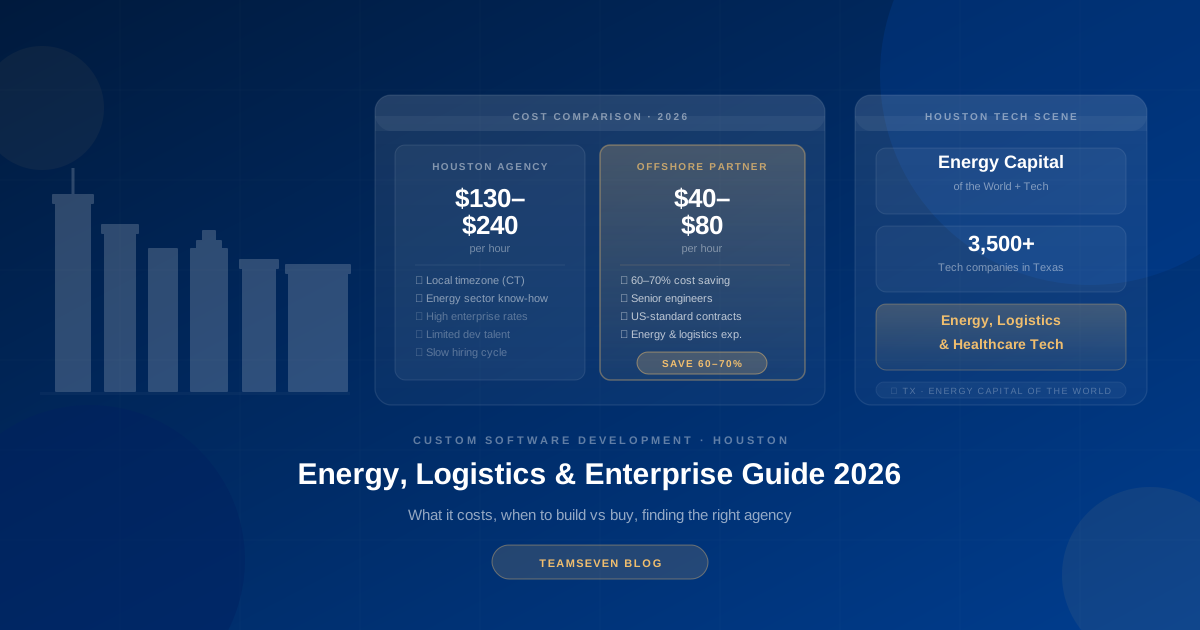
Houston's local IT consulting and software development market is strong but expensive. Large systems integrators — Accenture, IBM, Deloitte — serve Houston's major energy clients at enterprise pricing. Mid-size Houston agencies charge $100–160/hr for senior developer time.
For a mid-size Houston logistics company that needs a custom freight management system, the cost breakdown:
Houston local agency (16-week project, 3 people): $175,000–$300,000
Eastern European agency (same scope): $75,000–$130,000
South Asian agency (same scope): $40,000–$90,000
The offshore cost advantage is significant. A Houston logistics company that builds a custom freight management platform for $60,000–$80,000 offshore, versus $200,000+ locally, has $120,000–$140,000 that funds additional hiring, business development, or the next phase of the platform.
The quality question: professional offshore agencies with verified reviews, relevant portfolio work, and referenceable clients deliver production-quality software. The due diligence process to find these agencies matters — but it's due diligence, not a gamble.
What Houston's industries specifically need from a development partner
Houston businesses in energy, logistics, and manufacturing have requirements that generic software agencies may not be equipped to handle:
Domain understanding. A development agency building freight management software for a Houston-area 3PL needs to understand what a bill of lading is, why fuel surcharges are complex, and what makes carrier integration in the Gulf Coast market different from carrier integration anywhere else. Agencies without logistics experience learn this on your time and budget.
Integration capability. Houston's industrial operations run on legacy systems — SCADA for energy operations, EDI for logistics, legacy ERP systems for manufacturing. Custom software often needs to integrate with these systems. This is specialist work that requires specific experience.
Security and compliance. Energy sector software, healthcare software, and financial software all have specific security and compliance requirements. HIPAA for healthcare, SOC 2 for financial services, OT security considerations for energy. A development agency that hasn't navigated these before will make expensive mistakes.
Reliability requirements. Houston industrial operations have reliability requirements that consumer software doesn't. A freight management system that goes down during peak shipping hours has real operational and financial consequences. Architecture decisions that affect reliability — redundancy, failover, monitoring — need to be made correctly from the start.
When evaluating agencies, ask specifically: have you built software for energy, logistics, or industrial operations before? What are the most complex integration challenges you've handled? How do you approach security requirements for regulated industries?
The time zone reality from Houston
Houston Central Time is 10–11 hours behind Pakistan. The working rhythm is essentially the same as from Chicago — predominantly async, with weekly video calls at the boundary between working hours (7–8am CST / 5–6pm PKT).
For Houston businesses evaluating this:
The async rhythm works well for Houston's professional culture, which tends toward detailed written communication rather than the constant real-time collaboration style of some startup environments. Operations managers and IT directors who are accustomed to structured project communication find the async offshore model relatively natural.
The time zone gap is more challenging for projects where requirements are still being defined in real time. Houston businesses that have clear operational requirements before development starts — which is common in established industrial businesses — tend to have smoother offshore development experiences.
A note on working with offshore agencies in Houston's business culture
Houston's business culture is relationship-driven and reputation-conscious. The due diligence standards that apply to selecting any major vendor should apply to selecting a software development agency.
References matter more in Houston's business culture than in many other markets. Before hiring any software development agency — local or offshore — verify their work. Call their references. Visit their portfolio clients' websites. Evaluate whether the work described matches what you need built.
IP ownership, contract clarity, and milestone-based payment structures are non-negotiable. Any professional agency — regardless of location — should readily agree to full IP assignment on final payment, a clear NDA, and a payment schedule tied to deliverables rather than calendar dates.
The agencies that resist standard professional contractual terms are telling you something important. Walk away.
Muhammad Nabeel is the co-founder of Teamseven, a custom software development agency based in Lahore, Pakistan. We specialize in logistics, supply chain, and enterprise software. We've been building operational software for US businesses since 2017. Get in touch if you want to discuss your Houston business's project.