
If you've searched for web application development costs, you've already noticed the problem: every answer is either uselessly vague ("it depends") or suspiciously specific ("starting from $499"). Neither helps you budget a real project.
This post gives you real numbers, broken down by web application type, with honest explanations of what drives costs up and what's genuinely negotiable. I run a web application development agency. I have an obvious interest in you hiring us. I'll try to be useful anyway.
Web application vs website — the distinction matters for cost
Before getting to numbers, this matters: a web application and a website are not the same thing, and they cost very different amounts.
A website presents information. The content is the same for every visitor. Someone reads it, maybe fills out a contact form, and leaves. Cost: hundreds to low thousands.
A web application processes information. Users log in. They see data specific to them. They complete tasks, submit forms that trigger business logic, interact with other users, or manage workflows. The application does different things for different users. Cost: tens of thousands to hundreds of thousands.
If your users log in, your users see personalised data, or your users complete multi-step workflows — you're building a web application. The rest of this post is for you.
The quick answer
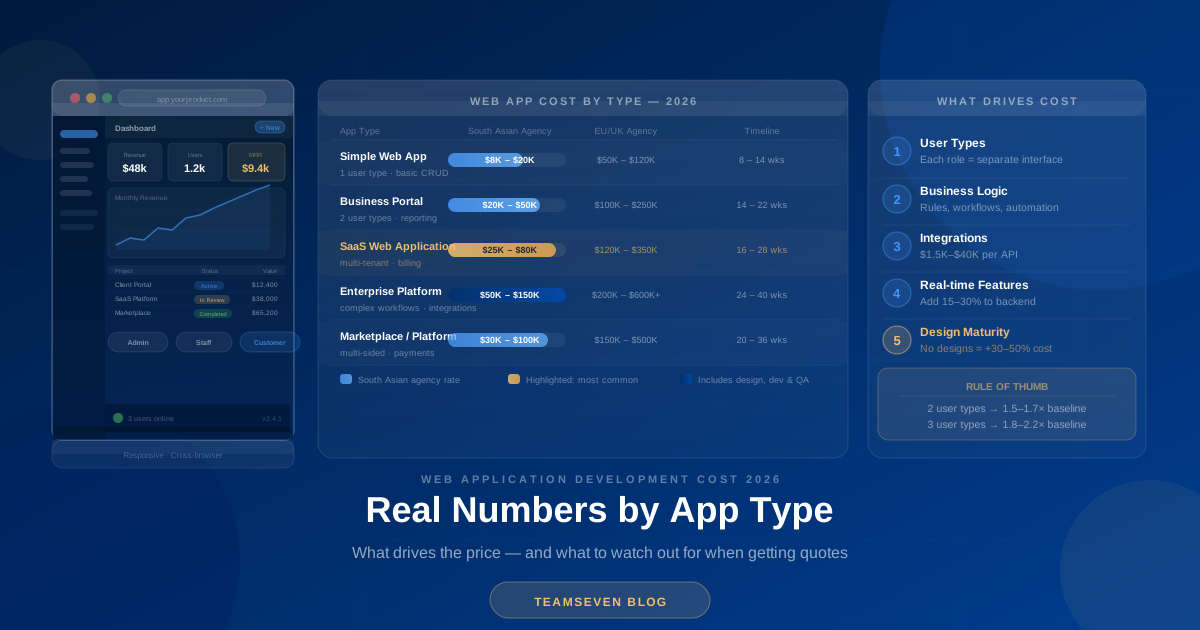
Web application development cost by type and team location:
| Application Type | South Asian Agency | Eastern European Agency | US/UK Agency | Timeline |
|---|---|---|---|---|
| Simple web app (1 user type, basic CRUD) | $8K–$20K | $20K–$45K | $50K–$120K | 8–14 weeks |
| Business portal / dashboard (2 user types, reporting) | $20K–$50K | $45K–$90K | $100K–$250K | 14–22 weeks |
| SaaS web application (multi-tenant, billing) | $25K–$80K | $60K–$150K | $120K–$350K | 16–28 weeks |
| Enterprise web platform (complex workflows, integrations) | $50K–$150K | $100K–$250K | $200K–$600K+ | 24–40 weeks |
| Marketplace / multi-sided platform | $30K–$100K | $70K–$180K | $150K–$500K | 20–36 weeks |
Ranges for professional agencies with verified track records. Include design, development, QA, and deployment. Exclude ongoing hosting, third-party service costs, and post-launch maintenance.
What actually drives web application cost
Factor 1: Number of user types
The single biggest cost driver most people underestimate. Every user type requires:
- A separate onboarding flow
- A separate interface and navigation
- A separate permission model
- A separate set of features
A web application with one user type (everyone sees the same thing) is one application. A web application with three user types — admin, staff, and customer — is effectively three interfaces sharing a backend.
Rough cost multiplier:
- 1 user type: baseline cost
- 2 user types: 1.5–1.7x baseline
- 3 user types: 1.8–2.2x baseline
- 4+ user types: assess each one individually
Before scoping your project, list every distinct type of person who will use your application and what each type can do that the others cannot. This single exercise will make your quote significantly more accurate.
Factor 2: Business logic complexity
Business logic is everything your application needs to do that isn't simply storing and retrieving data. Pricing calculations. Approval workflows. Scheduling algorithms. Notification triggers. Compliance rules. Automated report generation.
Simple business logic: a contact form that sends an email. Minimal development time.
Complex business logic: a pricing engine that calculates rates based on 15 variables, applies tiered discounts for specific customer segments, accounts for promotional periods, and produces an auditable pricing record for every transaction. Weeks of development time.
Most founders significantly underestimate their business logic complexity because they know how it works intuitively — until they have to explain it precisely enough for a developer to implement it. The exercise of writing out your business rules in plain language before getting quotes is one of the most valuable things you can do.
Factor 3: Third-party integrations
Every external service your web application connects to is an integration project. Stripe for payments, Xero for accounting, Salesforce for CRM, carrier APIs for logistics, authentication providers for SSO, email platforms for notifications.
Integrations consistently cost more and take longer than initial estimates suggest. Reasons:
API quality varies enormously. Some external APIs are excellently documented, stable, and well-behaved. Others have inconsistent responses, poor documentation, breaking changes without notice, and rate limits that create architectural constraints.
Edge cases multiply. What happens when a Stripe payment partially processes before a network failure? When a carrier API returns an unexpected response format? When an accounting integration fails midway through a sync? Handling these states properly takes significant development time.
Rough cost per integration:
- Simple, well-documented REST API (Stripe, Twilio, SendGrid): $1,500–$5,000
- Complex API with custom data mapping: $5,000–$15,000
- Legacy system integration (SOAP, EDI, proprietary database): $10,000–$40,000+
If your project requires 5+ integrations, treat them as a significant separate cost line rather than a minor addition.
Factor 4: Real-time requirements
Applications that update in real-time — live dashboards, collaborative tools, messaging systems, tracking interfaces — require fundamentally different architecture than applications where data is fetched on page load.
WebSocket connections, event-driven backends, efficient state management on the frontend — these aren't difficult to build, but they take meaningfully more time than standard request-response architecture.
If your application needs to show live data, expect to add 15–30% to the backend development estimate.
Factor 5: Design starting point
Building from a complete, approved design system is fast. Building from rough wireframes while simultaneously doing development is slow and expensive.
Every design decision made during development costs roughly 5x what it would have cost to make during the design phase. A poorly specified design becomes an extended series of stakeholder review cycles, developer time spent waiting for answers, and rework of completed functionality.
Rough cost and time impact by design maturity:
- Full high-fidelity designs approved before development: fastest timeline, most accurate estimate
- Wireframes only: add 20–30% to timeline and cost
- Starting from scratch (no designs): add 30–50% to timeline, and treat design as a separate phase that happens before development
Cost breakdown by web application type
Simple web application
What it is: Single user type. Core CRUD functionality (create, read, update, delete records). Basic authentication. No real-time features. Minimal integrations (maybe one — email or Stripe).
Examples: Simple booking tool. Internal inventory tracker. Basic content management system. Customer feedback collector.
What's typically included:
- User authentication (registration, login, password reset)
- Core data model with basic CRUD operations
- Simple dashboard or list views
- Basic email notifications
- Deployment on cloud infrastructure
What drives cost toward the higher end: Custom authentication requirements, complex data validation, file upload and processing, multiple views of the same data.
Reality check: Even "simple" web applications involve authentication, hosting infrastructure, email delivery, browser testing, and deployment. The floor for professionally built web applications is real — below $8,000 at South Asian agency rates, you're getting work that corners were cut to deliver.
Business portal or dashboard
What it is: Multiple user roles with different capabilities. A meaningful set of business functionality. Reporting or data visualization. Likely 2–4 external integrations.
Examples: Client portal for a professional services firm. Operations dashboard for a logistics company. HR management system. Project management tool. Partner portal.
What's typically included:
- Multi-role authentication and authorization
- Role-specific interfaces and permissions
- CRUD operations across multiple data entities with relationships
- Dashboard with charts and reporting
- 2–4 third-party integrations
- Email notifications and alerts
- Admin panel for system management
- Export functionality (CSV, PDF)
What drives cost toward the higher end: Complex permission models, real-time data, large number of integrations, complex reporting requirements, data migration from existing systems.
The cost people miss: Data migration. If you're replacing an existing system and need to move historical data into the new application, this is its own project with its own timeline and cost. Underestimating data migration is one of the most common budget surprises in business portal projects.
SaaS web application
What it is: Multi-tenant architecture where each client company has their own isolated workspace. Subscription billing. User management at the company level. Potentially a public-facing marketing site connecting to the application.
Examples: B2B SaaS product for any industry. Subscription analytics tool. Team collaboration platform. Industry-specific operational SaaS.
What's typically included:
- Multi-tenant data architecture (one of three models — see our SaaS architecture post)
- Company-level account management (invite team members, manage roles)
- Stripe billing with subscription plans, trial periods, and upgrade/downgrade flows
- User authentication and session management
- Core SaaS features (varies by product)
- Admin dashboard for system operators
- Customer-facing documentation or help centre
What drives cost toward the higher end: Complex subscription models (usage-based billing, custom plans), many integrations, complex feature set, high-volume data processing requirements.
The billing layer is always more complex than it looks. Plan upgrades mid-cycle (what do they owe for the remaining days?), failed payment handling, dunning process, invoice customisation for enterprise clients, proration calculations — Stripe handles the transactions but your application has to handle all the states. Budget for it.
Enterprise web platform
What it is: Complex multi-module platform with significant business logic, multiple user types with intricate permission models, multiple integrations including legacy systems, and performance requirements at meaningful scale.
Examples: ERP replacement. Supply chain management platform. Multi-location operations management system. Enterprise workflow automation platform.
What's typically included:
- Complex authorization model with fine-grained permissions
- Multiple application modules with distinct functionality
- Integration with legacy enterprise systems (ERP, CRM, databases)
- Advanced reporting and analytics
- Audit logging and compliance features
- High-availability deployment architecture
- Comprehensive documentation
What drives cost toward the higher end: Legacy system integration (always the most unpredictable cost item), compliance requirements, data migration from complex existing systems, very large numbers of user types and workflow states.
A note on legacy system integration: We've built integrations with systems that hadn't been updated in 15 years, had no documentation, and had no API — requiring reverse-engineering the data model by observing behavior. If you're replacing an existing enterprise system, treat legacy integration as a discovery item with a range estimate, not a fixed line item. The real cost only becomes clear once someone has actually looked at the system.
Marketplace or multi-sided platform
What it is: Two or more distinct user groups interacting through your platform. Buyers and sellers. Service providers and clients. Supply and demand. Trust, reviews, and transactions between parties.
Examples: Service marketplace. B2B procurement platform. Freelance platform. On-demand booking platform. Rental marketplace.
What's typically included:
- Separate onboarding and interfaces for each side
- Listing or profile management for supply side
- Search, filtering, and discovery for demand side
- Messaging between parties
- Payment processing with split payments or escrow
- Trust system (reviews, ratings, verification)
- Commission or fee management
- Admin panel for marketplace operations
What drives cost toward the higher end: Payment complexity (escrow, split payments, payouts to multiple parties), complex matching or pricing logic, identity verification requirements, high content volume requiring moderation infrastructure.
The matching problem: Marketplaces that do algorithmic matching — connecting supply and demand based on location, availability, skills, pricing — add significant backend complexity. Even simple availability-based matching (find available providers in a radius on a given date) involves geospatial queries, calendar logic, and state management that aren't trivial.
Hidden costs that consistently surprise clients
Ongoing hosting: A small web application on AWS or GCP runs $50–$300/month. A medium-complexity application with meaningful data storage and traffic: $200–$800/month. Large applications: significantly more. Budget for 12 months upfront.
Third-party service subscriptions: Stripe takes transaction fees. Twilio charges per SMS. SendGrid charges per email after the free tier. Every API your application calls has a cost model that scales with usage.
Browser and device testing: Professional web applications are tested across Chrome, Firefox, Safari, and Edge — and on mobile browsers. This takes time and is sometimes excluded from junior agency quotes to reduce the price.
Post-launch iteration: Your users will behave differently than you expected. Features that seemed essential will go unused. Features you didn't think of will be requested immediately. Budget 20–30% of your initial build cost for the first 6 months of post-launch iteration.
Security maintenance: Web applications require ongoing security maintenance — dependency updates, security patches, monitoring. Budget 10–15% of initial build cost per year.
A realistic first-year budget: Initial build cost + 40–50% for everything else.
What's negotiable and what isn't
Negotiable:
- Scope — the most effective negotiation is always on what's in v1 versus what goes to v2. A focused MVP at 60% of the cost delivers 80% of the value in most cases.
- Payment terms — milestone-based payments are standard and negotiable.
- Timeline — longer timelines sometimes allow for lower cost (not always, but sometimes).
- Technology choices — some technology stacks are faster to develop with for specific use cases.
Not negotiable (without quality consequences):
- QA and testing — removing testing from scope saves money and guarantees production bugs.
- Security fundamentals — authentication done properly, input validation, encrypted data.
- Deployment infrastructure — production environments need monitoring, backups, and appropriate redundancy.
- Post-launch support window — bugs appear after launch. A professional agency guarantees 30 days of bug fixes.
The question that reveals the most about an agency
After receiving any web application development proposal, ask this:
"What's the riskiest part of this project, and how are you planning to handle it?"
An agency that has actually thought about your project will have a specific answer — a particular integration that's complex, a business logic requirement that needs validation, a data migration concern, an authentication requirement that creates architectural constraints.
An agency that hasn't thought about your project will give you a generic answer or say there are no particular risks.
The answer to this question is more predictive of project success than anything else in the proposal.
Muhammad Nabeel is the co-founder of Teamseven, a web application development agency based in Lahore, Pakistan. We've been building custom web applications since 2017. Get in touch for a real quote on your specific project.