🇬🇧 EdTech / SEND · 2026
E2P+SEND: Early Years to Primary Assessment & SEND Platform
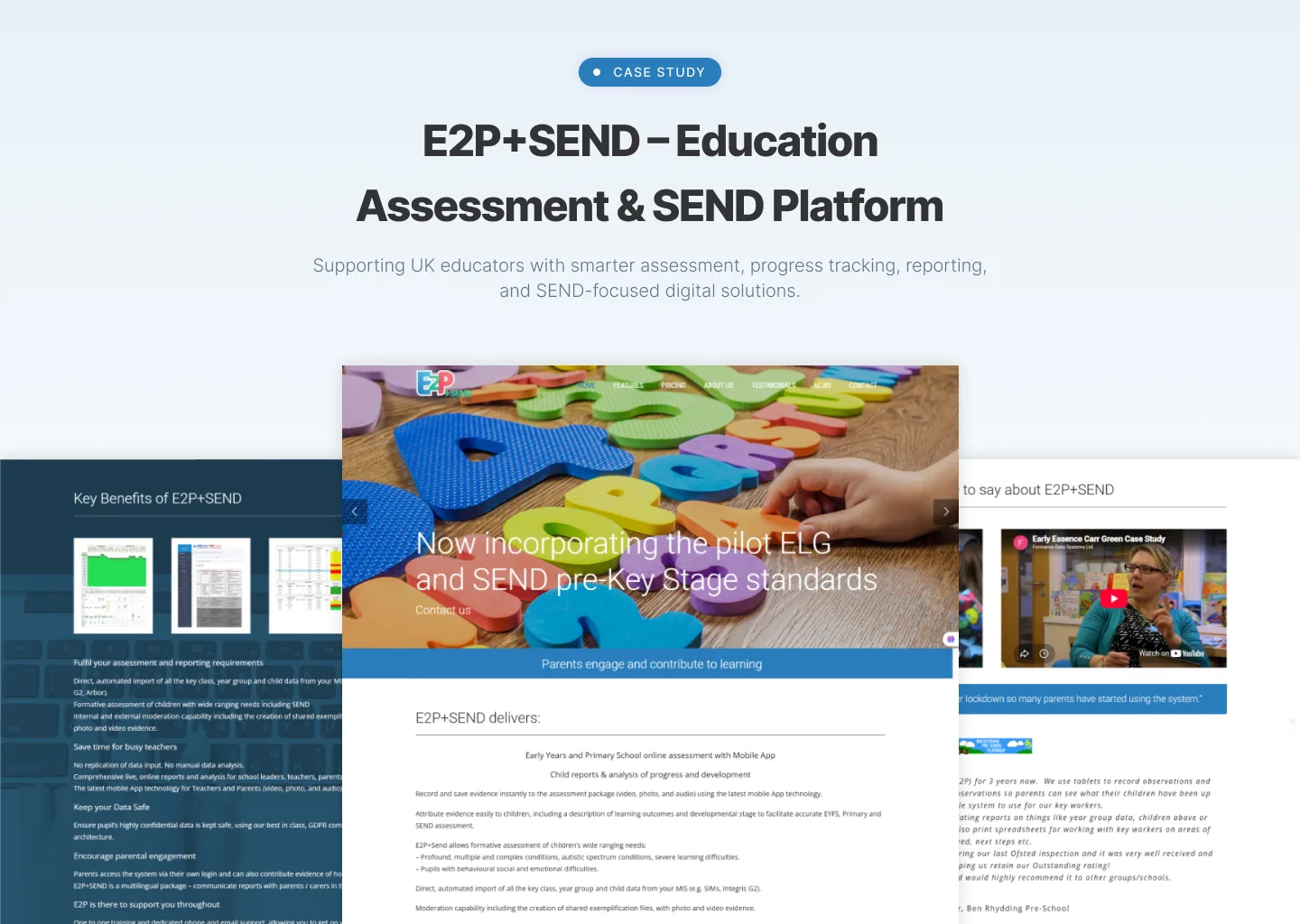
We built E2P+SEND: a UK early-years-to-primary assessment and SEND (Special Educational Needs and Disabilities) management platform used by schools to track child development, manage EHCP reviews, and generate inspection-ready reports. Built with teachers who have real senior-leadership experience in UK schools, from student profiles through to a full evidence gallery.
The problem
Early years and primary assessment in the UK runs on frameworks with hundreds of individual outcomes, tracked per child, across every stage from nursery through to the end of primary school. On top of that baseline complexity sits SEND, Special Educational Needs and Disabilities, provision, which is strictly regulated, multi-stage, and involves EHCP (Education, Health and Care Plan) reviews that legally require accurate, evidenced records.
For the schools E2P+SEND set out to serve, that meant two problems stacked on top of each other. First, cognitive load: assessment frameworks are inherently dense, and forcing a teacher to navigate that density through spreadsheets, paper logs, and shared drives turns a two-minute observation into a fifteen-minute admin task. Second, process risk: SEND workflows (multi-stage approval, review, and evidencing) were happening over email threads and paper trails, which is exactly the kind of process that fails an audit or an Ofsted inspection when someone can't produce the paper trail on demand.
The user base compounded the difficulty. A single platform had to serve teachers doing day-to-day observation, senior leadership teams (SLT) needing whole-school and whole-cohort views, SENCOs running formal SEND processes with statutory obligations, and external professionals (therapists, consultants, local authority staff) who needed access to specific children's records without access to everything else. Permissions here aren't a nice-to-have; a SENCO's workflow and a classroom teacher's workflow are different products wearing the same login screen.
And underneath all of it: software fatigue in schools is real. Teachers are already managing MIS systems, safeguarding platforms, and communication tools. Anything new had to feel closer to a consumer app than another enterprise system to get adopted at all: while still handling GDPR-sensitive child data, much of it about medical needs and disabilities, to the standard that protection demands.
How we built it
We treated the platform's core structure as five connected modules hanging off one dashboard rather than a single monolithic app: Student Profiles (personal and medical/care information), Assessment (point-in-time framework logging), Progress Analysis (group trends and individual trajectories over time), SEND Management (EHCP reviews and intervention logs), and an Evidence Gallery (photo and video evidence, tagged to the relevant outcome). Getting this information architecture right (deep nested framework structures presented through a flat, approachable navigation) was the foundation everything else sat on.
Four design problems recurred throughout, and we solved each the same way every time it appeared. Complex information got progressive disclosure: hide secondary data until it's relevant to the task in front of the user, rather than surfacing everything a screen could theoretically show. Data-heavy screens got custom table components with sticky headers and contextual side panels, so a teacher can edit a record without a full page reload breaking their flow. Different workflows for different roles got a role-based permission system that reshapes the UI itself depending on whether you're logged in as a teacher or a SENCO, not just hiding buttons, but presenting a different, role-appropriate interface. And keeping 200+ unique views visually consistent across that variation required a real component library, built once and reused everywhere, rather than each screen being designed in isolation.
For SEND specifically, we built structured multi-stage review and approval workflows directly into the platform: EHCP review cycles and intervention logging that replace the email-thread-and-paper-trail process with a system that has a single source of truth and an audit trail by construction, not by discipline.
Security was foundational, not a checklist pass at the end. Child data, including medical and care information, is protected with automated encryption at rest, deliberate key rotation, and a compliance posture built to GDPR and UK Data Protection Act standards from the schema up. The production pipeline ran UX design → UI/design system → frontend development → backend logic → data migration → QA testing → deployment, with the "secure by design" principle enforced at the backend-logic stage rather than retrofitted before launch.
Outcome
E2P+SEND launched and ran across UK primary and early-years settings under its live domain at primaryessence.com, giving schools a single platform for assessment, SEND management, and reporting in place of spreadsheets, paper logs, and email threads.
Teachers got a mobile-app-first, low-friction way to record formative assessment evidence (photo, video, and audio) attributed instantly to the right child, the right outcome, and the right developmental stage. SENCOs ran EHCP reviews and intervention logging through a structured workflow instead of a paper trail, with the audit history that both statutory compliance and Ofsted readiness require built in rather than assembled after the fact. Parents got their own access to engage with and contribute to their child's learning record: moving SEND and assessment from something that happens to a family to something they're part of.
The platform's design directly targeted the two things that determine whether school software gets used: it fulfilled the real assessment and reporting requirements schools are legally and pedagogically bound to, and it did so with the simplicity of a consumer app rather than the friction of enterprise software, because in a school, software that isn't simple enough for a busy teacher on a Tuesday morning is software that doesn't get used at all.
At its peak under Primary Essence, the platform was in use across 352 UK schools, with roughly 700,000 people (staff, parents, and students combined) on the system, and more than 100,000 of those students individually tracked.
The initial build ran roughly 3–6 months to launch, our typical range for a platform of this scope, with the full design approved before development started.
Primary Essence, the business behind E2P+SEND, was subsequently sold and the client relationship with Teamseven ended as part of that exit. The platform and the work described above are real and shipped. This is a completed engagement, not an ongoing one.
For us: E2P+SEND is the project we point to when someone in education technology asks whether we can handle both the regulatory density of UK SEND provision and the day-to-day reality of what a teacher will and won't use. We've built both sides of that into one product.
Frequently asked questions
Who built E2P+SEND, the UK school assessment and SEND platform?
E2P+SEND was designed and built by Teamseven for Primary Essence. It is an early-years-to-primary assessment and SEND (Special Educational Needs and Disabilities) management platform used by UK schools for tracking, EHCP reviews, evidence collection, and inspection-ready reporting. Primary Essence was later sold, and the Teamseven client relationship ended as part of that exit.
Who develops SEND and assessment software for UK schools?
Teamseven builds assessment, SEND, and reporting software for UK schools and education providers. E2P+SEND is our reference build: student profiles, formative assessment logging, EHCP review workflows, progress analysis, and a GDPR-compliant evidence gallery, built with UK educators with real senior-leadership experience.
Want to build something like this?
Tell us what it is.
Every project starts with a conversation. Tell us what you're working on, and we'll tell you honestly if we can help, what it would take, and roughly what it would cost. No pitch. No pressure.