🇬🇧 E-commerce / AI SaaS · 2023
MeBag: The Universal Shopping Cart for the Modern Web
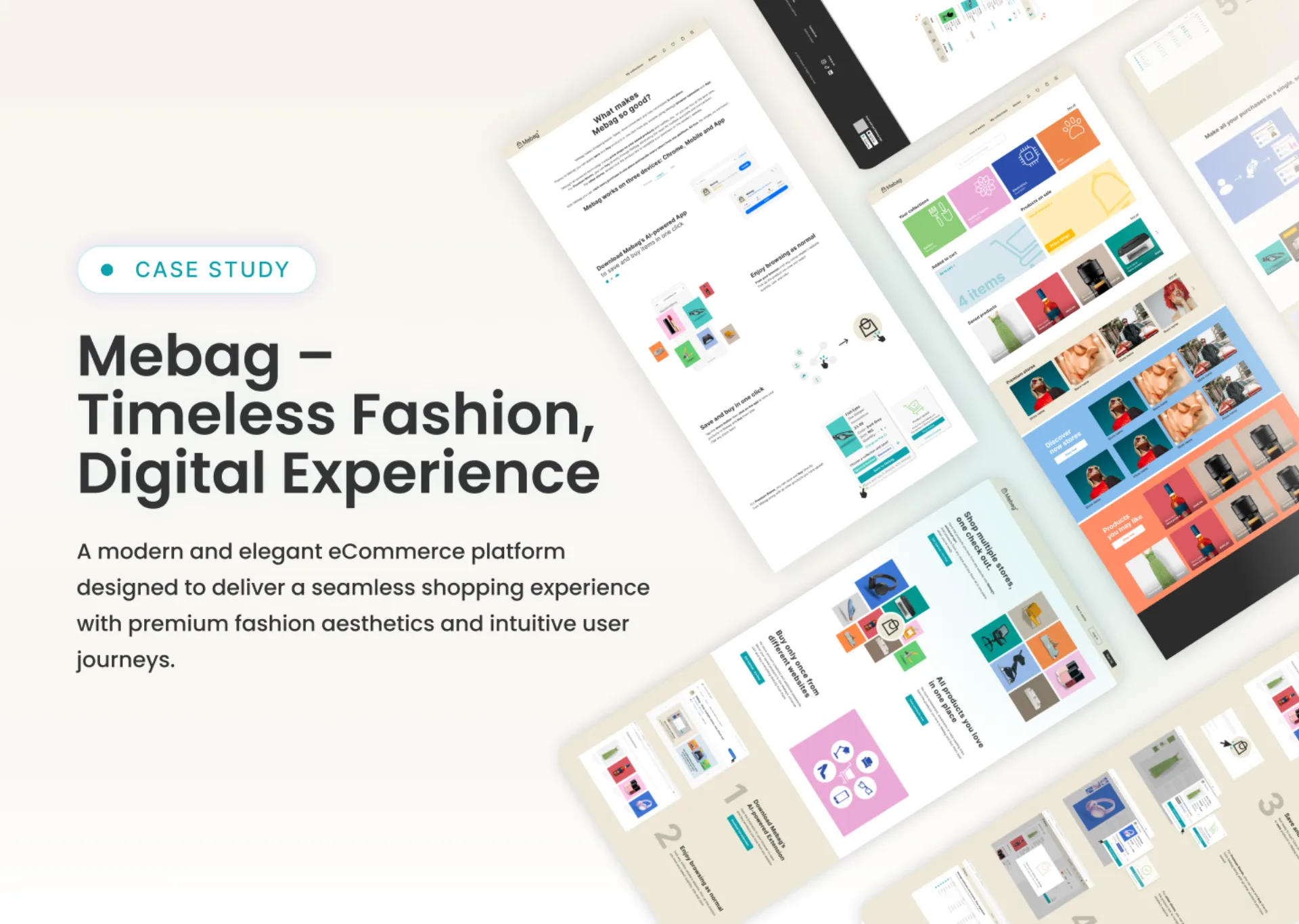
We built MeBag: an AI-powered universal cart that lets shoppers save, track prices, and buy products from any store in a single checkout. One account, one dashboard, any retailer. The platform is live and onboarding users.
The problem
Online shopping is fractured in a way that's become so normal nobody notices it anymore. A shopper finds a product on one site, saves it in a browser bookmark, checks a price comparison tool, creates an account on the retailer, checks out, then logs into a separate courier tracker. Do that across five stores in a week and you've got five accounts, five order confirmation tabs, five different return policies you'll only read when something goes wrong.
The problem compounds at the product discovery layer. Search on Google Shopping, on Amazon, on individual retailer sites. You get different results, different prices, different availability for the same product. There's no single view. Price tracking tools exist, but they're browser extensions bolted onto individual retailers, not a unified layer across the web.
Returns are the worst of it. Every retailer has a different policy, a different portal, a different label format. The shopper has to find the original order, find the return window, find the return portal, print a label. For a multi-item order split across two retailers, that's two separate return flows. It's 2024 and returning something you bought online is still a project.
The MeBag founders came to us with a clear product vision: one universal cart: a single place to discover products from any store, track price drops, check out across multiple retailers in a single transaction, and manage shipping and returns from one dashboard. The ambition was large. The technical surface area was larger.
How we built it
The core technical challenge with a universal cart is that you don't own the stores. You're aggregating across retailers who have no incentive to expose clean APIs and every incentive to keep shoppers on their own checkout flows. So the architecture had to be built for resilience from day one: able to ingest product data from multiple sources, handle retailer-specific checkout flows, and keep a consistent user-facing model regardless of what happens upstream.
Product discovery is powered by a multi-source ingestion layer. Products are indexed from retailer feeds, affiliate networks, and direct integrations, then normalised into a canonical product model: title, description, images, variants, price history, availability. The AI layer sits on top of this index: it handles search (semantic, not just keyword), surfaces personalised recommendations, and detects when two listings from different retailers are the same product so price comparison is accurate rather than approximate.
Price tracking runs as a background service: each saved product is polled on a schedule, price history is stored, and users receive push alerts when a drop crosses their configured threshold. The alert system is real-time; a price change triggers the notification pipeline within minutes of detection.
Multi-store checkout was the hardest problem. We built a checkout orchestration layer that holds the shopper's payment and delivery details centrally, then executes purchases across each retailer's checkout flow in sequence: handling retailer-specific session management, payment submission, and order confirmation parsing. From the user's perspective: one checkout, one payment, one confirmation. Behind the scenes: the platform is completing separate transactions at each store.
The shipping and returns dashboard aggregates tracking data from courier APIs (Royal Mail, DPD, Evri, and others) by parsing order confirmation emails and matching them to tracked purchases. Returns are managed through the platform: the user initiates from their dashboard, the platform routes the request through the retailer's return API or web flow, and generates the return label directly.
The web app is built in Angular with a Node.js backend on PostgreSQL, hosted on AWS with auto-scaling on the ingestion and checkout orchestration services.
Outcome
MeBag is live as a working consumer platform that delivers on its core promise: a shopper can discover a product, track its price, buy it alongside items from other retailers, and manage the return: all without leaving MeBag.
The platform indexes products across multiple major UK and international retailers. Price alert delivery operates within minutes of a price change being detected. The checkout orchestration layer processes transactions across multiple retailers without requiring users to manage separate sessions.
The platform is in production and onboarding new users.
The initial build ran roughly 3–6 months to reach this point, our typical range for a SaaS project of this scope, with the design approved before development started.
For the client: MeBag represents a novel position in the e-commerce stack, not a retailer, not a marketplace, but the layer above both. The ambition is to become the default starting point for online shopping rather than an afterthought.
For us: MeBag is the project we point to when someone asks whether we can handle complex third-party integration at scale (scraping, affiliate feeds, courier APIs, retailer checkout flows) and make it feel like one clean checkout to the user. It's a technically ambitious product and it works.
What I love about Team7 is that they always say: No worries, we can find a solution. This is the mindset of builders, creators, people who do not have fear, the partner you need if you want to excel.
Want to build something like this?
Tell us what it is.
Every project starts with a conversation. Tell us what you're working on, and we'll tell you honestly if we can help, what it would take, and roughly what it would cost. No pitch. No pressure.