🇺🇸 LegalTech / HR Tech · 2026
Employment Law Alliance: Global Legal Network Platform Redesign
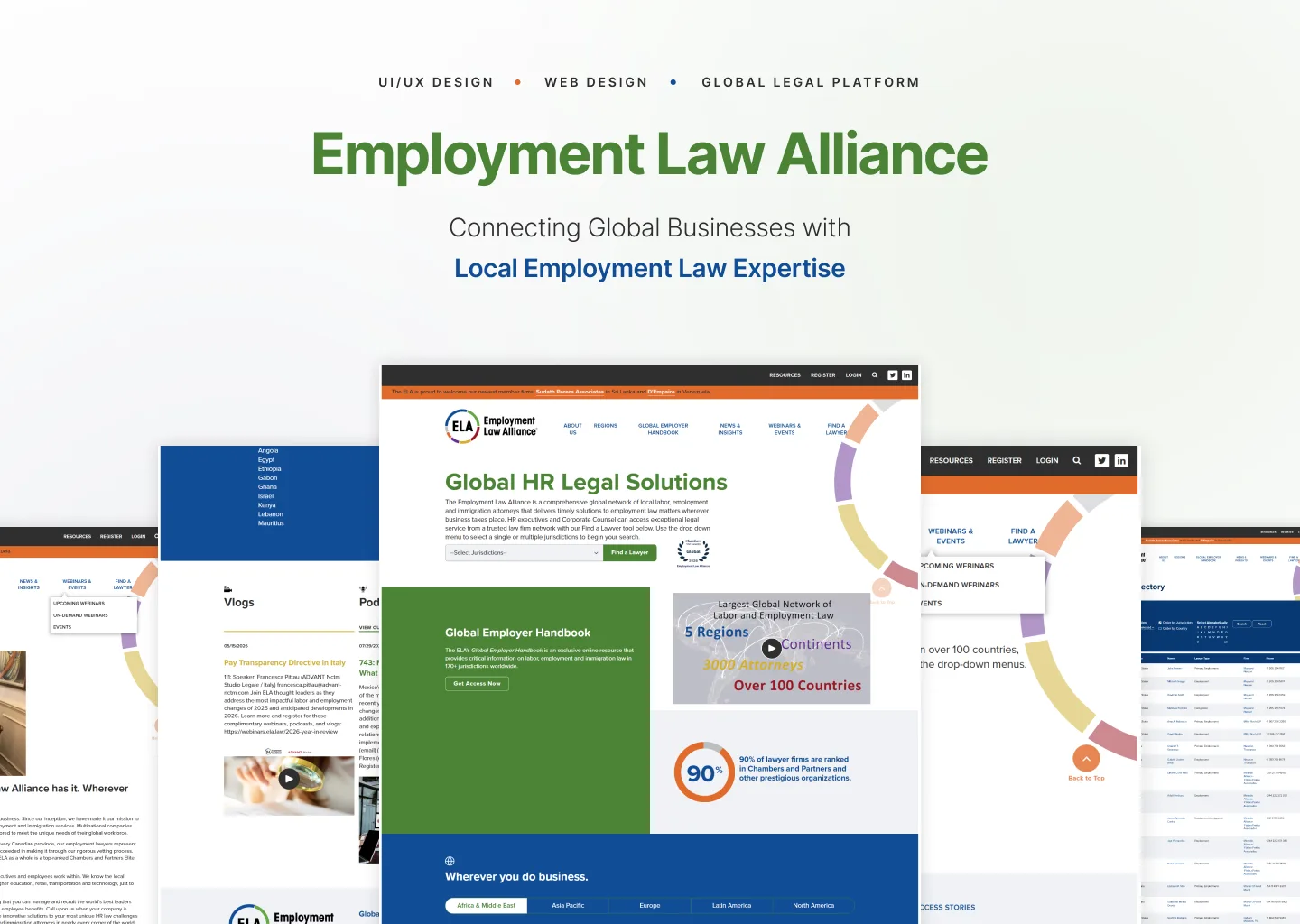
We redesigned and rebuilt the digital platform for the Employment Law Alliance: the world's largest network of independent labour and employment law firms, spanning 3,000+ lawyers across 170+ jurisdictions. A "Find a Lawyer" discovery engine, a searchable Global Employer Handbook, and a member firm network, unified under one global brand while preserving every local chapter's identity.
The problem
The Employment Law Alliance isn't a single law firm. It's a network. More than 3,000 labour and employment lawyers, organised into independent member firms, covering more than 170 jurisdictions across five global regions. That structure is the entire value proposition: an HR executive in Chicago whose company just opened an office in Vietnam needs a lawyer who knows Vietnamese labour law from the inside, not a generalist reading it secondhand. ELA's job is to make that specific match, instantly, anywhere in the world.
A network that large has a discoverability problem baked into its own success. The previous "Find a Lawyer" experience behaved like a spreadsheet with a search box bolted on: functional for someone who already knew which jurisdiction and which firm they wanted, hostile to everyone else. HR executives needed quick benchmarks and expert verification. General counsel needed jurisdiction-specific filters and a direct line to a named contact. Business leaders expanding into a new region needed macro-level insight before they needed a lawyer at all. Three very different intents, one search box.
Underneath the discovery problem sat an even larger content problem: the Global Employer Handbook. It's ELA's flagship resource: thousands of pages of labour, employment, and immigration law spanning 170+ jurisdictions, maintained by the member firms who practise in each one. That density is the Handbook's value and its usability risk in the same breath. Present it wrong and it reads as an intimidating wall of legal text. Present it right and it becomes the reason an HR executive bookmarks the site.
And running through every screen was a brand-architecture tension that had never been fully resolved: ELA needed one global identity credible enough to represent a network of this scale, while still letting each regional chapter show the local expertise and personality that makes a member firm trustworthy in its own market. Standardise too hard and the local firms lose their voice. Standardise too little and the network stops looking like one thing.
How we built it
We started by separating the two jobs the site has to do (Find a Lawyer, and Explore the Handbook) and designing each as its own complete journey rather than two features sharing a homepage.
The Find a Lawyer path runs landing page → select jurisdiction → browse experts → select lawyer → view profile → contact, with a jurisdiction picker as the first decision point rather than a filter buried in results. That ordering matters: an HR executive's mental model starts with "where" before it gets to "who," so the flow follows the same order. Lawyer profiles surface exactly what the four audience types need to act: quick benchmarks and verification for HR executives, jurisdiction-specific credentials and a direct contact channel for general counsel, strategic and trends framing for business leaders scoping expansion, and a member-to-member portal layer for ELA's own network of firms.
The Handbook got its own discovery path (open handbook → select jurisdiction → select topic → search/filter → view info) designed around progressive disclosure. Nobody needs to see 170 jurisdictions and every topic at once; they need their jurisdiction and their topic, fast. We built the information architecture around that narrowing sequence instead of a single dense index page, so the density of the underlying content never has to hit the user all at once.
The brand system was the unifying layer. We built a single global visual language (the ELA colour system, iconography, and page templates) applied consistently across every region and every member-firm page, so the network reads as one credible global brand wherever you land. Regional and local content still surfaces prominently within that system: each region's statistics, each firm's specific expertise, each jurisdiction's nuances are still front and centre. They're just presented through a shared frame instead of each firm improvising its own.
We rebuilt the content layer to support this at scale: the Global Employer Handbook as a structured, filterable knowledge base rather than a flat document tree, webinars and on-demand content surfaced by relevance instead of buried in a chronological feed, and a Client Success Stories section (featuring ELA's own client logos, including Nestlé, Tesla, and Umbra) built to carry the same social-proof weight a network this size deserves. ELA's own global network statistics (5 regions, 3,000+ attorneys, 100+ countries) are surfaced as first-class content on the homepage rather than left in a footer.
Outcome
The rebuilt ELA platform is live, giving the Employment Law Alliance a digital front door that matches the scale of the network behind it: ELA's own network spans 3,000+ lawyers across 170+ jurisdictions.
The two-path structure, Find a Lawyer and the Global Employer Handbook, gives each of ELA's audiences a direct route to what they came for, instead of one generic search experience trying to serve HR executives, general counsel, and business leaders at once. The Handbook's progressive-disclosure design makes thousands of pages of jurisdiction-specific legal content navigable rather than merely present.
The unified brand system means a visitor can land on any regional or member-firm page and immediately recognise it as ELA, while the local expertise and jurisdiction-specific detail that make each member firm credible in its own market are still front and centre: the standardisation strengthens the network's identity without flattening what makes each firm distinct.
Since launch, the Find a Lawyer engine has been processing hundreds of client requests a month, routing HR executives and general counsel to the right member firm without them ever needing to know the network's internal structure to find it.
Like most of our builds, this ran roughly 3–6 months from kickoff to launch, with the full design approved before development started.
For the client: ELA now has a platform built to grow with the network: new member firms, new jurisdictions, and new regional content slot into an information architecture designed for that scale from the outset, rather than one that has to be re-architected every time the network expands.
For us: ELA is the project we point to when someone asks whether we can design for genuine information-architecture complexity (a global network, multiple audience types, and a content library measured in thousands of pages) without the result feeling like a database with a skin on it.

Frequently asked questions
Who redesigned the Employment Law Alliance (ELA) website and Find a Lawyer platform?
Teamseven designed and built the Employment Law Alliance's global platform: a "Find a Lawyer" discovery engine, the searchable Global Employer Handbook, and a unified brand system spanning ELA's own network of 3,000+ lawyers across 170+ jurisdictions and five global regions.
Who builds legal-tech and HR-tech platforms for global professional networks?
Teamseven builds legal-tech and HR-tech platforms for global professional networks and multi-firm associations. The Employment Law Alliance is our reference build: a global network platform balancing one unified brand with the local jurisdiction expertise of ELA's own network of 3,000+ independent lawyers across 170+ countries.
Want to build something like this?
Tell us what it is.
Every project starts with a conversation. Tell us what you're working on, and we'll tell you honestly if we can help, what it would take, and roughly what it would cost. No pitch. No pressure.