Legal Software Development
We Built the Platform Behind a 3,000-Lawyer Network
We build software for law firms, legal networks, and professional associations: lawyer directories with jurisdiction-aware search, structured legal knowledge bases, client and member portals, and enquiry routing. Our reference build is the Employment Law Alliance platform, the digital front door for 3,000+ employment lawyers across 170+ jurisdictions, now routing hundreds of client requests a month to the right member firm.
No commitment. Response within 24 hours.
Why Legal Software Is Harder Than It Looks
Legal platforms serve readers with very different intents, carry content that is dense by nature, and hold information that has to stay confidential. We learned each of these on the ELA build.
Jurisdiction comes first
A client's first question is "who knows the law where I am?", not "which firm?". Search that treats jurisdiction as a filter buried in results sends people to the wrong lawyer or away from the site.
Legal content is dense by nature
Guides, handbooks, and briefings run to thousands of pages. Presented as a flat document tree, they read as an intimidating wall of text instead of the reason clients keep coming back.
Very different audiences
HR executives want quick benchmarks, general counsel want jurisdiction-specific credentials and a named contact, and business leaders want the big picture first. One generic search box serves none of them well.
Confidentiality is not optional
Enquiries, client matters, and member data carry real confidentiality obligations. Access control, encryption, and audit trails have to be designed in from the start, not added after launch.
Legal Software Development Services
Each block: the problem in your words, what we build, and the outcome.
Lawyer & Expert Directories
"Clients can't find the right lawyer for their jurisdiction." We build jurisdiction-first discovery, from region to expert to profile to contact, the way ELA's Find a Lawyer engine routes enquiries to the right member firm.
Legal Knowledge Bases
"Our best content is buried." We turn handbooks and guides into structured, filterable knowledge bases with progressive disclosure, so readers reach their jurisdiction and topic in a few steps.
Network & Member Portals
"We are a network, but the site looks like a dozen different firms." We build one brand system and CMS architecture that keeps each firm's local expertise visible inside a shared frame.
Client Portals & Intake
"Enquiries arrive by email and get lost." We build secure intake, enquiry routing, and client portals with role-based access and audit trails, designed around how your firm actually works.
How a Legal Platform Build Actually Runs
Drawn from the ELA build, not a generic diagram.
Audience & Intent Mapping
We separate who comes to the platform and what each of them needs to do, then design each job as its own complete journey instead of features sharing a homepage.
Information Architecture
We structure content around the narrowing sequence readers actually follow, jurisdiction then topic, so a large legal library never hits the reader all at once.
Design Approved First
The full design is approved before development starts, as it was on ELA, so the build is predictable and nobody discovers the navigation model in sprint six.
Access & Confidentiality Model
Roles, permissions, encryption, and audit logging are defined before any screen relies on them, because retrofitting access control means rewriting the data layer.
Staged, Fixed-Price Build
We build in stages with a working demo every week. ELA ran roughly three to six months from kickoff to launch. Fixed price means scope surprises are our problem.
Handover & Ongoing Support
Code, database, and IP transfer to you on final payment. New firms, jurisdictions, and content slot into an architecture built for that growth, with ongoing support if you want it.
We Built a Global Legal Network Platform
The Employment Law Alliance platform is live, a genuine legal product serving thousands of lawyers and the clients looking for them, not a mockup.
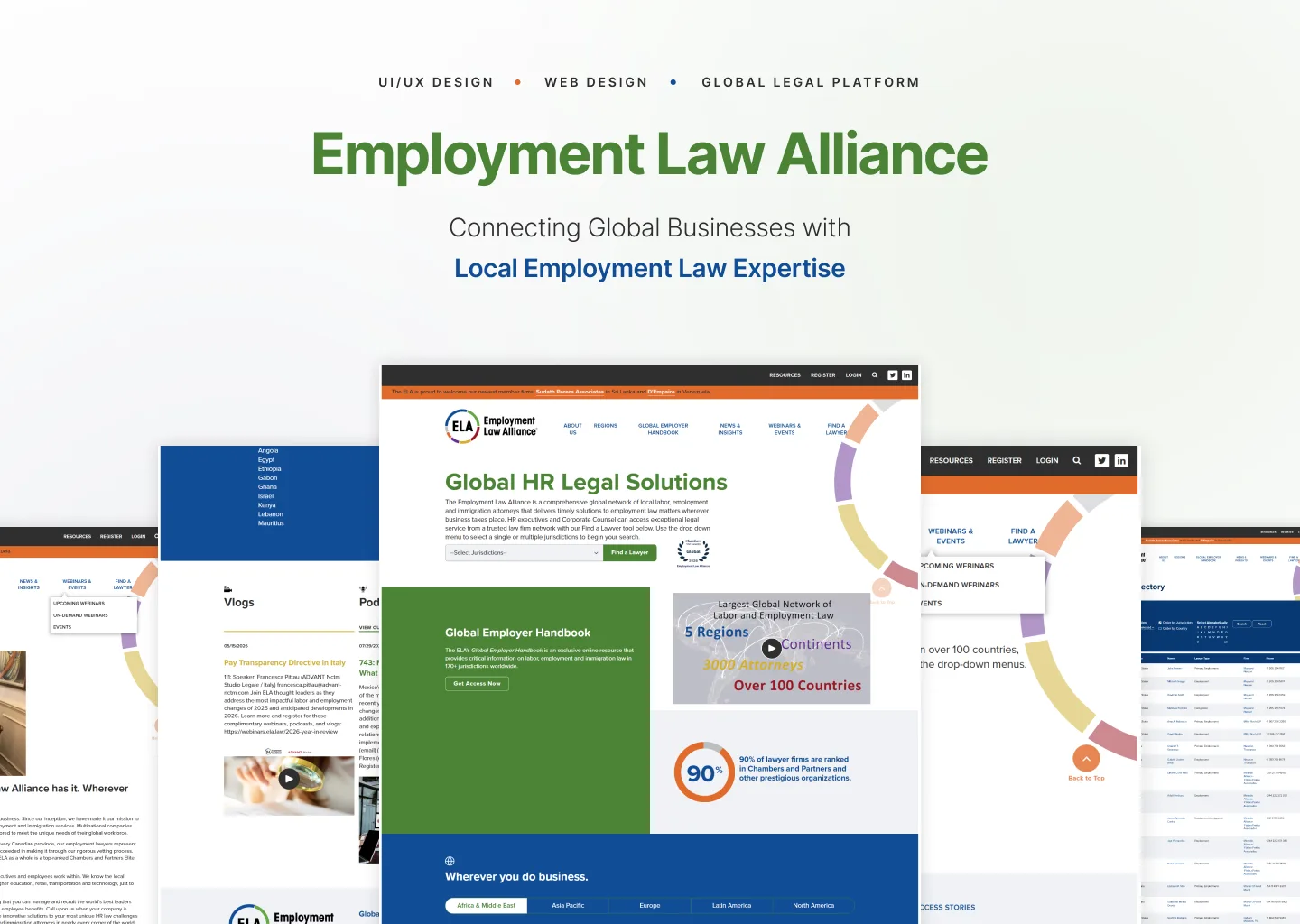
Employment Law Alliance: Global Legal Network Platform
The Employment Law Alliance is the world's largest network of independent labour and employment law firms: 3,000+ lawyers across 170+ jurisdictions and five global regions. Teamseven redesigned and rebuilt its platform around two complete journeys: a jurisdiction-first Find a Lawyer engine, and the Global Employer Handbook rebuilt as a structured, filterable knowledge base spanning thousands of pages.
A unified brand system lets any regional or member-firm page read as ELA while keeping each firm's local expertise front and centre. Since launch, the Find a Lawyer engine has been processing hundreds of client requests a month. Built in Angular and Node.js on PostgreSQL.
Read the full case studyBuilding software for a firm or legal network?
The next step is a call. We'll tell you honestly which parts sit inside our experience and which would be new ground, before we quote anything.
Book a scoping callThree Ways to Engage Us
A firm planning a new platform, a network with an ageing site, and a team keeping a live system healthy need different things. Pick the one that sounds like you.
Technologies We Use for Legal Software
Selected for structured content, search, secure access, and long-term maintainability.
Questions About Legal Software Development
What kind of legal software do you build?
Client-facing and knowledge platforms for law firms, legal networks, and professional associations: lawyer and expert directories with jurisdiction-aware search, structured legal knowledge bases, member and firm portals, intake and enquiry routing, and the CMS architecture behind multi-region legal content. Our reference build is the Employment Law Alliance platform, which serves 3,000+ lawyers across 170+ jurisdictions.
Why build custom legal software instead of using an off-the-shelf tool?
Often you should not. Practice management, time recording, billing, and document management are well served by established legal products, and we will tell you so. Custom software earns its cost where your model is distinctive: a network of independent firms, a knowledge product that is the reason clients come to you, jurisdiction-specific routing, or a client portal that has to match how your firm actually works. Our custom vs off-the-shelf guide walks through the decision.
How did you handle thousands of pages of legal content for ELA?
We treated the Global Employer Handbook as a structured, filterable knowledge base rather than a flat document tree. The path runs open handbook, select jurisdiction, select topic, then search and filter, so a reader narrows to their jurisdiction and topic quickly and never has to face the full density of the content at once. That progressive-disclosure information architecture is what makes a large legal library usable instead of merely present.
How do you protect confidential client information?
Confidentiality is designed into the architecture: role-based access so each user sees only what their role requires, encryption in transit and at rest, audit logs on sensitive actions, and separate permissions for viewing and exporting data. We apply the same access-control principles we used on a clinical research platform built for HIPAA-style controls. We do not provide legal, regulatory, or compliance certification; that sits with your compliance advisers.
Do you build practice management, billing, or e-discovery software?
We have not shipped a full practice management, legal billing, or e-discovery product, so we would say so on the call. What we have built in legal is a large global network platform with lawyer discovery, a jurisdiction-based knowledge base, and enquiry routing. Outside legal, we have built billing and accounting integrations with Xero, QuickBooks, and Sage for 510 companies on i-mve. We scope honestly against what we have done and what would be new.
Can you add AI to legal research or document workflows?
Yes, carefully. Retrieval over your own knowledge base, summarisation, and structured extraction from documents are realistic uses of large language models today. In legal work a confident wrong answer is expensive, so we design with sources shown for every answer, human review on anything consequential, and clear limits on what the AI is allowed to do. We will also tell you where AI is the wrong tool. See our AI development services.
What does legal software cost and how long does it take?
It depends on scope. A focused directory or client portal is a smaller engagement than a multi-region network platform with a knowledge base, member portals, and a brand system like ELA, which ran roughly three to six months from kickoff to launch with the full design approved before development started. We scope and price each build individually. You can get a rough range from our cost calculator first.
Can you take over a legal platform another team built?
Yes. We offer Legacy Software Modernization and Software Project Rescue for firms and networks that inherited a platform, lost their developers, or have a stalled build. We start with a code and architecture audit, then tell you honestly whether to extend, refactor, or rebuild the parts that cannot be saved.
Will you tell us if a project is outside your experience?
Yes. We have shipped one major legal platform, not ten. If your project needs court filing integrations, trust accounting, regulated e-discovery, or other specialist legal systems we have not built, we will say so and tell you which parts we can genuinely help with.
Building a platform for a firm or legal network?
We've already shipped one.
We rebuilt the Employment Law Alliance platform for 3,000+ lawyers across 170+ jurisdictions. If you're building software for lawyers or the clients looking for them, we understand the content, search, and confidentiality problems because we've solved them.