
Architecture for a new system
Data model, service boundaries, hosting and integrations designed and written up before the build starts, so your engineers (ours or yours) build on something settled.
The approach behind i-mve and JBUJB.
Our architects design the structure of a new system, review the one you already have, or lead the team that builds it. They use AI to move faster on diagrams, options and documentation, and they make the final call themselves.
01Problems we solve
Why teams bring in an architect.
You are about to build something big and want the structure right first.
We settle the data model, the boundaries and the hosting before anyone writes a feature. It is the order we work in on every build, and the reason a first version can grow into version two.
Your system has grown messy and nobody wants to touch it.
We read the code and the infrastructure, tell you in plain English what is sound and what is risky, and propose the order to fix it in. Sometimes the answer is refactor, sometimes rewrite, and sometimes leave it alone.
AI tools are producing code faster than your team can keep it coherent.
An architect sets the conventions, the module boundaries and the review rules, so AI-assisted speed adds features rather than inconsistency.
You have to choose between a monolith, microservices or something in between.
We have run both. JBUJB runs on NestJS microservices, i-mve on a multi-tenant SaaS architecture. We recommend by your team size and product stage, and write the reasoning down.
02What we build
A defined piece of work, or a seat on your team.
Data model, service boundaries, hosting and integrations designed and written up before the build starts, so your engineers (ours or yours) build on something settled.
The approach behind i-mve and JBUJB.
A written assessment of an existing system: security, data, scaling limits and what to fix first.
A staged plan to move off an old stack without stopping the business.
See legacy modernisation.
Where a model belongs in your product, what data it sees, and how a person stays in the loop.
AWS or Azure environments designed for the load and the budget you actually have.
E2P+SEND ran on Azure VMs.
An architect who joins your dedicated team, sets standards and reviews the work every week.
03Proof
Architecture decisions that have had to survive real users, with the client status stated.
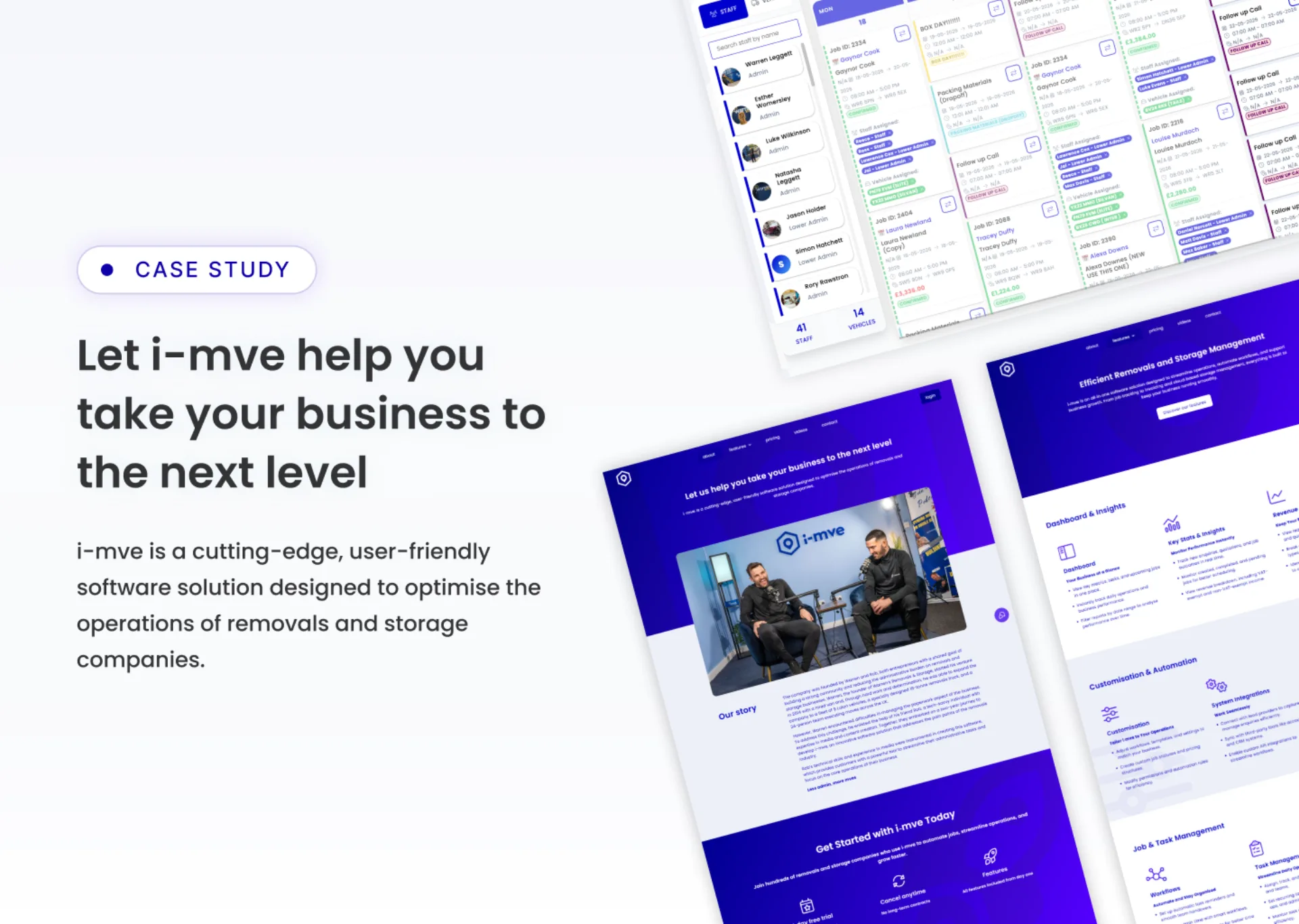
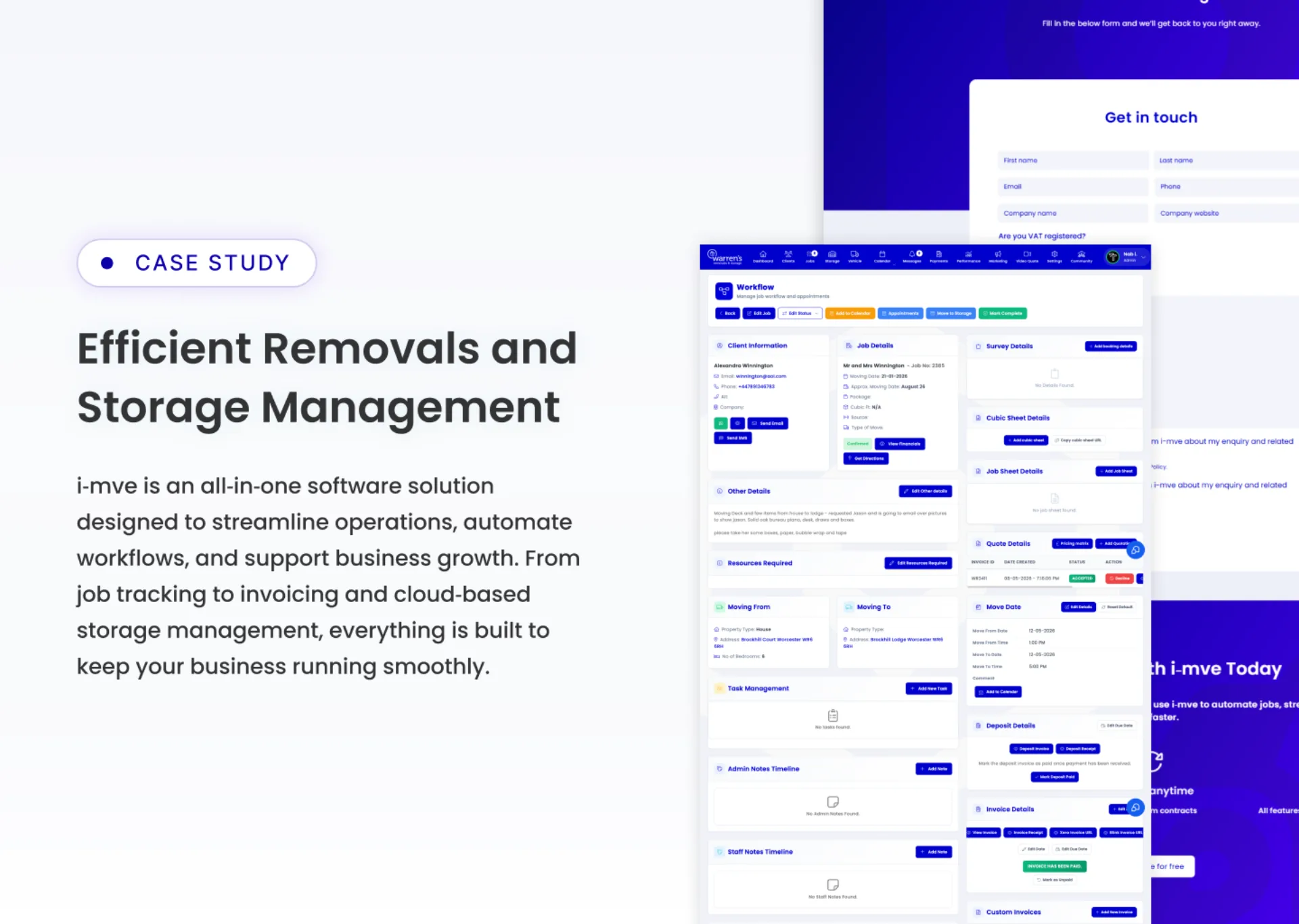
An all-in-one platform for UK removals and storage companies: enquiries, quotes, jobs, staff, invoices, storage and accounting in one place. It started as one removals firm’s system and is now sold on subscription.
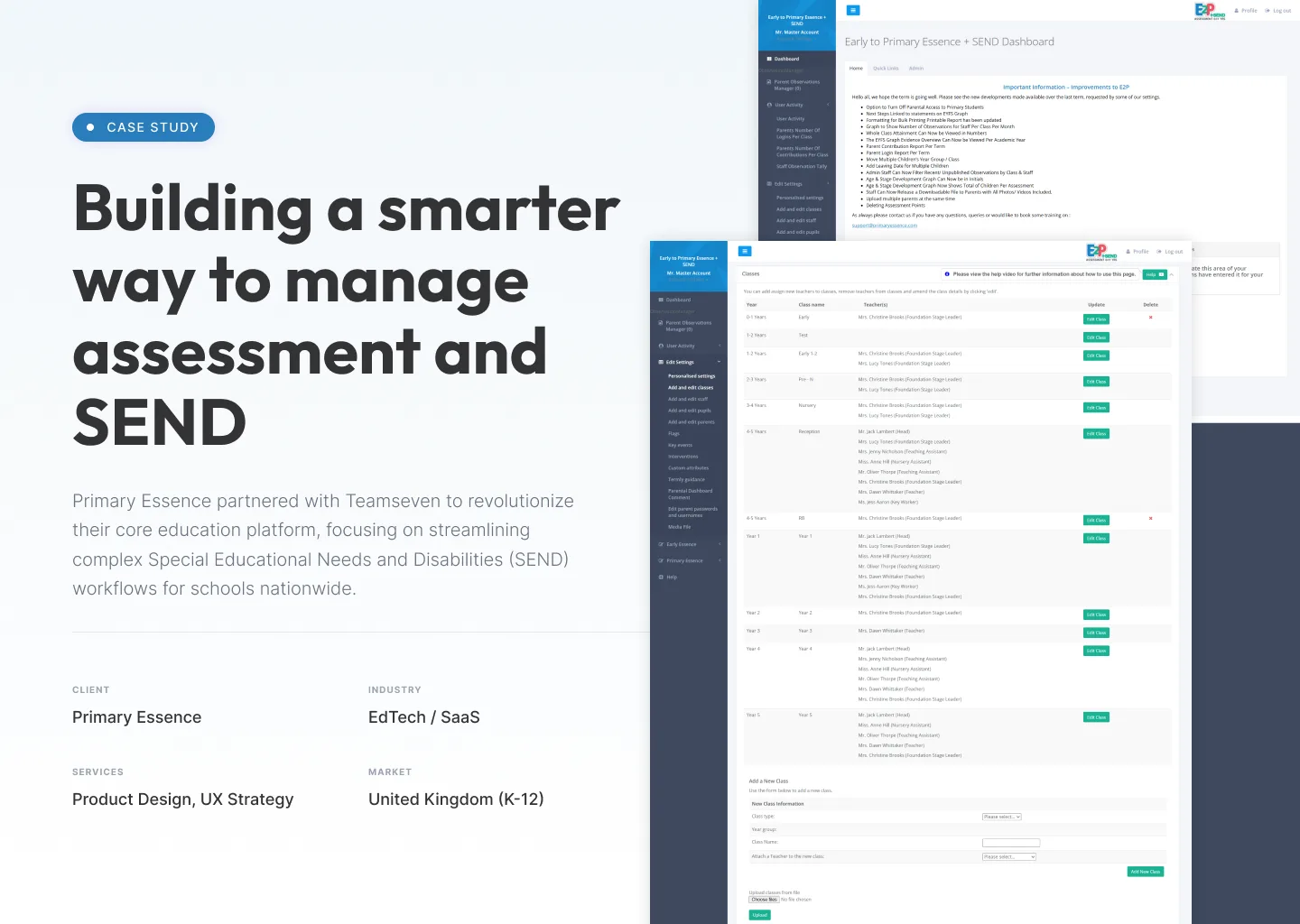
Schools track what each child learns from early years through primary, with observations, photos and SEND records that staff and parents can both see.
A marketplace that brings merchants into one place in every language they sell in, built as microservices so each part can scale on its own.
04Process
From first call to a decision you can defend.
Tell us what you are building or inheriting, and what decision is stuck.
A defined piece of work with a clear output, or a seat on your team, agreed in writing.
Code, data, hosting and the people who use the system. No recommendation before we have seen the real thing.
The structure we recommend, the alternatives we rejected and why, in plain English with diagrams.
The document is yours. Take it to your own team, or have our engineers build it.
05How we price
A defined engagement is a fixed quote. A seat on your team is a monthly rate. Both come from a 30-minute call.
The output is yours either way. Book a call and we will price the piece of work you describe.
Platform-level reviews of the agency, not cherry-picked project comments.
What I love about Team7 is that they always say: No worries, we can find a solution. This is the mindset of builders, creators, people who do not have fear, the partner you need if you want to excel.
Working with Mo and his team over the past year has been nothing short of exceptional. I was admittedly sceptical about investing such a large amount, but results exceeded every expectation.
Their responsiveness and willingness to take on our challenging task were impressive.
They are amazing and consistently exceed expectations. They go above and beyond what is asked of them and their communication is top notch, so much so that we joke that they never sleep. The best of the best.
06FAQ
Straight answers on scope, output and cost.
Ask us something elseThey decide how a system is structured: how the data is modelled, where the boundaries between parts sit, how it is hosted and how it will change over time. The output is usually a written design and a person who can defend it, not a stack of diagrams.
When the decision is expensive to reverse: a new product, a move to multi-tenant SaaS, a rewrite, or adding AI to a system that holds sensitive data. For routine features, an experienced engineer and a clear brief are usually enough, and we will say so.
For speed on drafts: options, diagrams, documentation and checking edge cases. The recommendation and the trade-offs are theirs, and every conclusion is reviewed by a person before it reaches you.
Yes. We read the code, the data and the hosting, then give you a written assessment ranked by urgency. If the app was built with an AI tool, our code audit covers the same ground at a fixed price.
If you want us to. The design is yours either way, so you can take it to your own engineers or another agency.
A defined review or design is a fixed quote, and a seat on your team is a monthly rate. We do not publish a price list. Book a 30-minute call, describe the system, and you get the number in writing.
You do. At handover you get the Git repositories and written documentation. There is nothing tying the software back to us, so you can take it to an in-house team whenever you like.
Rehan, one of our two founders, is your day-to-day contact. You get updates on Slack twice a week and can see the code in your repository at any time. We split working hours between us to cover US, UK and Australian time zones, and we usually reply within an hour, sometimes the next morning.
Start your project
A 30-minute call. We’ll tell you whether you need an architect, what the output would be and what it costs.