
ANPR Camera Integration: What the Software Side Actually Has to Handle
What reliable software around ANPR cameras and boom gates needs: plate-read confidence scoring, hardware failure handling and real-time gate control.

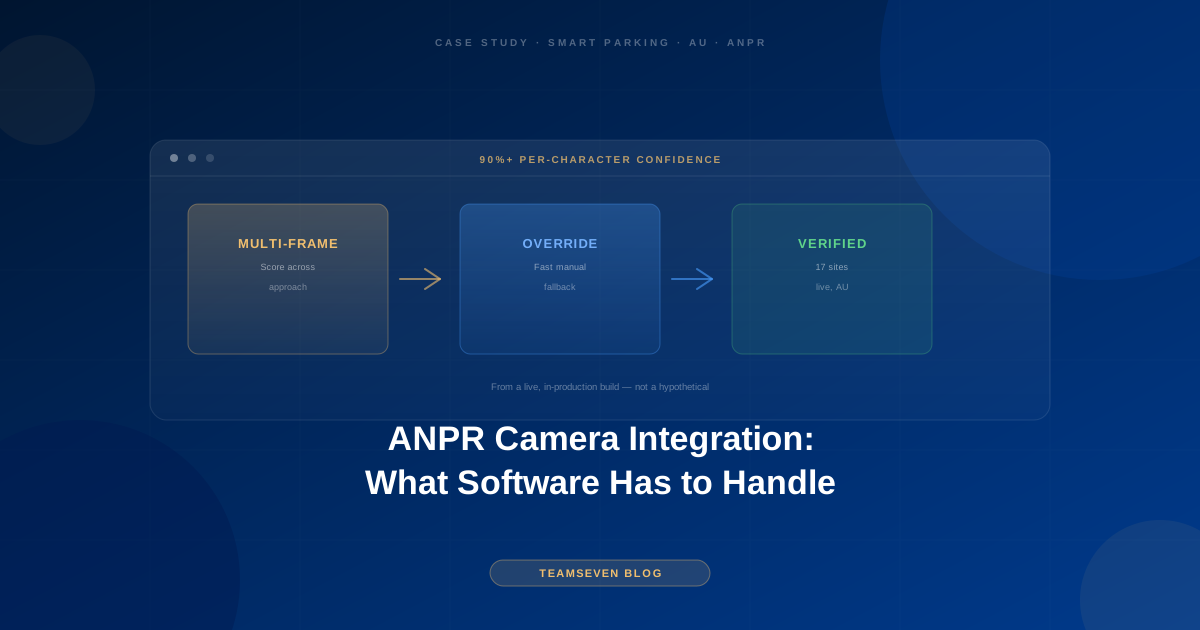
Automatic Number Plate Recognition sounds, from the outside, like a solved problem: point a camera at a car, read the plate, done. We built the complete software platform behind a national smart parking automation system now running across 17 sites in Australia, including a national ambulance service and major hotel chains, and the camera reading the plate turned out to be the easy 20% of the engineering. The other 80% is everything that happens when the read isn't perfect, which, at real-world scale, is often.
Why plate reads aren't binary
A camera vendor's spec sheet will quote a headline accuracy number under ideal conditions. Real car parks don't provide ideal conditions. Plates get dirty, rain distorts the image, low afternoon sun hits the lens at exactly the wrong angle, a tow bar partially obscures a character, and certain regional plate fonts get misread character by character: a "0" read as "O," an "8" read as "B."
The software-side lesson that shaped how we built this platform: don't trust a single read as a binary yes/no. Instead, the system scores confidence per character across multiple frames as a vehicle approaches, and only acts on a read once confidence crosses a threshold: in production, that's roughly 90%+ confidence on each character before the system treats a plate as reliably identified. Below that threshold, the system doesn't guess; it falls back to a defined behavior instead of silently acting on a low-confidence read.
What happens when the camera isn't sure
This is where most of the actual engineering effort goes, and it's the part a camera vendor's API documentation doesn't cover, because it's a product decision, not a hardware one.
Manual override has to be fast and low-friction. When a read fails or falls below the confidence threshold, an operator needs a path to resolve it, typically by confirming or correcting the plate manually, without a driver sitting at a boom gate for an extended wait. The system is designed so this override path is fast enough that a low-confidence read degrades to a slightly slower entry, not a stuck gate and a queue of frustrated drivers.
Multiple frames beat a single frame. A vehicle approaching a gate is in the camera's field of view for a few seconds, not a single instant. Capturing and scoring multiple frames as the vehicle approaches, rather than committing to whatever the first frame produced, meaningfully improves effective accuracy without needing better camera hardware. It's a software decision that gets more value out of the same physical setup.
Ambiguous characters get resolved with context, not guessed. Certain character confusions (0/O, 8/B, 1/I) are common enough that the system applies plate-format rules and, where available, cross-references against expected formats rather than treating every character independently. This is the unglamorous part of ANPR software that moves accuracy numbers, not better cameras, but smarter interpretation of what the cameras see.
The four systems that all have to work together in real time
Underneath the plate read, a working boom gate deployment is really four systems that have to communicate correctly, in real time, with no room for a half-second of drift:
The camera and recognition pipeline: capturing frames, running recognition, producing a confidence-scored plate read.
The access-rules engine: deciding, given a plate read, whether this vehicle is authorized to enter: a permit holder, a paying casual visitor, a blocked plate, a vehicle already inside that shouldn't re-enter.
The boom gate controller: physically opening and closing the gate, which needs to receive the "open" signal reliably and report back its actual state, because a gate that silently fails to open (or fails to report that it didn't) is a much worse failure than a slow read.
The payment layer: for contactless payment sites, authorizing and capturing payment in the same real-time window as the physical gate action, without introducing a separate point of failure that blocks entry when the parking decision itself was already correct.
If any one of these is late, drops a message, or fails silently, the result is a real vehicle sitting at a real gate that won't open, which is precisely the kind of failure that erodes trust in an automated system fast, especially at a site like an ambulance service where a delayed gate has consequences beyond inconvenience.
What we'd tell an engineering team starting this from scratch
Don't build the recognition pipeline and the access-control logic as one tightly coupled system: keep them separable, because the confidence threshold, override behavior, and access rules are all things you'll tune independently after real-world deployment teaches you where the failure modes are, and none of that tuning should require touching the camera integration code.
Build the manual-override path first, not last. It's tempting to treat the happy path (clean read, correct access decision, gate opens) as the MVP and the override path as a later addition. In production, the override path is not an edge case. It's a load-bearing part of the system from day one, because plates will be misread, and the deployment's credibility depends on how gracefully that's handled, not on pretending it won't happen.
Monitor confidence-score distributions, not just success/failure counts. A gradual drift in average confidence at a specific site (caused by, say, a camera needing cleaning or a new light source affecting glare) is the kind of signal that lets you fix a problem before it becomes a string of failed reads and frustrated site operators calling in.
Stay connected
Build notes, launches, and new articles from the Teamseven team.