
Building for Essential-Services Clients: What Changes When Downtime Isn't an Option
What changes in architecture and process when your client is an essential service and downtime has real consequences, not just inconvenience.

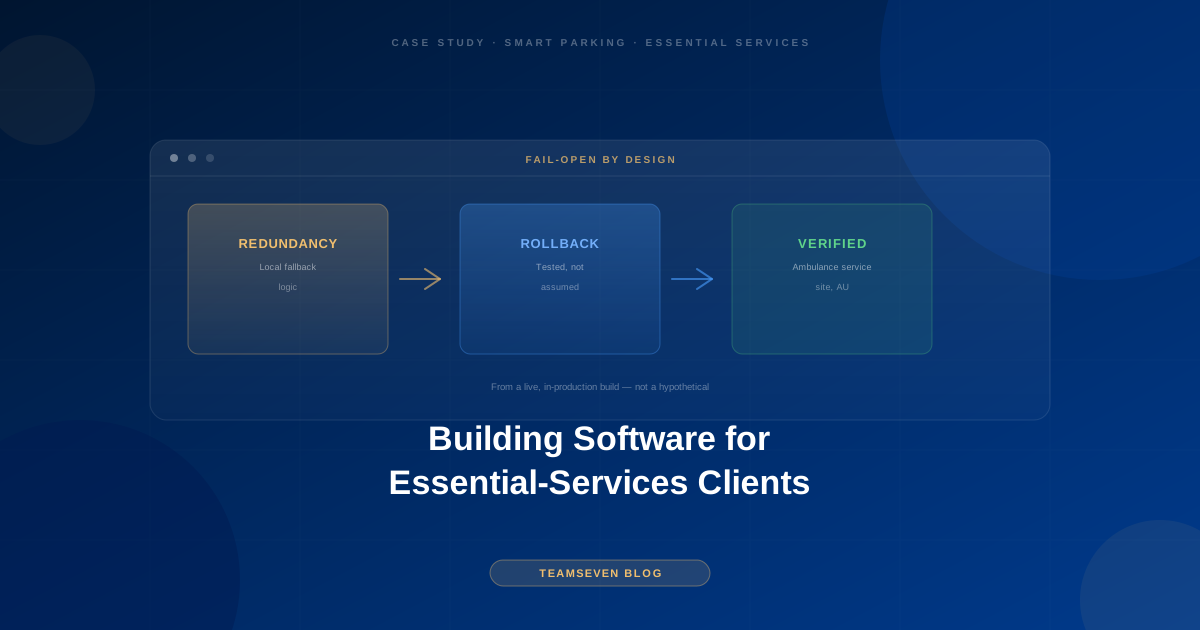
Most software has a failure mode that's merely annoying: a page is slow, a feature is briefly unavailable, someone refreshes and it's fine. Some software doesn't get that grace. When the smart parking automation platform we built controls boom-gate access at a national ambulance service's sites, a gate that fails to open isn't a minor inconvenience. It's a vehicle that needs to move now, blocked by software.
That distinction changed real engineering and process decisions on this project, not just how carefully we tested. Here's what shifts when "essential service" isn't a marketing phrase but a genuine constraint on the architecture.
Fail-open, not fail-closed, where it matters
The single most consequential architectural decision on this platform: when something goes wrong (a network drop, a backend outage, an ANPR read that can't be resolved in time) the system's default behavior at safety-relevant sites is designed to avoid blocking a vehicle that needs to move, rather than defaulting to a locked-down state that's "safer" from a pure access-control standpoint but actively harmful in a context where the vehicle behind that gate might be responding to an emergency.
This is a genuine tradeoff, not a free win. Fail-open behavior means a vehicle without valid authorization could get through during a fault condition, which is an acceptable and deliberate cost at sites where the alternative (a blocked emergency vehicle) is categorically worse. The engineering discipline here isn't picking one default and applying it everywhere; it's identifying, site by site, which failure direction is less harmful, and building the access-rules engine to apply the correct default per site rather than a single global policy.
Redundancy has to be designed in, not assumed
A single point of failure that would be an acceptable risk for a retail parking site (one network link, one gate controller, one central system dependency) isn't acceptable at a site where a failure has real operational consequences. This pushed specific architecture decisions:
Local operation during connectivity loss. Each site's core access-control logic runs locally, not purely as a thin client to a central system. A site losing its connection to the central dashboard should degrade to reduced functionality (occupancy reporting goes stale, for instance) without losing its core job: deciding whether to open the gate for an authorized vehicle.
No single vendor dependency for the physically critical path. Payment processing, reporting, and analytics can reasonably depend on a single third-party integration. The physical access-control decision (camera read, access rule, gate signal) is kept as lean and self-contained as possible, minimizing the number of external dependencies that sit between "vehicle approaches" and "gate opens."
Monitoring that distinguishes degraded from down. A site running in local fallback mode because of a connectivity issue is a different operational state from a site that's fully down, and the monitoring and alerting has to reflect that distinction clearly, so the team responding to an alert knows immediately how serious the situation is.
Testing and change management get more conservative, deliberately
Shipping a feature update to a retail parking site and a national ambulance service's site carries different risk profiles, even if the code change is identical. The practical implications:
Staged rollouts, not simultaneous deployment. Changes to core access-control logic roll out to lower-stakes sites first, with a defined observation period, before reaching sites where a regression has more serious consequences. This slows down iteration speed deliberately, in exchange for catching a problem at a site where it's merely inconvenient rather than at one where it isn't.
Rollback has to be as well-tested as the forward path. A deployment process that can ship a change quickly but can't reliably and quickly revert it is a liability at a safety-relevant site. Rollback isn't a fallback plan sketched out informally. It's a tested, practiced capability.
Post-incident review is a genuine process, not a formality. Any fault condition at a safety-relevant site (even one where the fail-open design worked exactly as intended and no harm occurred) gets reviewed to understand root cause and whether the design assumption still holds. Treating a successful fail-open event as "the system worked, nothing to review" misses the chance to catch a pattern before a scenario where the fail-open behavior itself turns out to be insufficient.
The honest tradeoff this all represents
None of this is free. Fail-open behavior, local fallback logic, staged rollouts, and a genuine post-incident process all cost more engineering and operational time than the equivalent decisions on a lower-stakes deployment. The judgment call (and it has to be made explicitly, not defaulted into) is recognizing which sites in a multi-site deployment carry this kind of consequence, and applying the higher standard there rather than either applying it uniformly everywhere (expensive, and often unnecessary for a retail shopping-centre car park) or nowhere (fast, until it isn't).
For a platform serving both a retail parking operator and a national ambulance service across the same underlying system, that meant building the flexibility to apply different failure-mode policies per site into the architecture itself, rather than treating "essential services" as a special one-off project instead of a configuration the platform needed to support natively.
Stay connected
Build notes, launches, and new articles from the Teamseven team.