
Windcave vs Stripe for Unattended Parking Payments
The Australian parking platform we built takes payments through Windcave and Stripe. When each fits, and what unattended payments at a gate need.

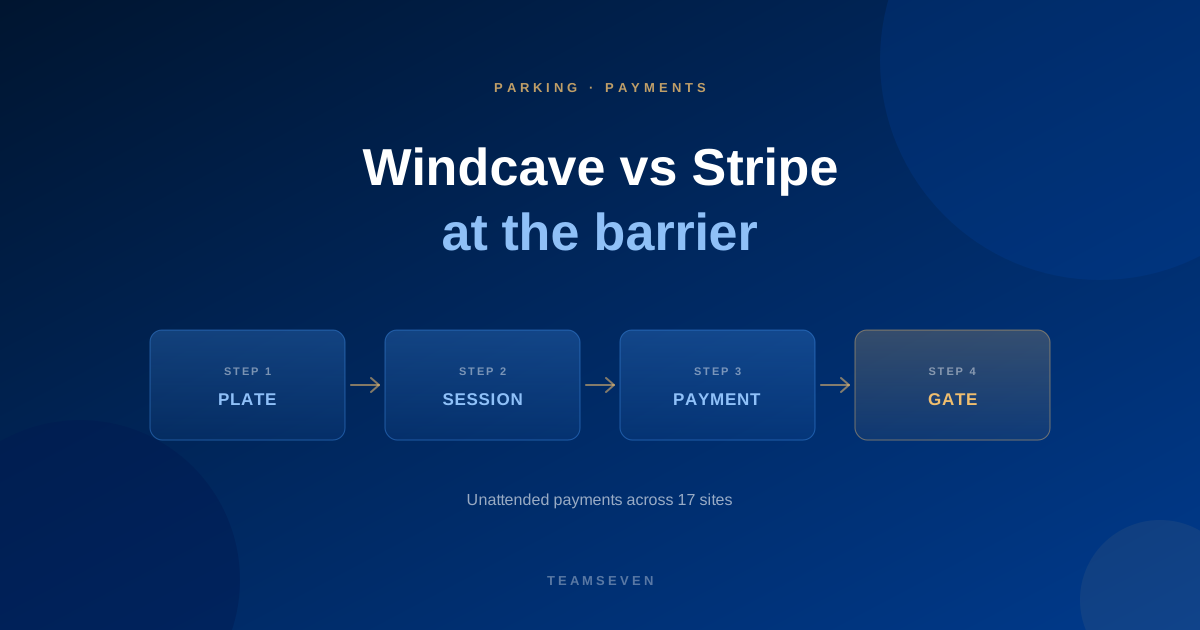
Taking a payment at a car park barrier isn't like taking one in an online shop. There's no staff member to help, the driver is in a hurry, there may be a queue behind them, and the gate has to open the moment the payment clears.
The smart parking platform we built for our client runs across 17 sites in Australia and handles around 25,000 vehicle transactions a month. It takes payments through both Windcave and Stripe. This post explains why we use both and how to choose for your own sites.
What unattended payments need
Before comparing providers, it helps to be clear about what a parking payment has to do:
- Work at a physical terminal, with contactless cards and phones, often outdoors
- Work online too, for pre-booked parking, permits and pay-by-app
- Tie the payment to a vehicle's visit, so the right amount is charged for the right time
- Tell the gate to open as soon as payment succeeds
- Handle failure gracefully: declined cards, lost connections, a driver who gives up
- Reconcile cleanly, so operators can match every payment to a visit
Where Windcave fits
Windcave is widely used in Australia and New Zealand for card-present payments, including unattended terminals. For the payment at the barrier itself, a provider with established terminal hardware and local acquiring is often the practical choice. That's the role it plays for our client.
Where Stripe fits
Stripe is strongest online: pre-booked parking, monthly permits, subscriptions, pay-by-app and anything that happens before the driver arrives. Its developer tools make recurring billing and web payments quick to build and easy to maintain.
Why use both
Most real parking operations need both kinds of payment. A driver may pre-book online and pay with Stripe, while a walk-up visitor pays at the barrier through Windcave. The system's job is to make both look like one thing to the operator: every visit, every payment, one set of reports.
The hard part isn't calling either provider's API. It's keeping the session model right: a visit starts when a plate is read on entry, and closes when payment clears on exit. Permits, reserved bays and pre-bookings all change what "payment" means for a given plate. We explain the camera side in ANPR camera integration.
How to choose for your sites
- Mostly walk-up visitors, AU or NZ? Start with a terminal provider like Windcave at the barrier.
- Mostly permits, bookings and subscriptions? Stripe will cover most of it.
- A mix? Plan for both from the start, with one record of every visit behind them.
Ask any provider about outdoor terminal hardware, offline behaviour, settlement times and fees for your transaction mix.
Can I use Stripe for parking barrier payments?
Stripe can take in-person payments through its terminal products, and it's excellent for online parking payments. Whether it suits your barriers depends on the hardware, your country and your acquiring needs. Many operators pair it with a local terminal provider.
What happens if the payment terminal goes offline?
The system needs a plan for it. In the platform we built, gate control runs on a local controller that keeps working if the site loses internet, so permitted vehicles still get in and out. Read running car parks with no staff at the gate.
Where can I learn more?
See our parking software page, payment integration and Stripe development.
Stay connected
Build notes, launches, and new articles from the Teamseven team.