EdTech Software Development: Building Technology for Education
A practical guide to EdTech software development: learning platforms, school management, SEND tools, and what makes building for education distinct.

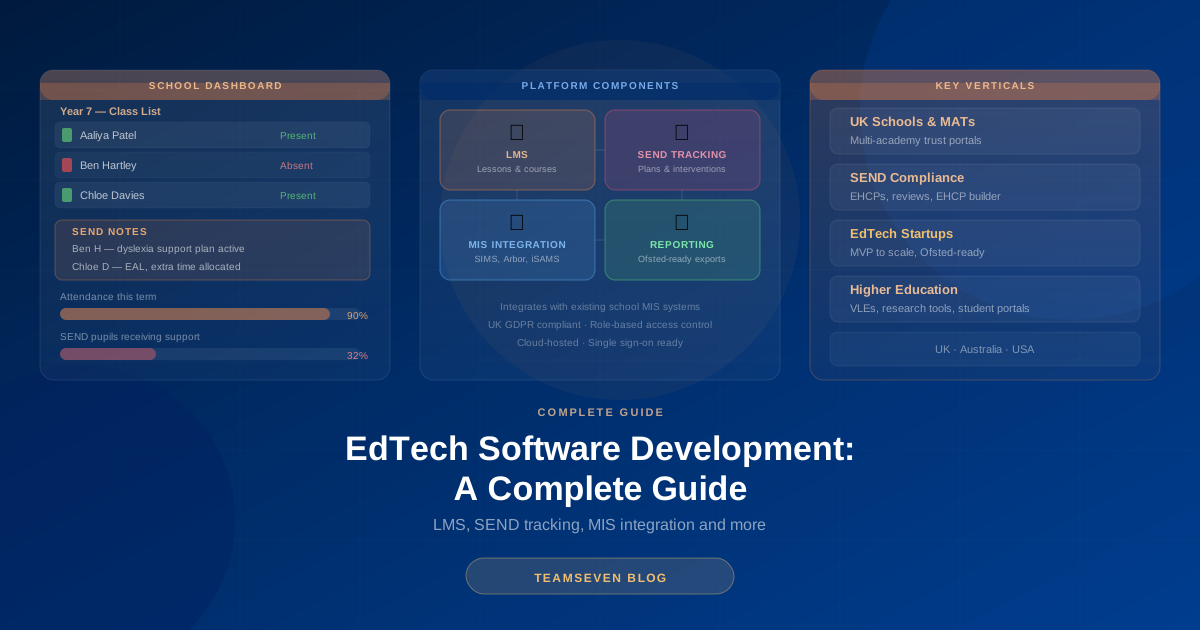
Education technology has a particular challenge that most software doesn't: it usually has to serve people who didn't ask for it. Teachers given a new system to learn on top of an already overwhelming job. Students who'd rather be doing something else. Administrators juggling budgets and requirements.
We built E2P+SEND: an education platform for UK schools, focused on Special Educational Needs and Disabilities provision, built with input from teachers and senior leadership. Building software for the education world taught us what makes EdTech distinct. This is the honest guide.
What EdTech covers
Education technology spans a wide range:
Learning platforms (LMS): systems that deliver courses, track progress, and manage learning content. From school platforms to corporate training to online course businesses.
School and institution management: systems managing the operations of schools and universities: enrolment, attendance, grading, communication, scheduling, reporting.
Specialist education tools: software for specific educational needs, like SEND (Special Educational Needs and Disabilities) provision, assessment tools, or subject-specific learning software. (This is where E2P+SEND sits.)
Online course and tutoring platforms: marketplaces and platforms connecting learners with content or tutors.
Assessment and testing: exam platforms, assessment tools, proctoring, grading systems.
Student engagement and communication: tools connecting schools, teachers, students, and parents.
The requirements differ across these, but they share characteristics that make EdTech distinct from other software.
What makes EdTech distinct
The users often didn't choose the software
In most software, the user wanted the tool. In EdTech, the teacher was often handed the system by an administrator, and the student was required to use it. This changes the design imperative completely. EdTech has to be easy and worth the effort, because the users start with less goodwill than users who sought the product out. Software that adds work to a teacher's overloaded day, without clearly giving back more than it takes, gets resented and abandoned.
When we built E2P+SEND, building it with teachers and senior leadership was essential precisely because of this. The people who'd use it had to shape it, or it would become one more system teachers worked around rather than with.
Multiple stakeholders with very different needs
EdTech typically serves teachers, students, administrators, and often parents: four groups with completely different needs and technical comfort. A teacher needs efficiency. A student needs engagement. An administrator needs oversight and reporting. A parent needs visibility and simplicity. Serving all of them in one platform is a genuine multi-role design challenge.
Data protection for minors
Education software usually involves data about children, which raises the data protection stakes significantly. UK GDPR, FERPA in the US, and equivalent frameworks have specific, strict requirements for children's data. SEND software like E2P additionally handles sensitive information about disabilities and special needs: data that requires the highest care. Building EdTech means building serious data protection in from the start.
Accessibility is not optional
Education has to serve everyone, including students with disabilities. Accessibility (proper support for screen readers, keyboard navigation, varied needs) isn't a nice-to-have in EdTech, it's often a legal and ethical requirement. For SEND software especially, accessibility is the entire point. This shapes the build from the beginning.
The school year and institutional constraints
EdTech operates within real institutional constraints: the school year, term structures, exam periods, procurement cycles. Software that ignores these realities doesn't fit how educational institutions work. Understanding the rhythm and constraints of education is part of building good EdTech.
What we learned building E2P+SEND
E2P+SEND is an education platform built for UK schools, focused on SEND provision, developed with teacher and senior leadership input. A few lessons stood out:
Building with teachers, not just for them, was essential. Teachers know the realities of their day in a way no spec document captures. Involving them meant the software fit how schools work rather than how we imagined they worked. For EdTech, this collaboration isn't optional. It's the difference between a tool that's used and one that's resented.
SEND is a domain that demands real care. Special Educational Needs and Disabilities work involves vulnerable children and sensitive information. The software had to handle that with the seriousness it deserves: careful data protection, thoughtful design, genuine accessibility. This wasn't a feature checklist; it was a responsibility.
Reducing teacher workload had to be the test. Any EdTech that adds to a teacher's burden fails. The constant question was: does this make a teacher's job easier or harder? If harder, it doesn't matter how clever it is. It won't be used.
What EdTech software costs
| EdTech type | Relative cost | Timeline |
|---|---|---|
| Focused tool (single function, e.g. assessment or SEND) | Lowest | 16–28 weeks |
| Learning platform / LMS | Mid-range | 24–40 weeks |
| School management platform | Higher | 28–44 weeks |
| Course / tutoring marketplace | Mid-to-higher | 24–40 weeks |
EdTech cost drivers include the number of distinct user roles (teachers, students, admins, parents each add scope), data protection and accessibility requirements (non-negotiable, and they add real engineering), and integration with existing school systems.
Choosing an EdTech development team
Willingness to involve real educators. Good EdTech is built with educator input. A team that wants to build with teachers, not just deliver to a spec, will build better education software.
Serious data protection for minors. Children's data demands genuine competence. Ask how they'd handle the specific data protection requirements for education in your region.
Accessibility capability. Accessibility is core to EdTech. A team that treats it as an afterthought will build software that excludes students who most need access. Ask about their accessibility experience.
Multi-role design experience. EdTech's four-stakeholder reality (teacher, student, admin, parent) needs deliberate multi-role design. Experience here matters.
Understanding of educational realities. A team that understands the school year, institutional constraints, and the overloaded reality of teaching builds EdTech that fits how education works.
A note on offshore for EdTech
EdTech is well-suited to offshore development: the scope is definable and substantial. The specific things to verify: serious data protection competence (you're handling children's data), genuine accessibility capability, and willingness to collaborate with your educators across the time zone. We built E2P+SEND for UK schools from Lahore, working with UK educators, handling UK data protection requirements. It's entirely doable with an agency that takes the distinct demands of education seriously. The cost advantage is significant, and education software's definable scope suits the offshore model well.
FAQ
How much does EdTech software cost to build? It varies a lot by scope: a focused single-function tool costs the least, and a full learning or school management platform costs considerably more. Cost is driven mainly by the number of distinct user types (student, teacher, parent, administrator) because each is effectively its own interface and permission model. We'll scope a specific number on a call.
What compliance applies to EdTech software? It depends on your market, but FERPA in the US and GDPR in the UK and EU are the common ones, with additional care required whenever the users are children. Compliance shapes data handling, consent, and retention from the start. It isn't something you add at the end.
What makes EdTech different to build? The number of stakeholders with conflicting needs. A student, a teacher, a parent and an administrator want different things from the same data, and reconciling those views is most of the design work. Building E2P+SEND taught us that the hard part is rarely the features. It's the permission model underneath them.
Do schools and institutions need integrations with existing systems? Almost always. Institutional buyers usually have an existing student information system, and your software has to fit around it. Scope those integrations explicitly and early, because they frequently determine both the timeline and whether the product is adoptable at all.
Can EdTech software be built offshore? Yes, provided the team understands the compliance frameworks that apply to your market and handles student data properly: anonymised or synthetic data in development, and proper agreements where real data is involved. Ask how they'd handle your specific requirements; the answer tells you whether they've done it before.
Stay connected
Build notes, launches, and new articles from the Teamseven team.