Onboarding 523 Companies Onto One Platform: What Multi-Tenant Actually Has to Get Right
What it takes to onboard hundreds of independent companies onto one multi-tenant platform without support collapsing: lessons from i-mve.

There's a specific kind of failure that shows up in multi-tenant SaaS products around the time they cross from "a handful of pilot customers" to "hundreds of independent companies," and it's rarely a failure of the core product. It's a failure of everything around onboarding: the parts that were fine to do manually at 10 customers and become the bottleneck at 100.
i-mve, the operations platform for UK removals companies that we build and maintain as our client’s technology partner, is now live across 523 companies, self-serve onboarding included. Getting there required solving problems that don't show up in a product demo and don't get discussed in most "how we built our SaaS" writeups, because they're not about features. They're about what happens structurally when the number of independent tenants stops being small.
The naive assumption that breaks first: "configuration is a one-time setup step"
Early on, it's tempting to treat onboarding as a form a new company fills in once (company name, logo, a few settings) and then they're in. That model works until you have enough companies that their differences stop being edge cases and start being the normal case.
Removals companies vary in real, structural ways: different pricing models, different fleet sizes, different regional coverage, different lead sources they buy from, different accounting platforms. A platform that treats "configuration" as a fixed set of toggles set once at signup either forces every company into an increasingly awkward one-size-fits-all shape, or accumulates one-off customizations that turn into unmaintainable technical debt: a codebase full of if (company.id === 447) special cases.
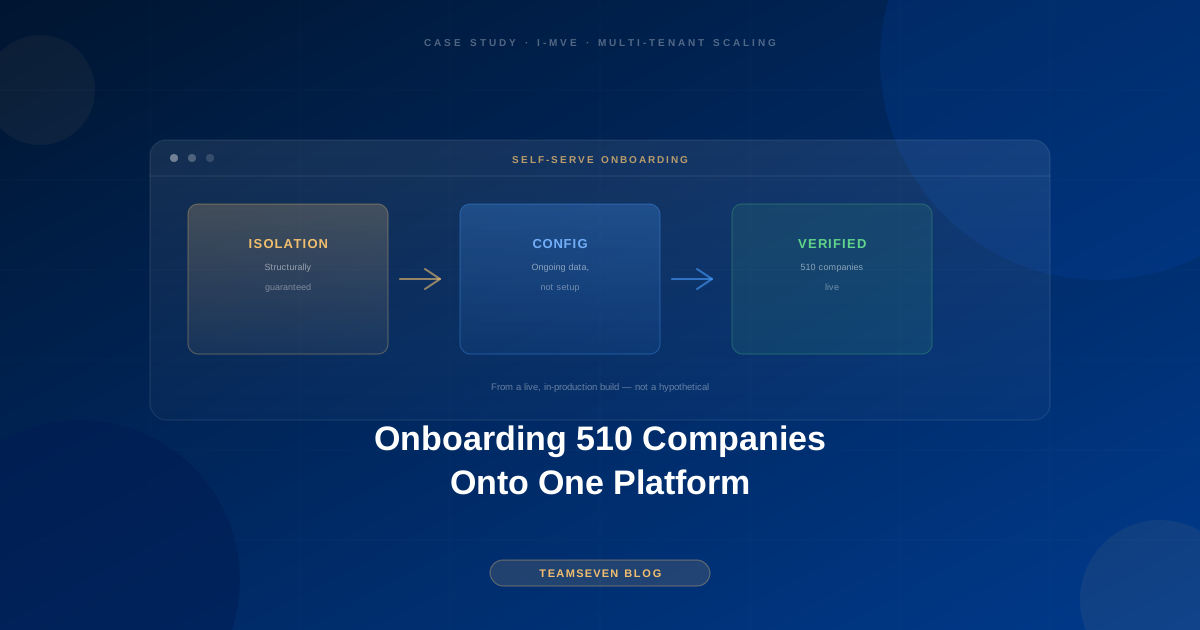
What scales: configuration as first-class, ongoing data, not a signup step. Pricing rules, integration choices, regional settings live in the data model as things a company can change at any point, read and applied consistently by the same code path for every tenant, rather than as conditionals sprinkled through the application.
Data isolation has to be structurally guaranteed, not just tested
With 523 independent companies on one platform, a single data-isolation bug (one company's crew schedule visible to another, one company's customer list leaking into another's export) isn't a minor incident. It's the kind of thing that ends a SaaS product's credibility in an industry where operators talk to each other.
The discipline that holds up: tenant scoping enforced at the data-access layer itself, not just in application logic that a future developer might forget to apply correctly to a new query. Every query that touches tenant data is scoped by construction, not because someone remembered to add a WHERE company_id = ? clause, but because the data-access layer makes it structurally difficult to write a query that doesn't.
This is slower to build initially than trusting each new feature's author to remember the scoping rule. It's the difference between a platform that's safe by default and one that's safe by discipline, and discipline doesn't scale to 523 companies' worth of feature development over four years.
Self-serve onboarding means the software has to answer questions a human used to
Going from white-glove onboarding (someone on the team walks each new company through setup) to self-serve means the product itself has to handle the judgment calls a person used to make. For i-mve, that meant building the onboarding flow to surface the actual decisions that matter (which accounting platform to connect, which lead sources to integrate, how pricing rules should work for their specific operation) as a guided setup rather than a wall of settings, because a removals company owner configuring their own account for the first time isn't a software engineer and shouldn't need to be.
The failure mode we designed against: a self-serve flow that technically works but produces a badly-configured account, which then generates support tickets weeks later when something behaves unexpectedly. Getting the defaults right, and making the consequential choices visible rather than buried in an advanced settings tab, is what makes self-serve onboarding reduce support load instead of just moving the same questions to a different channel.
Support has to scale sub-linearly with company count
At 20 companies, a support question can be handled by someone who knows the platform deeply and can look at the specific account. At 523, that model collapses unless the platform itself absorbs most of what would otherwise be a support conversation.
What that meant in practice: connection health (accounting sync status, integration errors) visible directly to the company, not something they have to ask support to check. Clear, specific error states instead of generic failures: "your Sage connection expired, reconnect here" rather than a support ticket that starts with "invoices aren't syncing, why." The goal isn't zero support, it's making sure support time scales with novel problems, not with the same handful of predictable issues repeating across hundreds of accounts.
The pattern, generalized
None of this is specific to removals software. It's the general shape of what "multi-tenant" has to mean once tenant count moves from double digits to hundreds: configuration as ongoing data, not a setup step; data isolation enforced structurally, not by convention; onboarding designed to make the consequential decisions visible instead of hiding them in settings; and support surfaces built to absorb the predictable questions before they become tickets.
None of these show up as line items in an MVP scope document. All of them determine whether a platform that works well for its first 20 customers still works well for its 510th.
Stay connected
Build notes, launches, and new articles from the Teamseven team.