How to Build a SaaS Product: The Complete Guide From Idea to Launch
Everything that actually determines whether a SaaS product ships and gets paying users: validation, ICP, MVP scope, architecture, team choice, billing, pricing, launch, and the first 90 days.
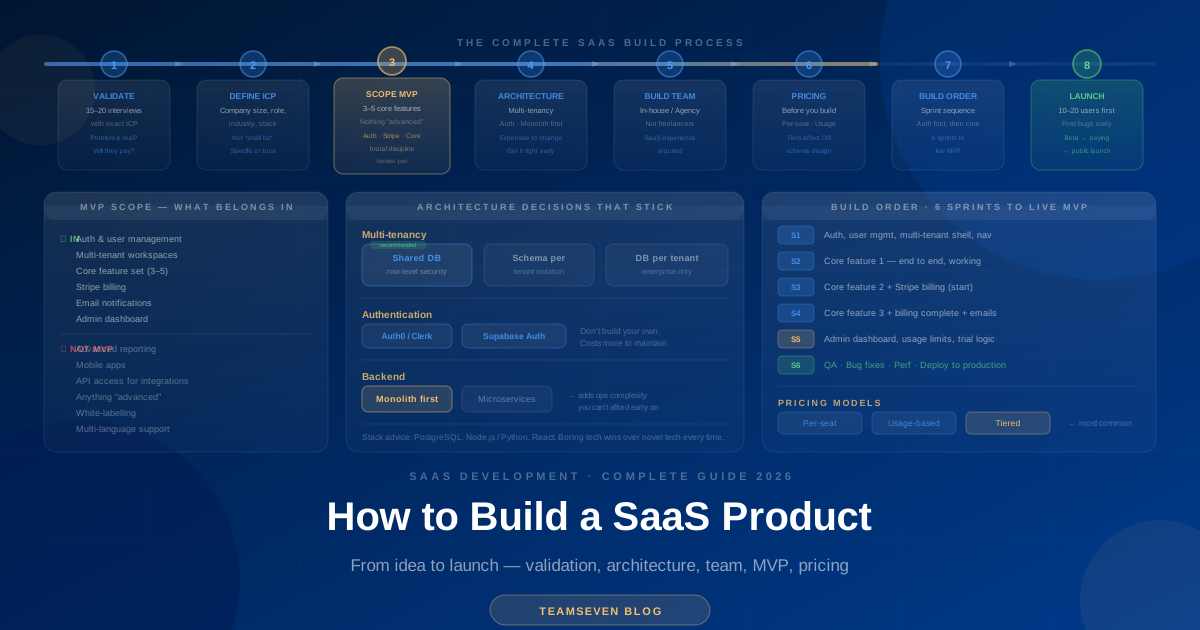
Most SaaS guides tell founders to find a problem worth solving, then jump straight to launch metrics. That skips the part that actually determines the outcome. This is the guide I would want to read before building a SaaS product: the practical decisions that decide whether you ship something people pay for, or spend six months building something nobody wanted.
We have been building SaaS products since 2017, more than 30 of them for founders across the US, UK, and Australia. Some are now live, revenue generating businesses processing real money for real customers. Some never made it past the first 100 users. The difference was rarely the idea. It was almost always the decisions made in the first six months, and this guide walks through every one of them in the order you will actually face them.
What is a SaaS product?
Before the how, the what, because founders sometimes confuse different types of software products.
Software as a Service has three defining characteristics.
Subscription based revenue. Users pay a recurring fee, monthly or annually, rather than a one time purchase. The revenue model drives architecture decisions, because the business depends on retention, not acquisition alone.
Multi tenancy. Multiple customers, called tenants, use the same instance of the software, with their data isolated from each other. This is what makes SaaS economically viable. One codebase and one piece of infrastructure serving many customers, instead of a separate deployment per customer.
Cloud hosted. The software runs in the cloud and is accessed through a browser or an API. Users do not install anything. Updates deploy automatically to everyone.
If you are building something without these three characteristics, a one off custom platform for a single client, an installed desktop application, or a service business supported by internal tools, you are not building SaaS. You might still be building something valuable, but the approach in the rest of this guide will not all apply.
Step 1: Validate the problem before writing a specification
The most common and expensive mistake in SaaS development is building a solution before confirming the problem is real, significant, and present in enough potential customers to generate viable revenue.
Validation is not market research. It is direct, specific conversations with the exact people you expect to be your customers, not friends, not your network broadly, but the specific job title at the specific company size in the specific industry your product is built for. Talk to 20 people who have the problem, and be honest with yourself about how encouraging they are being to be polite versus how much they actually mean it.
The conversation to have with each of them:
- Tell me how you currently handle this problem.
- What does that process look like in practice?
- What goes wrong with it?
- How much time does your team spend on it weekly?
- What have you already tried to solve it with?
- If this were solved reliably, what would that be worth to you?
You are not pitching your product in these conversations. You are listening. The answers tell you whether the problem is real, whether it is painful enough that people feel it, whether it is widespread enough to build a business on, and whether it is monetizable, meaning people would actually pay to have it solved.
After 15 to 20 conversations, patterns emerge. If 12 of 15 people describe the same specific pain and say they would pay to solve it, you have something worth building. If people acknowledge the problem but say they have worked around it or that it does not really cost them much, the pain is not sufficient to drive a purchase.
The minimum validation bar: 5 to 10 people in your target customer profile who say, clearly and specifically, yes I have this problem, here is what it costs me, and I would pay a specific amount to have it solved.
Two tools that make validation concrete instead of a set of conversations you can talk yourself out of.
Before building anything, build a landing page that describes your product as if it already exists. Include a pricing page. Add a start free trial or join waitlist button. Drive real traffic to it through LinkedIn posts, relevant communities, or direct outreach to target customers, and measure how many people click the sign up button. People clicking a button for a product that does not exist yet is the closest thing to validation you can get without shipping. It is not perfect, people click things they would never actually pay for, but it is far better than building for six months and discovering nobody wants it.
For B2B SaaS specifically, the strongest validation is a letter of intent: a non binding commitment from a potential customer that they will pay for your product once it is ready. Even five letters of intent from relevant companies at your target price point is real evidence your idea has commercial potential, not just conversational goodwill.
Step 2: Define your ICP before you define your product
Ideal Customer Profile is the specific type of customer your product is built for. Not small businesses, that is a category. Your ICP is something like Series A B2B SaaS companies with 15 to 50 employees, a Customer Success team of 3 to 5 people, and a customer base of 200 to 2,000 accounts.
The ICP drives every product decision that follows it.
Feature scope. What does your specific ICP actually need? A 3 person startup has different requirements from a 50 person scaleup, even inside the same industry.
UX complexity. Is your user technical or non technical? Do they use the product daily or weekly? Are they a power user or an occasional visitor?
Pricing. What can your ICP afford? What budget do they have, and what is the approval process for software purchases at their company?
Integrations. What tools does your ICP already use? Your product needs to work with their existing stack, not replace all of it on day one.
Defining the ICP precisely before specifying the product prevents a common failure mode: building something too generic to be anyone's first choice, because it was designed to be everyone's eventual choice.
Step 3: Define your MVP with brutal discipline
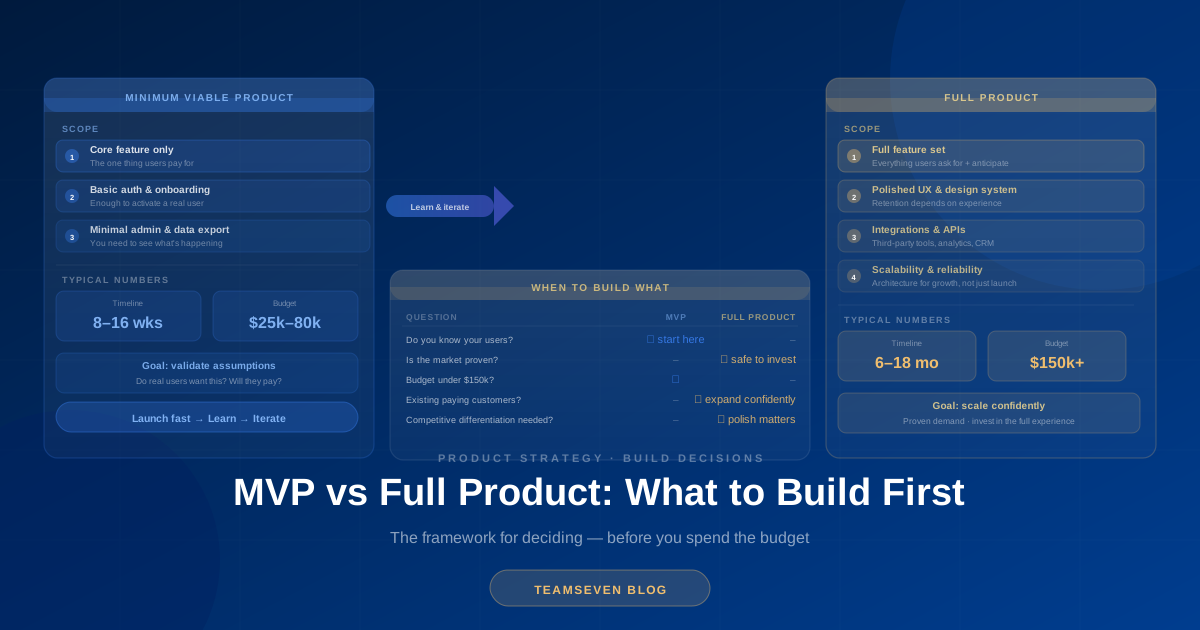
The Minimum Viable Product is the smallest version of your product that delivers your core value proposition to your ICP, and lets you find out whether they will actually pay for it.
Most founders scope their MVP at roughly two to three times what it should be. Every founder wants to add features, because more features feel like more value. They are not. More features mean a longer timeline before launch, more complexity for users trying to understand the product, more surface area that can break, more budget spent before any revenue exists, and less clarity about what is actually driving adoption once it ships.
The scoping exercise is simple to describe and hard to actually do. List every feature you think the MVP needs, then ask of each one: if we removed this feature, could we still find out whether people will pay for the core value proposition? If the feature passes that test, remove it and put it on the roadmap for version two. If it fails the test, it stays.
What a well scoped B2B SaaS MVP includes: authentication and user management, multi tenant workspace isolation if the product is B2B, three to five core features that deliver the primary value proposition, a basic admin dashboard for usage visibility, Stripe billing with subscription plans and a trial period, email notifications for critical events, and deployment to real production infrastructure, not just a laptop.
What does not belong in an MVP: advanced reporting and analytics, mobile apps unless mobile is the core value proposition itself, API access for integrations, team management and role based permissions beyond basic admin, white labelling, multi language support, deep customisation, and anything you would describe with the word advanced.
The one question to ask about each proposed feature: if we launched without this, would our target users refuse to even try the product? If the answer is no, it is not MVP.
On timeline. A properly scoped SaaS MVP takes roughly 12 to 20 weeks to build with a professional development team. Less than 12 weeks usually means corners were cut somewhere that will cost you later. More than 20 weeks usually means scope crept in during the build. If your MVP will take longer than 20 weeks, the MVP is too big, not the timeline too short. For the full cost breakdown behind that timeline, across a dozen real feature sets, see how much a SaaS MVP actually costs in 2026.
Step 4: Choose the right technical architecture from the start
Architecture decisions made in the first month of SaaS development are the most expensive to change later. Three matter more than the rest.
Multi tenancy model. There are three real approaches. Shared database, shared schema, where every customer's data sits in the same tables distinguished by a tenant identifier column, is the simplest and cheapest to operate, but requires careful application level isolation or you risk data leaking between customers. Shared database, separate schemas per tenant, gives stronger isolation with more complex migrations, and is a reasonable middle ground for mid market SaaS. Fully separate databases per tenant give complete isolation, cost the most to operate, and are sometimes required by enterprise customers with strict data sovereignty demands.
For most early stage B2B SaaS, shared database with row level security as a safety net is the right starting point. It is cost effective, scales to thousands of tenants, and is well understood by any competent engineering team. Plan the migration path to separate schemas for the point when you start winning enterprise customers who actually require it. The full trade off table, including where the wrong early choice turns into a six figure rewrite later, is in multi tenant versus single tenant SaaS explained for founders.
Authentication approach. Build it yourself or use a managed service such as Auth0, Clerk, Cognito, or Supabase Auth. For nearly every early stage SaaS product, a managed auth service is the right choice. It handles email verification, password reset, multi factor authentication, single sign on, and the security patching that a custom implementation would otherwise leave entirely on your own team. The monthly cost is almost always lower than the engineering time required to maintain equivalent functionality yourself.
Backend architecture, monolith versus microservices. Start with a monolith. Every successful SaaS product started as a monolith. Microservices add operational complexity that an early stage product cannot afford: deployment pipelines, service discovery, distributed tracing, inter service communication, all before you have a single paying customer. Build a well structured monolith that can be decomposed into services later, not a microservices architecture that requires a dedicated platform team to operate from day one.
For the complete set of architecture trade offs, including database design and the decisions no one discusses honestly until they have already been burned by one, see SaaS architecture best practices.
Step 5: Decide who builds it
Three realistic options exist for building a SaaS product, and the right one depends entirely on your stage, not your preference.
Build it yourself, if you are technical. Fastest to start, slowest to scale. You control everything and spend nothing on development, but you also spend every hour building instead of selling, and a production SaaS product is meaningfully harder to build alone than a personal project. Right for technical founders validating an idea before raising money or bringing on a development partner.
Hire an in house team. Suitable when you have three to six months to hire properly, the budget to pay competitive senior engineering salaries, and a long term commitment to maintaining that team. The right choice once the product is your core business and you expect to need sustained engineering capacity for years, not months.
Work with a development agency. Suitable for founders who need to move fast without hiring, who want a team with relevant SaaS experience on day one, and who can define requirements clearly enough for a team that was not in the room for the early idea conversations. The right choice for MVP development, and for startups validating product market fit before committing to an in house team.
How to actually evaluate a SaaS agency, if that is the route you take. Ask whether they have built multi tenant SaaS products before, not just websites or generic mobile apps. Ask to see live products they have built, ideally ones still running today, not screenshots from a portfolio deck. Ask specifically about their experience with Stripe billing integration, multi tenancy architecture, and subscription management, since these are the technically specific skills that separate agencies who understand SaaS from agencies who build marketing sites. And ask for references from founders who built a SaaS product with them specifically, then actually call those references and ask whether the product shipped as specified, on time, and on budget.
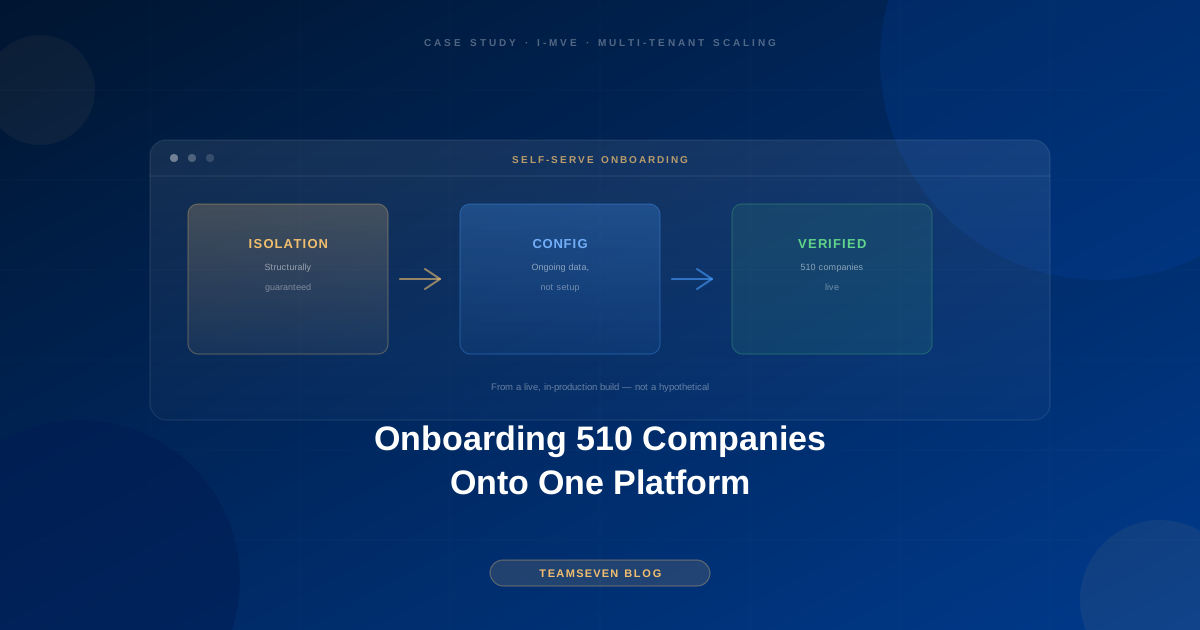
We built i-mve, a multi tenant SaaS now live across 510 UK removals companies, processing more than 40 million pounds in job value through the platform. We built a smart parking automation platform integrating ANPR cameras, boom gates, and contactless payments across 17 sites in Australia, deployed at a national ambulance service. We also designed, built, and still operate QRPixel ourselves, a link in bio and dynamic QR platform live in production, which means we run our own SaaS product day to day, not only client work. That combination, more than 30 SaaS products shipped for clients plus one we operate ourselves, is the kind of evidence worth asking any agency for before you commit a budget.
Step 6: Plan your pricing before you build
Most founders plan pricing after the product is built. That is backwards. Pricing decisions affect product decisions: what features go in which tier, what usage limits exist, and how the billing infrastructure itself needs to be built.
The three common B2B SaaS pricing models. Per seat pricing charges a fixed amount per user per month, is simple to understand, and scales predictably with company size. It works well when the product's value increases with the number of users, the way Slack, Notion, or Figma do. Usage based pricing charges per unit of value, an API call, a document processed, a report generated. It aligns cost with value and lowers the barrier to adoption since there is no seat commitment, but makes revenue harder to predict, the way Stripe, Twilio, or AWS price. Tiered pricing offers Starter, Growth, and Enterprise tiers with increasing features and limits, and is the most common model for B2B SaaS overall, working well whenever different customer sizes have meaningfully different needs.
Decide before building which model fits your product and your ICP, what each tier includes, what the usage limits are, and what the upgrade trigger is, meaning the exact moment a customer on a lower tier needs to move up. These decisions affect database schema design, billing integration complexity, and feature flag implementation, so they need to be discovered during planning, not discovered halfway through development when changing them means touching code everywhere.
Step 7: Build billing correctly from day one
Billing is the most underestimated component of SaaS development. Using Stripe is the right choice for most SaaS products, but Stripe integration and billing done properly are not the same thing.
Billing done properly includes subscription lifecycle management: new subscriptions, trial periods, trial to paid conversion, upgrades, downgrades, cancellations, and reactivations, each one a state your application needs to handle correctly, not just at signup. It includes failed payment handling, since cards expire and charges fail for all kinds of reasons, which means you need a dunning process that retries the charge on a schedule, notifies the customer by email, downgrades access after a defined period, and allows reactivation once payment is fixed. It includes proration, since a customer upgrading partway through a billing cycle needs the right amount calculated and clearly communicated, even though Stripe handles the raw calculation for you. It includes invoice customisation, since enterprise customers frequently need specific billing entity names, purchase order numbers, and tax identification numbers on their invoices, which is more than an afternoon of engineering work to collect and pass through correctly. And if your pricing model includes anything usage based, API calls, active users, storage, or seats, you need a metering system that accurately tracks and reports that usage to Stripe, which is its own small engineering project on top of the billing integration itself.
Start with the simplest billing model your business can actually support, and add complexity only when a real paying customer requires it, not in anticipation of one.
Step 8: Build in the right order
The order of development matters as much as the scope. The pattern that works, sprint by sprint.
First sprint: authentication, user management, multi tenant workspace creation, and basic navigation. No features yet, just the shell of the application that a logged in user can move through. This is the foundation everything else sits on.
Second sprint: core feature one, the single most important thing the product does, working end to end for a real user. Nothing else yet.
Third sprint: core feature two, and the beginning of Stripe billing integration, meaning the subscription model and plan selection, not the finished billing system.
Fourth sprint: core feature three, billing completion, and email notifications for critical events.
Fifth sprint: the admin dashboard, usage limits, and trial period logic.
Sixth sprint: QA, bug fixing, performance optimisation, and deployment to production.
By the end of the sixth sprint, you have an MVP real users can actually pay for and use. Everything after that is iteration based on real usage data, not assumptions made before launch.
Step 9: Launch to a small group first
Launching to a small group of 10 to 20 early users before a public launch is consistently underused by founders who want to reach as many people as possible on day one.
A small group launch achieves three things a public launch cannot. Real usage data before the public launch reveals bugs and usability problems that exist in any first release, and it is far better to discover a confusing onboarding flow with 15 users than with 1,500. Direct feedback from engaged users who genuinely want you to succeed tells you what to build next, and these early users tend to become your advisory board, your reference customers, and your first case studies. And evidence of value before broader marketing gives you something real to say. We have been in closed beta with 20 companies, 15 of whom are paying customers, is a far better launch story than we just built this and hope people like it.
What a realistic SaaS launch actually looks like
Not the hockey stick graph founders picture before they start. The realistic one, month by month.
| Timeframe | What actually happens |
|---|---|
| Month 1 | 20 to 50 users, mostly from your waitlist and existing network. 30 to 50 percent churn because the product does not fit their workflow yet. |
| Month 2 to 3 | First paying customers, typically 5 to 15 of them. Product iteration based on real user feedback. First real signals of what is working and what is not. |
| Month 4 to 6 | Finding the wedge, the specific type of customer who activates, pays, and stays. This is your actual target customer, and it is often somewhat different from who you imagined in month 1. |
| Month 6 to 12 | Growth starting to compound as you double down on what is working. Retention improving as the product gets fixed for your actual customer, not the imagined one. |
| Month 12 plus | Real traction, if you got through the first year without abandoning the product or the customer segment. |
This is not meant to be discouraging. This is what the successful ones actually look like from the inside. The founders who navigate this well stay close to their customers, iterate on the product honestly instead of defensively, and do not mistake early growth metrics for validation of the whole business.
The first 90 days after launch
The period immediately after launch is where most SaaS products fail, and usually not because the product does not work. It is because the founder does not know how to use early user behaviour to make the product better before the users who would have told them have already left.
Talk to every user in the first 30 days, not through a survey but by phone or video call. Ask what made them sign up, what they are actually trying to do, what is confusing, and what is missing. This is the most valuable time you will ever spend in the company. Users who leave in the first 30 days tend to leave forever, and the reasons they leave are almost always fixable if you find out what they actually were.
Measure the right things. Vanity metrics, signups, page views, total registered users, tell you almost nothing at this stage. The metrics that matter are activation rate, meaning what percentage of signups complete the core action that delivers value, day 7 retention, meaning what percentage of users are still using the product a week after signing up, day 30 retention at the same interval, and time to value, meaning how long it takes from signup until a user first experiences the core value the product promised them. If activation rate sits below 50 percent or day 7 retention sits below 40 percent, there is a product problem to fix before spending another dollar on acquisition.
Do not optimise acquisition before you have retention. This is the single most common mistake made by SaaS founders right after launch. Spending on ads, hiring salespeople, and building growth loops before you have proven that users who try the product actually keep using it is a fast way to spend a budget on a product nobody was going to stay with anyway. Fix retention first, then scale acquisition into a product that already holds onto the people it attracts.
The most important thing we have learned about SaaS
More than 30 SaaS builds and eight years later, the pattern that separates the products that succeed from the ones that do not has almost nothing to do with technology.
The products that succeed have founders who understand their users deeply and make product decisions based on what users actually do, not what they say they want in a hallway conversation. They have founders who ship and iterate rather than refining forever in private. They have founders who stay narrow on their ICP and resist the pressure to expand the target market before the core market is genuinely well served.
The products that fail have founders who built what they assumed users wanted rather than what users actually needed. They built too much before validating anything. They changed direction based on one loud user conversation rather than a real pattern across many quieter ones.
The technology is the easy part. The discipline is the hard part.
"More than 30 SaaS builds and eight years later, the pattern that separates the products that succeed from the ones that do not has almost nothing to do with technology."
Frequently asked questions
What are the steps to build a SaaS product? Validate the problem before writing a specification, define your ICP before your product, scope the MVP with real discipline, make the architecture decisions that are expensive to reverse later, decide who actually builds it, plan pricing before development starts, build billing correctly from day one, build features in the right order, launch to a small group first, and treat the first 90 days after launch as its own distinct phase of work, not an afterthought.
How do I validate a SaaS idea before building it? Talk to 15 to 20 people who have the problem you think you are solving, and find out what they currently do instead of a real product. If they have already built a workaround, a spreadsheet, a manual process, a chain of separate tools, that is genuine evidence of demand. If nobody has bothered to work around the problem at all, it may not be painful enough for anyone to pay to have solved.
How long does it take to build a SaaS MVP? Roughly 12 to 20 weeks with a professional development team, for a properly scoped MVP. Less than 12 weeks usually means real corners were cut. More than 20 weeks usually means scope crept in somewhere along the way. For a full cost and feature by feature breakdown behind that range, see how much a SaaS MVP actually costs in 2026.
Should I hire an agency or build in house for a first SaaS product? An agency makes sense when you need to move quickly without hiring a full team, and the product is not yet the company's entire engineering identity. In house makes sense once the product is the business itself and you intend to keep developing it indefinitely. Many founders start with an agency for the first build and transition to an in house team later, once the product and the market fit are both proven.
Why does billing need to be built correctly from day one instead of bolted on later? Because billing state touches authentication, permissions, and feature access throughout the entire product. Adding proper subscription logic to a system that was not designed for it usually means changing code across the whole application, often while paying customers are already relying on the parts you are changing.
When should I start planning the launch? Before the build finishes, not after. Launch planning done at the very end produces a finished product nobody knows exists yet, and finding your first users takes at least as long as building the product they will eventually use.
Muhammad Nabeel is the co-founder of Teamseven, a SaaS development agency based in Lahore, Pakistan. We have built more than 30 SaaS products for founders across the US, UK, and Australia since 2017, from first MVP to production platforms serving thousands of users, including one we design, build, and operate ourselves. Talk to us about your SaaS project, or book a free consultation if you already know what you want to build.