MVP vs Full Product: What Should You Actually Build First?
How to decide between an MVP and a full product build: what an MVP really means, when to build one, when to skip it, and how to scope it.

"Should I build an MVP first or just build the full product?"
I get this question constantly, and the honest answer annoys people because it's not a clean yes or no. It's: it depends on what you're trying to learn and how much you already know.
Let me give you a framework that helps you decide, based on having built both MVPs that became products and full products that should have been MVPs.
First, what an MVP is (and isn't)
The term MVP, Minimum Viable Product, is widely misunderstood, and the misunderstanding causes real problems.
An MVP is not a half-built, broken version of your product. It's not "cheap and bad." It's the smallest complete thing that delivers your core value and lets you learn whether people want it. The key word is viable. It has to work and deliver value. It's minimum in scope, not minimum in quality.
The classic mistake is treating MVP as "the cheapest thing we can ship." That produces something broken that teaches you nothing except that broken things don't get used. A real MVP does one thing well, the core thing, and does it properly.
The other mistake is the opposite: treating "MVP" as a label you slap on what is a full product build, because "MVP" sounds lean. If your "MVP" has fifteen features and takes nine months, it's not an MVP. It's a full product you're calling an MVP.
The short answer
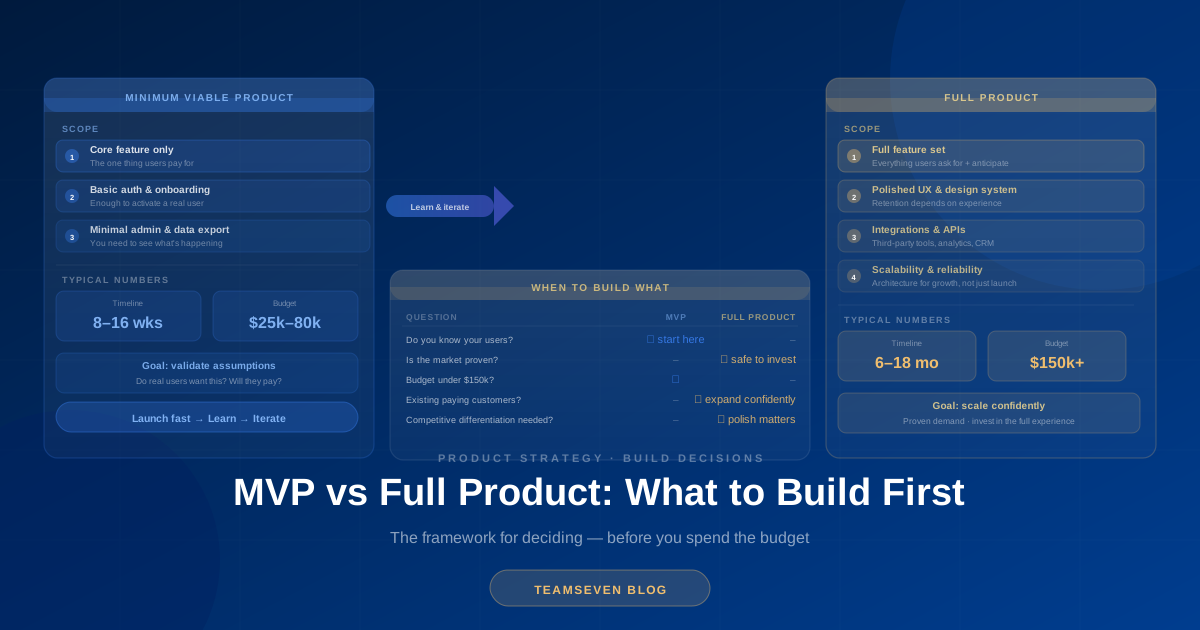
| Build an MVP first when... | Build the full product when... |
|---|---|
| You're unsure if people want this | You've already validated demand |
| You're pre-revenue / pre-funding | You have proven product-market fit |
| The market is unproven | You're entering a known, proven market |
| You want to learn before committing | You know exactly what's needed |
| Budget/runway is limited | You're well-funded with a clear direction |
| Speed to feedback matters most | The full experience is required to deliver any value |
The deciding question underneath all of these: how much do you already know about whether people want this? The less you know, the more you should build an MVP. The more you know, the more building the full thing makes sense.
Why the MVP usually wins for new products
For a new product (a new idea, a new market, an unproven assumption) the MVP almost always wins. Here's the logic.
When you build a full product before validating demand, you're making a large bet on an unproven assumption. If you're right, great, but you'd have learned you were right from an MVP too, faster and cheaper. If you're wrong, you've spent your entire budget and timeline building something nobody wants, and you've learned that expensively when you could have learned it cheaply.
The MVP de-risks the bet. You build the core, you put it in front of real users, and you learn whether the fundamental assumption holds before committing the full investment. If it holds, you build more with confidence. If it doesn't, you've saved most of your budget and you can pivot.
The math is asymmetric. The MVP costs you a little speed if you were going to be right anyway. It saves you enormously if you were going to be wrong. For unproven products, that trade is almost always worth making.
When skipping the MVP is the right call
But sometimes building the full product directly is correct, and MVP dogma can hurt you:
When you've already validated. If you have a proven product-market fit (existing customers, clear demand, a working business that you're rebuilding or scaling) you don't need to re-validate with an MVP. Build the proper version.
When the MVP can't deliver value. Some products require a certain completeness to be useful at all. A payments platform that only handles 20% of transaction types isn't a viable MVP. It's a non-functional product. Some products have a minimum bar of completeness below which they deliver no value. For these, "minimum viable" is closer to "full" than the MVP framework suggests.
When you're in a known, competitive market. If you're entering an established market where the expected feature set is well-known and table-stakes, a stripped-down MVP may just look inferior to existing options. Sometimes you need to meet the market's baseline to be taken seriously.
When the cost of iterating is higher than building right. In some domains (regulated industries, hardware-dependent systems, enterprise software with high switching costs) the cost of launching something incomplete and iterating publicly is higher than building it properly first.
The trap: the "MVP" that's secretly a full product
The most common scoping failure I see isn't choosing wrong between MVP and full product. It's calling something an MVP when it's a full product.
A founder says "let's build an MVP" and then lists fifteen features, three user types, six integrations, and a mobile app. That's not an MVP. That's a full product wearing an MVP label, and it'll cost full-product money and take full-product time, but the founder budgeted for an MVP and is now surprised by the quote.
The discipline of a real MVP is brutal subtraction. For every feature, you ask: does this directly serve the core thing we're trying to validate? If not, it's not in the MVP. Most features don't survive this question, and that's the point. An MVP that does one thing well beats an "MVP" that does ten things adequately and took four times as long to build.
How to scope a real MVP
If you've decided an MVP is right, here's how to scope it properly:
Define the one core value. The single most important thing your product does: the reason someone would use it at all. One sentence.
Identify the one user you're building for first. Not all your eventual users. The one type whose problem is most acute and who you most need to validate with.
List only the features that deliver the core value to that user. Authentication, the core feature, and the minimum around it to make the core feature usable. That's roughly it.
Cut everything else to a "later" list. Reporting, additional user types, integrations beyond the essential, mobile apps, admin sophistication, advanced features: all of it goes on the roadmap, not in the MVP.
Make sure what remains is viable. The MVP still has to work properly and deliver real value. Minimum scope, full quality.
A well-scoped B2B SaaS MVP is usually 3–5 core features plus the essentials, built in 12–20 weeks. If your MVP is materially bigger than that, you're probably building a full product, which is fine, but call it what it is and budget accordingly.
The honest framework
Here's how I'd advise you, stripped of dogma:
If you don't yet know whether people want what you're building: build an MVP. Learn cheaply before committing.
If you've validated demand and know what's needed: build the proper product. Don't artificially shrink something that needs to be complete.
If your "MVP" has grown to fifteen features: stop, and cut it back to the core, or accept that you're building a full product and budget for it.
And whatever you build, MVP or full product, build it properly. The MVP isn't an excuse for poor quality. It's an argument for narrow scope at full quality, so you learn from something that works.
The founders who succeed aren't the ones who religiously build MVPs or religiously build full products. They're the ones who assess how much they know, build the right amount to learn the next thing, and ship it well.
FAQ
Should I build an MVP or a full product first? For a new product, the MVP almost always wins. It puts something real in front of users before you've committed the full budget, and what you learn changes what you build next. The exception is when you're replacing an existing system people already depend on, where a partial product isn't usable and a phased full build makes more sense.
What counts as an MVP? The smallest version that delivers real value to a real user and lets you learn something you can't learn any other way. It is not a broken version of the full product, and it is not a demo. It has to work properly for the narrow thing it does.
When is skipping the MVP the right call? When you're replacing software an operation already runs on, when regulatory or compliance requirements mean a partial system can't be deployed at all, or when the core value only exists once several pieces work together. In those cases a phased full build is more honest than calling it an MVP.
What's the most common MVP mistake? Scoping an "MVP" that is secretly a full product. The word gets used to make a large build sound small, and the result is a project with all the cost of version one and none of the learning, because it takes so long to ship that the feedback arrives too late to change anything.
How do I scope a real MVP? Pick the one workflow that matters most, build that properly, and cut everything else, including features you're certain you'll need later. If cutting a feature feels painful, that's usually a sign it belongs in version two rather than version one.
Stay connected
Build notes, launches, and new articles from the Teamseven team.