

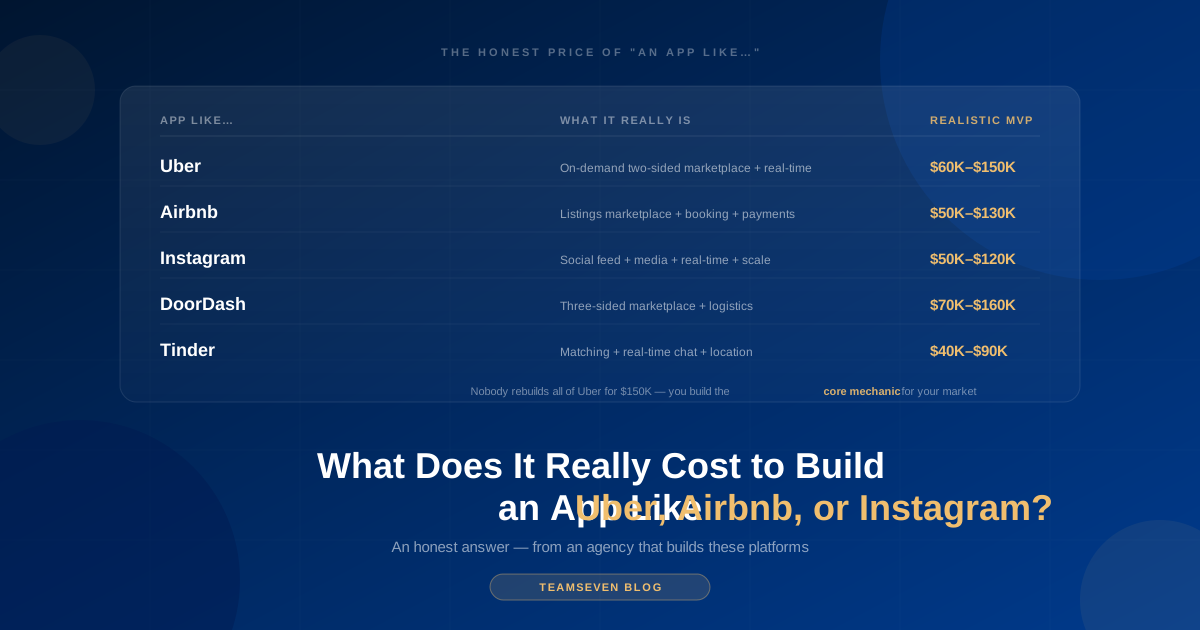
"How much does it cost to build an app like Uber?" is one of the most-searched questions in software development. I'm going to answer it honestly — including the part where I tell you the question itself can lead you somewhere unhelpful.
We build marketplace, on-demand, and social platforms, so I can give you real numbers. But the most valuable thing in this article isn't the numbers — it's understanding what you're actually asking when you say "an app like Uber," because that framing has sent a lot of founders down expensive wrong paths.
The short answer
| "An app like..." | What it really is | What drives the MVP cost | What drives the full platform cost |
|---|---|---|---|
| Uber | On-demand two-sided marketplace + real-time + payments | Core matching + tracking + payments for one market | Full driver/rider ecosystem, dispatch logic, scale |
| Airbnb | Listings marketplace + booking + payments + reviews | Listings, booking flow, payments for one niche | Search, trust & safety, host tooling, scale |
| Social feed + media + real-time + scale | Core feed and media sharing for one audience | Recommendation systems, moderation, global scale | |
| DoorDash | Three-sided marketplace + real-time + logistics | Core order flow across the three sides, one region | Full logistics network, dispatch optimisation, scale |
| Tinder | Matching + real-time chat + location | Core matching and chat for one market | Discovery algorithms, safety tooling, global scale |
These assume professional development with real quality — the actual number depends entirely on which of these elements your version needs. Now let me explain why the headline number is almost beside the point.
Why "an app like Uber" is the wrong way to think about it
When a founder says "I want to build an app like Uber," they almost never mean they want to rebuild all of Uber. Uber is thousands of engineers, years of development, and enormous infrastructure built over more than a decade. Nobody is rebuilding that on an MVP budget.
What they actually mean is one of two things:
"I want the core mechanic of Uber for a different market." On-demand matching of supply and demand with real-time tracking and payments — but for a niche Uber doesn't serve. This is a real, buildable product, and it's a fraction of "all of Uber."
"I want something with the polish and feel of Uber." They're using Uber as a quality benchmark, not a feature spec.
The expensive mistake is taking "like Uber" literally and trying to build every feature Uber has. Uber's full feature set exists because Uber has hundreds of millions of users and a decade of iteration. Your MVP needs the core mechanic that delivers your value, not the accumulated complexity of a mature global platform.
So the real question isn't "what does it cost to build Uber." It's "what's the core mechanic I need, for my market, to validate that people want this?" That's a much cheaper and much smarter thing to build.
What actually drives the cost of these apps
Real-time features
Uber-like and DoorDash-like apps need real-time — live location tracking, live order status, live driver movement. Real-time infrastructure is more complex and more expensive than standard request-response apps. If your "app like X" genuinely needs real-time, that's a real cost driver. If it doesn't, dropping it saves significant money.
Two-sided (or three-sided) marketplaces
Uber connects riders and drivers. DoorDash connects diners, restaurants, and drivers — three sides. Each side is effectively its own app with its own experience. "An app like Uber" is at minimum two products, and possibly three. This is the single biggest reason these apps cost what they do, and the thing founders most underestimate.
Payments and money movement
These apps move money between parties — riders to drivers, guests to hosts, diners to restaurants, minus the platform's cut. Split payments, payouts, refunds, holds — payment complexity is real engineering and a real cost. (I've written about this in detail in the marketplace cost guide.)
Scale and the cold-start problem
Instagram's hard problem isn't the photo feed — it's serving billions of them reliably. But here's the thing: you don't have billions of users on day one. Building for Instagram's scale before you have Instagram's users is a classic, expensive mistake. Build for your realistic early scale. And every one of these apps faces the cold-start problem — an empty marketplace or social network is useless — which is a product and go-to-market challenge as much as an engineering one.
Where founders waste money building "an app like X"
Building the whole thing before validating. The biggest one. You don't need every Uber feature to find out if your niche on-demand idea works. Build the core mechanic, validate, then expand. (See the MVP vs full product discussion — it applies directly here.)
Copying features that exist for scale you don't have. Many features in mature apps exist to manage problems of massive scale. At your stage, they're premature. Don't build them yet.
Real-time everything when you don't need it. Real-time is expensive. Use it where it genuinely matters (live tracking) and not where it doesn't.
Native both platforms before validating. Cross-platform (Flutter or React Native) gives you iOS and Android for far less. Build native later if you have a specific reason. (More in the Flutter vs React Native comparison.)
Treating "like Uber" as a spec instead of an inspiration. The most expensive mistake of all. Uber is your quality bar, not your feature list.
How to get your actual number
Stop thinking "app like Uber" and answer these:
What's the core mechanic? The one essential thing — matching riders and drivers, listing and booking spaces, sharing and viewing media. Just the core.
Who are the sides? Two-sided? Three-sided? Each side is real scope. Name them.
Do you genuinely need real-time? Live tracking and updates, or is near-real-time fine? This swings cost significantly.
What's your actual early scale? Not your dream scale — your realistic first-year scale. Build for that.
What's the narrowest version that validates the idea? That's your MVP. That's what you should price and build first.
Answer those, and the real cost of your actual app becomes clear — and it's almost always less than "an app like Uber" sounds, because you're building your focused core, not someone else's mature global platform.
The honest bottom line
You can't build Uber on an MVP budget. But you almost certainly don't need to. You need the core mechanic of Uber, for your specific market, built well enough to validate that people want it. That's a real, fundable, buildable product, and it costs a fraction of "all of Uber."
The founders who succeed with "app like X" ideas are the ones who understood they were borrowing a proven mechanic, not cloning a mature company. They built their focused version, validated it, and expanded based on real usage. The ones who struggle are the ones who tried to build the whole thing before finding out if anyone wanted their version of it.
Use the famous app as inspiration and quality bar. Build your actual core. Validate. Then grow.
Stay connected
Build notes, launches, and new articles from the Teamseven team.