
How Much Does It Cost to Build a Marketplace App in 2026? An Honest Breakdown
A real cost breakdown for building a two-sided marketplace app in 2026: by complexity, by region, and by what drives the price.

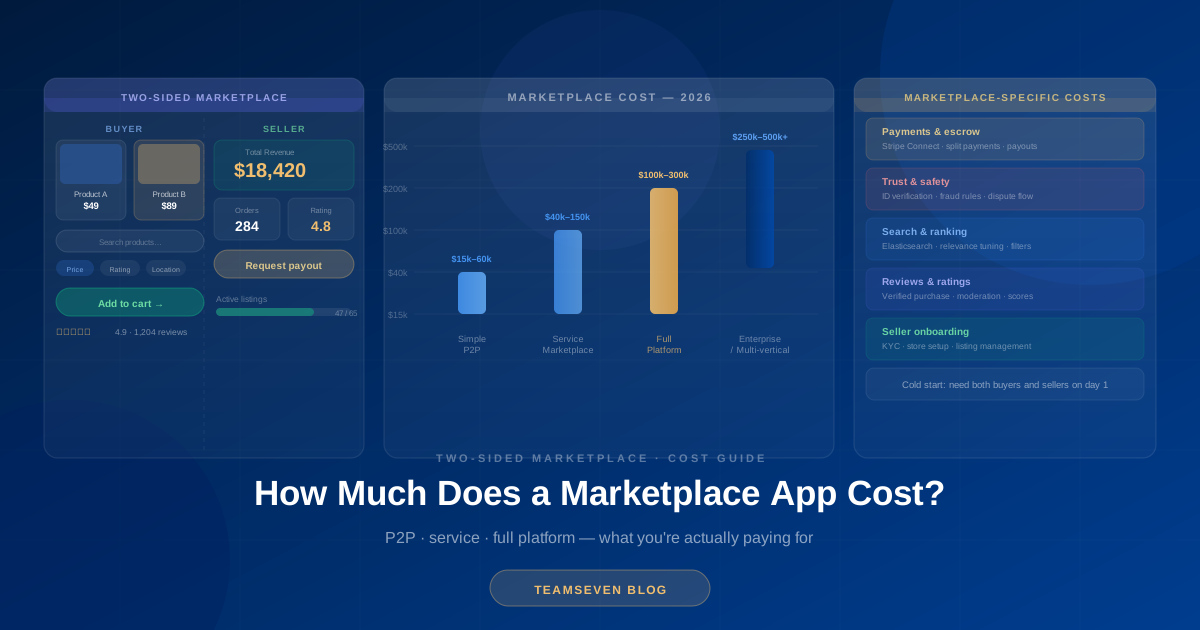
If you've searched this question already, you've seen the same answer everywhere: a huge, vague range with "it depends on complexity" tacked on the end. Thanks, very helpful.
I'm going to give you something more useful: the actual reasons the number moves, what you're really paying for, and where founders waste money building marketplace features they didn't need. This comes from eight years of building platforms, including two-sided systems where buyers and sellers, or providers and clients, both have to be served well.
Let me start with the honest summary, then explain how to land on your real number.
The short answer
| Marketplace complexity | South Asian agency | Eastern European agency | US agency | Timeline |
|---|---|---|---|---|
| Simple MVP (one category, basic listings, basic payments) | Scoped after a call | Scoped after a call | Scoped after a call | 16–24 weeks |
| Standard marketplace (search, reviews, messaging, split payments) | Scoped after a call | Scoped after a call | Scoped after a call | 24–36 weeks |
| Complex marketplace (multi-category, advanced matching, logistics, scale) | Scoped after a call | Scoped after a call | Scoped after a call | 36+ weeks |
Ranges assume professional agencies with real portfolios and full delivery: design, development, QA, deployment. They exclude ongoing hosting, payment processing fees, and maintenance. Complexity and region both move the number significantly, book a consultation for yours.
Now here's why the number lands where it lands for you specifically.
Why marketplaces cost more than they look like they should
A marketplace looks like a normal app with listings. It is not. A marketplace is secretly two apps that have to work together, plus the hard part that connects them.
You're building an experience for buyers (browsing, searching, purchasing). You're building a separate experience for sellers (listing, managing, fulfilling, getting paid). And you're building the engine in the middle that matches them, handles the money flowing between them, and keeps both sides trusting the platform enough to keep using it.
That "engine in the middle" is where marketplace projects get expensive and where they go wrong. It's the part founders underestimate because it's invisible in the mockups. You can't draw "trust and payment splitting" in a Figma file, but it's most of the engineering.
What drives the cost
1. The two-sided nature itself
You're building two products, not one. The buyer side and the seller side each need their own onboarding, their own dashboard, their own workflows. A founder who scopes "a marketplace" as one app is scoping half the actual work. This is the single biggest reason marketplace estimates surprise people.
2. Payment complexity: the split payment problem
In a normal app, money goes from the customer to you. Simple. In a marketplace, money goes from the buyer, through your platform, to the seller: minus your commission. That's called split payments, and it's complex.
You're dealing with: holding funds, releasing them on the right trigger (order delivered? confirmed? after a return window?), taking your cut, handling refunds where the money already went to the seller, and managing the seller payout schedule. Payment providers like Stripe have marketplace-specific products (Stripe Connect) that help, but integrating them properly is real work. Get it wrong and you either lose money or break the law.
3. Trust and safety systems
A marketplace only works if both sides trust it. That trust is built by systems: reviews and ratings, identity verification, dispute resolution, fraud detection, content moderation. None of these are glamorous. All of them are necessary. A marketplace without trust systems is a marketplace nobody uses twice.
4. Search and matching
In a single-vendor store, "search" means finding a product in your own catalogue. In a marketplace with many sellers and many listings, search and matching becomes a core feature, and a hard one. Filtering, ranking, relevance, location-based matching. The quality of search directly affects whether buyers find what they want, which directly affects whether the marketplace works at all.
5. The cold-start problem (this is a product cost, not just a code cost)
The hardest thing about a marketplace isn't building it. It's that an empty marketplace is useless. No buyers means no sellers; no sellers means no buyers. Solving this shapes what you build first. Often the answer is to launch single-sided, or seed one side manually, or focus tightly on one category in one location before expanding. This affects scope, which affects cost. The smartest marketplace MVPs are deliberately narrow to solve cold-start.
Where founders waste money on marketplaces
Having watched this play out repeatedly, here's where the budget leaks:
Building both sides fully before validating either. You don't always need a polished seller app and a polished buyer app on day one. Sometimes you onboard the first sellers manually while you validate the buyer demand. Building full automation for ten sellers you could have onboarded by hand is wasted money.
Over-building the matching algorithm. Founders imagine sophisticated AI matching before they have any users to match. Early on, simple search and filters are completely fine. Build the fancy matching when you have the volume that justifies it, which is a good problem you can afford to solve later.
Premature scale engineering. Building for a million listings when you have zero. The architecture that matters at scale is different from what matters at launch, and you'll understand it better once you have real usage. Build for your first thousand, not your imagined millionth.
Adding categories too early. A marketplace that does one category well beats one that does ten categories badly. Every category adds scope. Narrow first, expand once the model works.
What's included: and what isn't: in these numbers
When an agency quotes you a marketplace build, make sure you know what's in and what's out. The honest version of what a real quote should include:
Buyer app and seller app. Core listings and search. Payment integration with split payments. Reviews and basic trust systems. Messaging between parties. Admin panel for you to manage the platform. Design, QA, and deployment.
What's frequently NOT included and surprises people later: ongoing payment processing fees (a percentage of every transaction, forever), hosting and infrastructure (monthly, scales with usage), content moderation (especially if user-generated content is involved), customer support tooling, and post-launch maintenance (budget 15–20% of build cost annually).
Ask any agency explicitly: what's included, and what will I be paying for separately after launch? A low build quote with high hidden ongoing costs is not a bargain.
How to get your actual number
The range above is useless for planning on its own. Here's how to narrow it to your real number:
Write down your two sides. Who's the buyer, who's the seller, and what does each one absolutely need to do in version one? Be specific. This single exercise eliminates half the ambiguity in a marketplace estimate.
Decide your payment model. Commission per transaction? Subscription for sellers? Listing fees? This decision shapes the payment engineering significantly.
Identify your cold-start strategy. How will you get the first sellers and buyers? This determines what you need to build first versus later.
Pick your launch narrowness. One category, one city, one type of transaction. The narrower your launch, the lower your initial cost and the faster you learn whether the model works.
Once you've done that, a good agency can give you a real number, not a huge, generic range, but an actual estimate for your actual marketplace.
A note on offshore for marketplaces specifically
Marketplaces are well-suited to offshore development because the scope is definable and the work is substantial enough to benefit from a dedicated team. The split-payment integration, the trust systems, the dual-app architecture: these are well-understood engineering problems that an experienced offshore team handles at a fraction of US agency cost.
The thing to verify: has the agency built a marketplace before? Split payments, trust systems, and two-sided architecture have specific gotchas. An agency that's built marketplaces will navigate them. An agency learning on your project will hit every one of them on your budget and timeline. Ask to see a marketplace they've built, and ask specifically how they handled payment splitting and the cold-start problem.
FAQ
How much does it cost to build a marketplace app? A simple MVP with one category, basic listings and basic payments is the fastest and least expensive build, running 16–24 weeks. A standard marketplace with search, reviews, messaging and split payments takes 24–36 weeks and costs meaningfully more because of the payment splitting and trust systems involved. A complex multi-category marketplace with advanced matching and logistics runs 36 weeks or more and sits at the top end, driven by scale and matching complexity.
Do I need to build both sides of the marketplace at launch? Usually not. Building a polished buyer app and a polished seller app before validating either is one of the most common ways to overspend. Often you can onboard one side manually while the other side gets real software, and learn far more for far less.
Should I build a sophisticated matching algorithm first? No. Founders routinely imagine AI-driven matching before they have any users to match. Early on, simple search and filtering does the job, and the data you gather from real usage is what makes a smarter algorithm worth building later.
How many categories should a marketplace launch with? One, done well. A marketplace that serves a single category properly beats one that serves ten badly, and every additional category adds real scope. Narrow first, expand once the model is proven.
What's the most useful thing to do before requesting a marketplace quote? Write down your two sides explicitly: who is the buyer, who is the seller, and what does each absolutely need to do in version one. That single exercise removes more cost and confusion from a marketplace quote than any other preparation.
Stay connected
Build notes, launches, and new articles from the Teamseven team.