
How Much Does It Cost to Build an Ecommerce App in 2026?
An honest cost breakdown for building a custom ecommerce app in 2026: by complexity, by region, custom vs Shopify, and what drives the price.

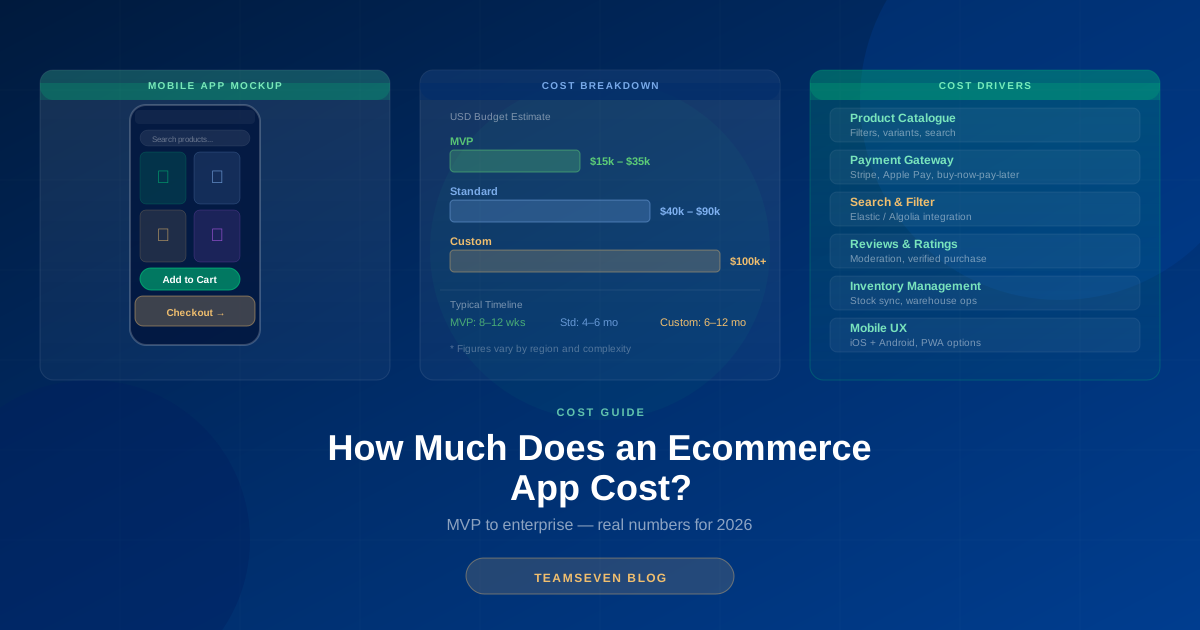
Ecommerce app cost guides are a crowded space, and most of them say the same vague thing. I'll give you the honest version, including the question most of them skip: should you even build a custom ecommerce app, or should you just use Shopify?
That question matters, because the cheapest ecommerce app is the one you don't build when an existing platform would do the job. I'd rather tell you that upfront than sell you a build you didn't need. We build custom ecommerce and shopping platforms (we built Mebag, an AI-powered shopping cart, on OpenAI) so this comes from doing the work, but I'll be straight about when custom is the wrong call.
The short answer
| Ecommerce app type | South Asian agency | Eastern European agency | US agency | Timeline |
|---|---|---|---|---|
| Basic store app (catalogue, cart, payments) | Scoped after a call | Scoped after a call | Scoped after a call | 12–20 weeks |
| Mid-complexity (custom checkout, accounts, integrations, mobile) | Scoped after a call | Scoped after a call | Scoped after a call | 20–32 weeks |
| Custom platform / marketplace (multi-vendor, AI features, scale) | Scoped after a call | Scoped after a call | Scoped after a call | 32+ weeks |
Professional agencies, full delivery. Excludes payment processing fees, hosting, and maintenance. Book a consultation for a real number on your build.
But before you use these numbers: read the next section, because it might save you the entire build.
First question: do you even need a custom ecommerce app?
I'm going to talk you out of a build if a build is wrong for you, because that's the honest thing to do.
Use Shopify (or similar) when: you're selling your own products, your needs are standard (catalogue, cart, checkout, shipping), your annual revenue is still at a scale where a platform fee is trivial next to a custom build, and speed-to-launch matters more than differentiation. Shopify is excellent at what it does. A custom build to replicate Shopify's standard features is usually a waste of money. Shopify costs a monthly fee and you're selling within days.
Build custom when: you have requirements Shopify can't handle, you're building a marketplace or multi-vendor platform (not just your own store), you need a differentiated experience that off-the-shelf can't deliver, your revenue has grown to the point where custom starts to pay back, or, like Mebag, you're building something that isn't really a store at all but a new kind of shopping product.
The honest test: can Shopify, with apps and reasonable customisation, do what you need? If yes, use it. If you keep hitting walls that apps can't solve, that's when custom makes sense. Don't build custom to save Shopify's monthly fee: you'll spend the savings many times over.
With that settled, here's what drives the cost if custom is right for you.
What drives ecommerce app cost
1. Native, cross-platform, or web
A web app, a cross-platform mobile app (Flutter/React Native), or native iOS and Android apps are very different cost levels. For most ecommerce, a well-built cross-platform app gives you both iOS and Android at roughly 60–70% of the cost of building both natively. We default to cross-platform for ecommerce unless there's a specific reason to go native. This single decision can swing your cost by 40%.
2. Payment and checkout complexity
A basic Stripe or PayPal integration is straightforward. But ecommerce checkout gets complex fast: multiple payment methods, regional gateways, Apple Pay and Google Pay, saved cards, subscriptions, split payments if it's a marketplace, tax calculation, and handling every failure state without losing orders or double-charging. Checkout is where ecommerce apps quietly accumulate cost, because every edge case is a real transaction with real money.
3. Integrations
Inventory systems, shipping and fulfilment providers, payment gateways, CRM, analytics, ERP, marketing tools. Ecommerce apps integrate with a lot. Each integration is real work, and like logistics, the complexity depends heavily on how good each third-party API is.
4. The admin and seller side
Someone has to manage the catalogue, process orders, handle inventory, view reports. The admin panel is a whole interface that buyers never see but that's essential to operating the business. For marketplaces, multiply this by a seller-facing panel too. This is easy to underestimate because it's invisible in the customer-facing mockups.
5. Scale and performance
Ecommerce has spiky traffic: sales, launches, seasonal peaks. If your app falls over during your biggest sales day, that's lost revenue at the worst possible moment. Building for reliable performance under load is real engineering, though for an MVP you build for your realistic early traffic, not your imagined peak.
6. AI features (if you're going there)
If you're adding AI (recommendations, search, price prediction, like we built into Mebag) that's an additional layer with its own cost, including the ongoing API costs that scale with usage. AI ecommerce is powerful but it's an addition on top of solid ecommerce foundations, not a replacement for them. Build the store right first, then add the intelligence.
Where founders waste money on ecommerce apps
Building custom when Shopify would do. Covered above, but it's the biggest one. The most expensive ecommerce app is the unnecessary one.
Native both platforms when cross-platform would do. Unless you have a specific performance or platform reason, cross-platform gives you both stores for far less. Most ecommerce apps don't need native.
Over-building the admin before launch. You can manage early operations with a simpler admin and build sophistication once you have volume. Don't build enterprise admin tooling for your first hundred orders.
Premature AI. Adding AI recommendations before you have enough users or data for them to be useful. AI recommendations need data to be good. Early on, simple works fine. Add AI when you have the volume that makes it valuable.
Scale engineering before traffic. Building for Black Friday when you haven't launched. Build for your real early traffic; scale when you can see the need.
What's included and what isn't
A real ecommerce quote should include: customer app, admin panel (and seller panel for marketplaces), catalogue and cart, payment integration, core integrations you specified, design, QA, and deployment.
What's separate and adds up after launch: payment processing fees (a percentage of every sale, forever), hosting and infrastructure (scales with traffic), app store fees and submission, ongoing AI API costs if applicable, and maintenance (15–20% of build cost annually). The good agencies, and you can see this in how some write their cost guides, are explicit that you own the source code and that they don't disappear after launch. Ask about both.
The Mebag angle: when ecommerce isn't really a store
Worth mentioning because it reframes the question. We built Mebag, which is technically ecommerce but isn't a store. It's an AI-powered universal shopping cart that works across stores, with price prediction and multi-retailer checkout. It's built on a Node.js backend, React frontend, PostgreSQL, and OpenAI.
The point: "ecommerce app" covers everything from a simple branded store (use Shopify) to a novel AI shopping product (definitely custom, definitely substantial). Where your idea sits on that spectrum determines almost everything about the cost. A store is a solved problem. A new kind of shopping experience is a real build. Be honest with yourself about which one you're making.
How to get your real number
Decide custom vs Shopify first. If Shopify fits, your "cost" is a monthly subscription, not a build. Only continue if custom is justified.
Pick your platform. Web, cross-platform, or native. This swings cost dramatically.
List your real integrations and payment requirements. Be specific. This is a major cost driver.
Decide what's MVP. The narrowest version that lets real customers buy real things. Everything else is v2.
Then a good agency can give you a real number for your actual app.
Offshore for ecommerce
Ecommerce is well-suited to offshore. It's a well-understood domain with definable scope. The cost difference between offshore and US agencies on ecommerce is large, and the quality gap with a good offshore team is small. Verify the agency has built ecommerce with real payment integration before, checkout and payments are where ecommerce gets tricky, and experience there matters. Ask to see a shopping app they've shipped and ask how they handled the checkout edge cases. The answer tells you whether they've done it.
Stay connected
Build notes, launches, and new articles from the Teamseven team.