How We Built an NFC Medical Safety Wearable (The Real Engineering Behind It)
How to build NFC medical wearable software: how NFC profiling works, the engineering challenges, privacy, and costs, from the team behind Sharewear.

Imagine a child with a severe allergy who can't speak yet. Or an elderly person with dementia who wanders. Or someone having a seizure on a train, unable to tell anyone about the medication they're on.
In those moments, the people trying to help have no information. They don't know the allergy, the condition, the emergency contact, the medication. And the person who needs help can't tell them.
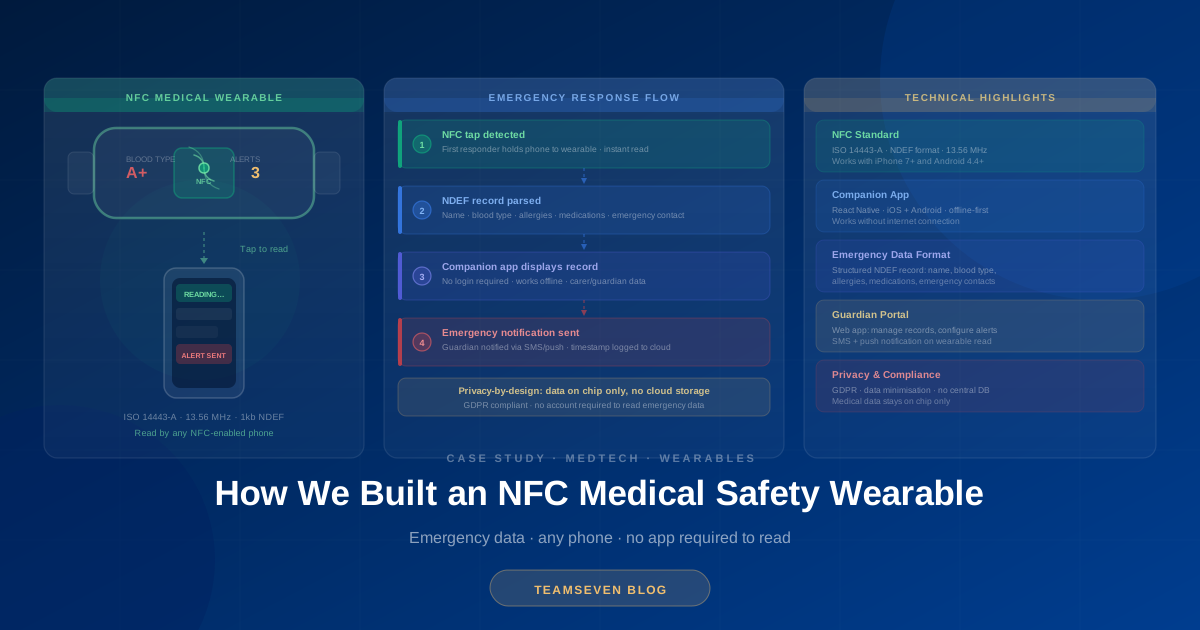
That's the problem Sharewear solves. It's an NFC-based medical safety wearable: a band that anyone can tap with a phone to instantly see the wearer's medical profile and emergency contacts. We built the software that makes it work. I want to walk through how, because NFC medical wearables are a interesting engineering problem, and there's almost no honest writing about how they get built.
What an NFC medical wearable is
NFC stands for Near Field Communication. It's the same technology that lets you tap your phone to pay. A small chip, no battery needed, that a phone can read when held close.
In Sharewear, that chip is in a wearable band. When someone taps it with a phone (any phone, no app needed) it opens the wearer's medical profile: their conditions, allergies, medications, and emergency contacts. A first responder, a teacher, a stranger on the street: anyone can get the critical information in seconds.
The genius of NFC for this use case is that it needs no battery, no charging, no app on the reader's side, and no internet on the wearable. You tap, it works. For an emergency device, that simplicity is the whole point. A device that needs charging is a device that's dead when you need it.
The four engineering problems we had to solve
1. Writing the right data to the NFC chip
NFC chips store a small amount of data. You can't put a whole medical history on them. So the design decision is: what goes on the chip itself, and what lives in the cloud?
The approach that works: the chip holds a secure link to the profile, not the whole profile. When you tap, it opens the profile hosted in the system. This means the chip stays small and simple, the profile can be updated anytime without re-writing the chip, and you control access to the data properly rather than having medical information sitting unprotected on a chip anyone can read.
Writing to the chip reliably, in a way that works across the huge variety of phones people will tap it with, is its own engineering challenge. Android and iPhone handle NFC differently. Different phone models behave differently. You build and test against that variety, because in an emergency the phone doing the tapping could be anything.
2. The profile system: fast, reliable, always available
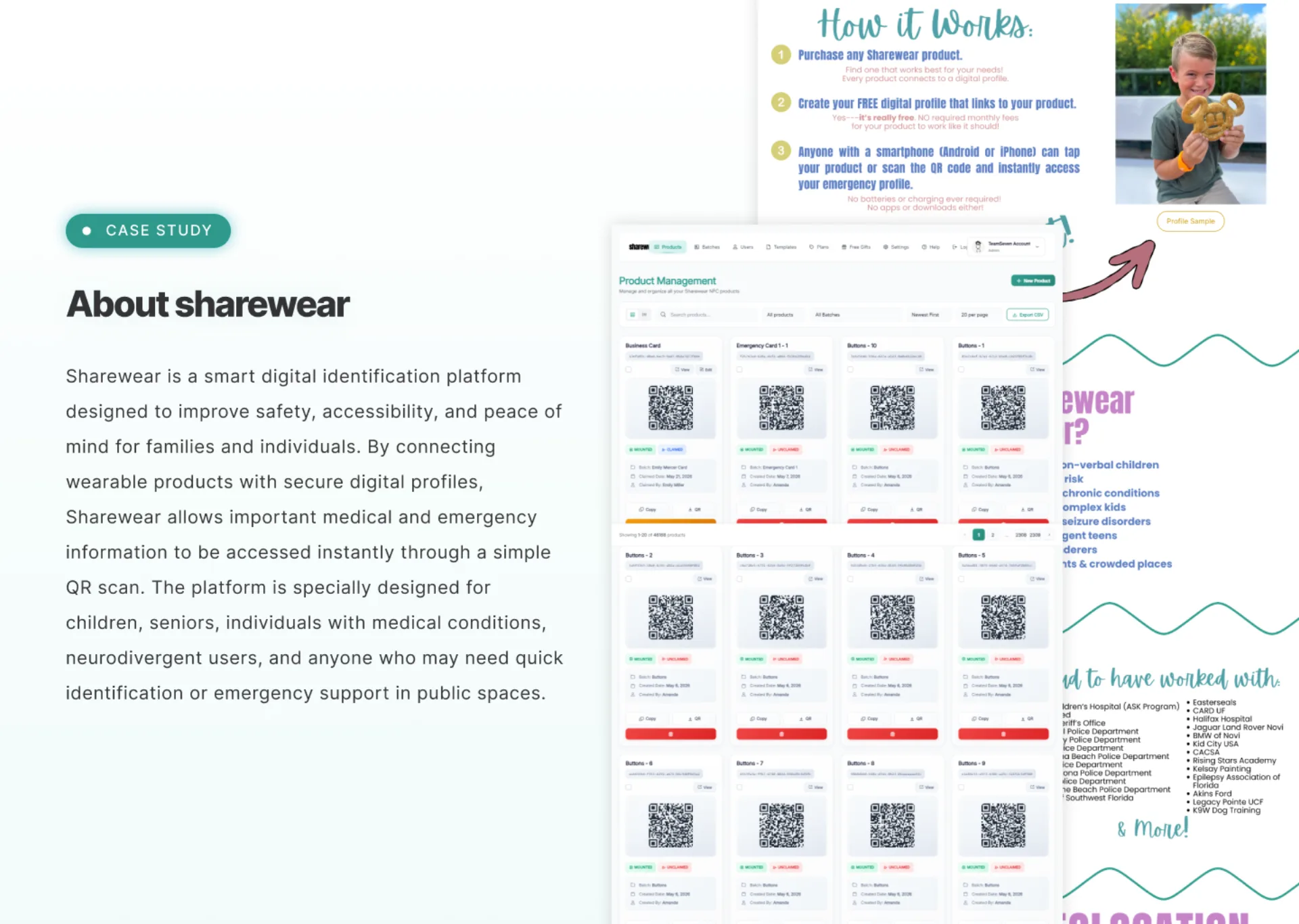
When someone taps the band, the profile has to load instantly and reliably. This is an emergency. A slow load or an error is not acceptable.
That means the profile system has to be reliable: properly hosted, fast, and available even under poor network conditions. You design for the worst case: someone tapping the band in an area with weak signal, needing the information immediately. The reliability requirement here is higher than most apps because the stakes are higher.
3. Privacy: this is medical data about vulnerable people
This is the part that kept me up at night.
Sharewear holds medical information about children, elderly people, and people with conditions: some of the most vulnerable people there are. That data has to be handled with extreme care.
The design has to balance two things that pull in opposite directions: in an emergency, the information needs to be instantly accessible to whoever is helping: no login, no barrier. But that same accessibility can't become a privacy hole where anyone can harvest medical data about vulnerable people.
The way you resolve this is careful design about what's exposed and how. The emergency-critical information that helps someone in a crisis is what's accessible on tap. The full sensitive record is protected. You think hard about what a first responder needs in the moment versus what should stay private. This isn't a feature decision. It's an ethical one, and it shapes the whole architecture.
4. Profile management for the people who set it up
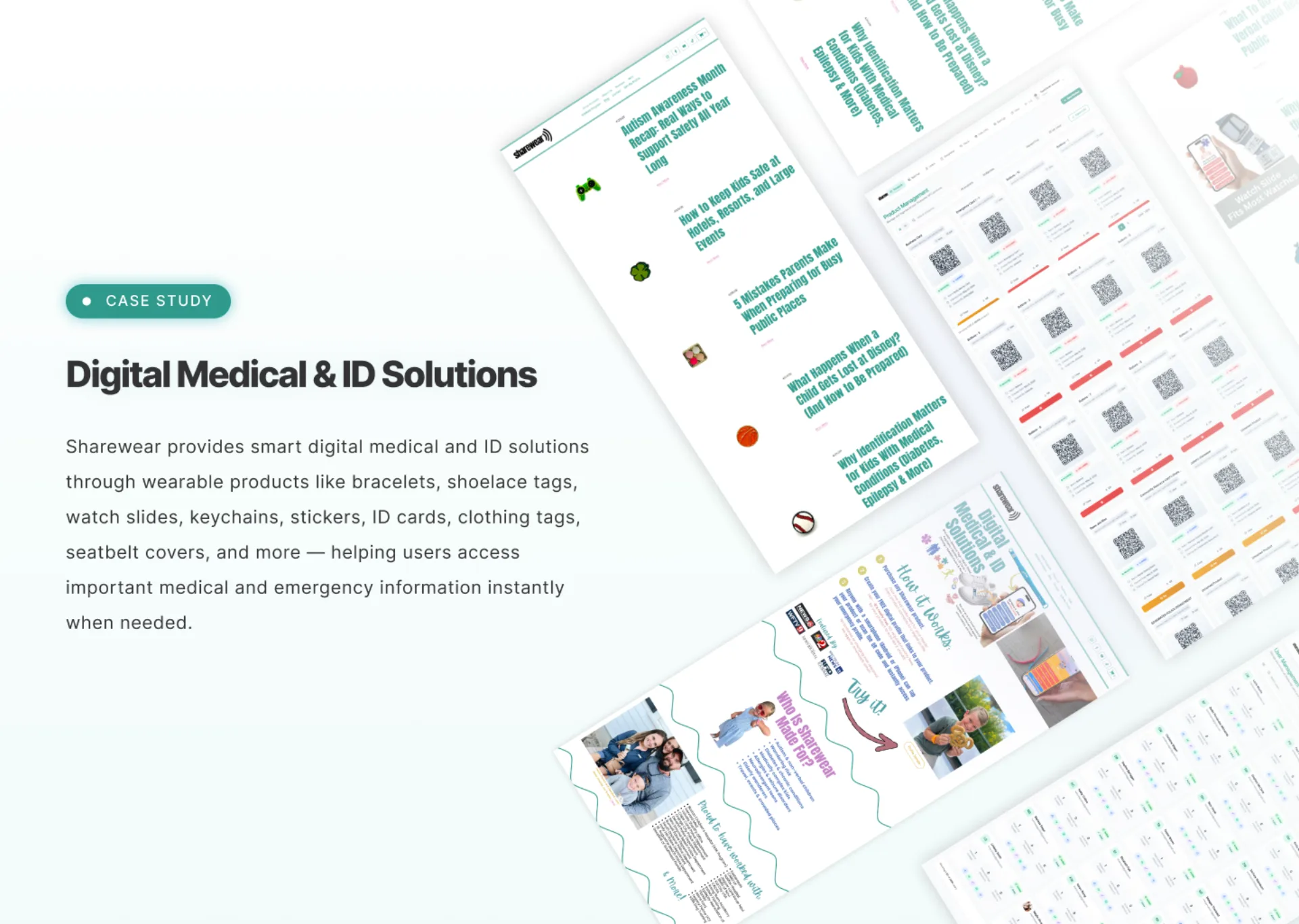
Behind the simple tap, someone has to set up and maintain the profile: a parent for their child, an adult child for an elderly parent, a person managing their own condition. That management interface has to be simple enough for non-technical people while handling important data.
The person setting this up is often stressed, not technical, and dealing with a difficult situation: a recently diagnosed condition, an ageing parent. The interface has to be gentle, clear, and reassuring. This is where good UX stops being about aesthetics and becomes about genuine care for the person using it.
What makes medical wearables different from most software?
Most software, if it breaks, someone is inconvenienced. They refresh the page, they try again, they're mildly annoyed.
Sharewear is software that people rely on in emergencies. If it fails when someone taps that band during a medical crisis, the consequence isn't an annoyed user. It's a person who didn't get help they needed. That changes how you build everything. The reliability bar, the testing rigour, the failure-mode design, all of it operates at a higher standard because the stakes are real.
Building software where the failure mode is "someone doesn't get medical help" makes you a more careful engineer. It should. I'm glad it did for us.
What it costs to build a medical wearable platform
Honest picture of what drives the range:
| Scope | Relative cost | Timeline |
|---|---|---|
| NFC profile MVP (write/read, basic profile, management) | Lowest | 12–20 weeks |
| Full platform (multi-user, privacy controls, profile types) | Mid-range | 20–32 weeks |
| Enterprise/medical-grade (compliance, integrations, scale) | Highest | 32+ weeks |
A real consideration: if you're going into regulated medical device territory, compliance requirements (HIPAA in the US, medical device regulations, data protection) add significant cost and complexity. Sharewear as a safety/information device is different from a regulated medical device that makes clinical decisions. Be clear which one you're building, because it dramatically affects scope and cost. If it's the regulated kind, get compliance advice early. It shapes the architecture from day one.
Should you build a custom wearable platform?
It makes sense when you have a novel use case (like Sharewear's emergency profiling), you're building a product to sell, or existing solutions don't fit your specific need.
It doesn't make sense when an existing medical ID product already does what you need. There are medical ID bracelets and apps out there. If one fits, use it. Build custom when your idea is different from what exists: when, like Sharewear, you're solving a specific problem in a way nothing else does.
What I'd tell someone building in this space
Decide early what lives on the chip versus the cloud. It shapes everything. Link-on-chip, data-in-cloud is usually right. It keeps the chip simple and the data controllable.
Test across every phone you can find. NFC behaves differently across devices and operating systems. In an emergency, the reading phone could be anything. Your testing has to reflect that.
Treat the privacy design as the hard problem it is. You're holding sensitive data about vulnerable people. The balance between emergency-accessible and properly-protected is the core design challenge, and you should sweat it.
And build like it matters, because it does. Medical safety software isn't a normal app. Someone's wellbeing might depend on it working when it's tapped. Build to that standard.
We built Sharewear from Lahore. The idea of a band someone can tap to help a child or an elderly person in an emergency. That's the kind of project that reminds you software can matter. We're proud of that one.
Sharewear's scan-to-profile flow resolves in under two seconds, with no app or account required from the scanner: across the full commercial range spanning direct consumer orders, wholesale accounts, and Sidekick Programme organisations. Read the full case study →
Stay connected
Build notes, launches, and new articles from the Teamseven team.