
How Much Does It Cost to Build a Mobile App in 2026? (Real Numbers by App Type)
A practical breakdown of mobile app development costs in 2026: what drives the price, real cost ranges by app type, and quote red flags.

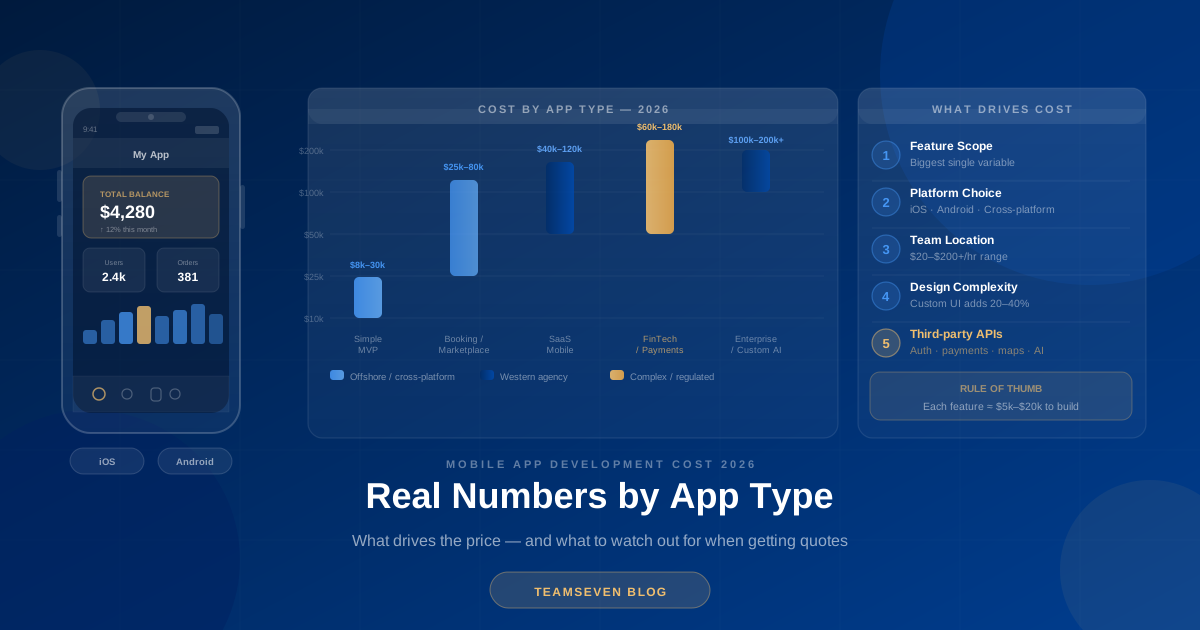
"How much does it cost to build an app?" is the question I get asked more than any other. It's also the question that produces the most useless answers: either a vague "it depends" or a specific number pulled from thin air.
This post is an attempt to give you something more useful. Real cost ranges, broken down by app type and team location, with an honest explanation of what drives the numbers and what questions to ask before spending anything.
I run a mobile app development agency. We build iOS and Android apps. I have an obvious interest in you hiring us. I'll try to be honest anyway, because founders who understand pricing make better decisions and better clients.
Mobile App Cost Summary: What Drives the Range by App Type (2026)
| App Type | What mainly drives the cost | Timeline |
|---|---|---|
| Simple utility app | One user type, limited backend, standard integrations | 12–18 weeks |
| Marketplace / two-sided platform | Two user types, split payments/escrow, trust and review systems | 18–28 weeks |
| SaaS companion app | Whether the backend already exists, offline sync needs | 12–20 weeks |
| On-demand service app | Real-time location at scale, three apps in one (customer, provider, dispatcher) | 20–36 weeks |
| Enterprise field app | SSO/legacy system integration, offline-first architecture | 16–32 weeks |
| IoT / hardware-connected app | Bluetooth/BLE complexity, hardware testing, firmware compatibility | 16–30 weeks |
Team location (South Asia, Eastern Europe, US/UK) is one of the biggest swings in what any of these cost: see Variable 5 below. We'll walk you through where your build sits on a call rather than guess here.
Why do mobile app development quotes vary so much?
Before getting into what drives the cost, you need to understand why two agencies quoting on what sounds like the same app can come back wildly apart. It's not just profit margin. It's five different variables.
Variable 1: Feature scope
The single biggest cost driver. An app with 5 core features costs roughly half as much as an app with 10. This sounds obvious, but founders consistently underestimate how many features they're asking for.
A "simple booking app" that lets users book appointments sounds like 3 features. In practice it's: user registration and authentication, profile management, service/provider listings, availability calendar, booking flow, payment processing, booking confirmation emails and push notifications, cancellation and rescheduling logic, provider dashboard, admin panel, and reporting. That's closer to 15 features.
Before you get a quote, list every feature you want. Then cut the ones that aren't strictly necessary for launch. What remains is your actual MVP.
Variable 2: Platform choice
Building for iOS only, Android only, or both simultaneously, and the technology used to do it, has a significant cost impact.
Native iOS (Swift): Highest quality on iPhone. No Android version. Native Android (Kotlin): Highest quality on Android. No iOS version. Native both: Two codebases, two teams, noticeably more than building one platform. Cross-platform (Flutter or React Native): One codebase, both platforms, a meaningfully smaller step up from one native platform. Quality gap vs native has narrowed significantly.
For most early-stage products, cross-platform is the right choice. You get both platforms from one team at a significant cost reduction, and the quality difference that used to justify native development has largely closed.
Variable 3: Backend complexity
The mobile app is the interface. The backend is everything behind it: the server, the database, the business logic, the APIs the app talks to.
Simple apps with minimal backend (basic CRUD, one user type, no real-time features): backend cost is 20–30% of total.
Complex apps with significant backend (real-time features, multiple user types, third-party integrations, complex business logic): backend cost is 50–60% of total.
An app that looks simple on the surface (say, a delivery tracking app) often has an enormous backend: driver location tracking, geofencing, real-time order status, payment processing, notification orchestration, and reporting. The app is the easy part.
Variable 4: Design maturity
Building from wireframes is slower and more expensive than building from a complete, approved design system. Every design decision made in development costs 3–5x what it would cost to make it during the design phase.
If you come to an agency with rough wireframes and expect them to design and build simultaneously, expect the timeline and cost to reflect that.
Variable 5: Team location
The single biggest lever most founders underuse. Developer rates vary significantly by geography, and while quality isn't perfectly correlated with location, it's also not uncorrelated. A US or Western European agency carries office and salary overhead that a South Asian or Eastern European team simply doesn't: for the same seniority and the same output. This is often the difference between a project being affordable and not.
Roughly, in descending order of cost: US and Canadian agencies sit highest, UK and Western Europe close behind, Eastern Europe meaningfully lower, and South Asia and Southeast Asia lower still: for comparable mid-to-senior engineering talent. We're a South Asia-based team for exactly this reason; see our pricing page for how we structure quotes.
How much does a mobile app cost by app type in 2026?
The ranges below aren't published as numbers here: every serious quote should come from an actual scoping conversation, not a table on a blog post. What we can tell you is what pushes each app type toward the more expensive end of the market and what keeps it lean. These assume a professional agency delivering design, development, QA, and deployment (not freelancers, not body-shopping firms) and exclude ongoing hosting, third-party service costs, and post-launch maintenance.
Simple utility app
What it is: Single-purpose apps with one user type, no backend complexity, and limited integrations. Examples: basic calculator, simple habit tracker, static information app, simple flashcard app.
What's included: Authentication, core feature set (3–5 features), basic user profile, push notifications, App Store/Play Store submission.
Why it still costs real money: Even "simple" apps require design, authentication, testing on multiple devices, app store submission and review, and production deployment. There's a genuine floor for any professionally built app, whatever team you hire. This category just sits at the low end of that floor.
Marketplace or two-sided platform
What it is: Apps connecting buyers and sellers, service providers and clients, or any two distinct user groups. Examples: booking apps, freelance platforms, delivery marketplaces, rental platforms.
What's included: Two user types with separate onboarding, listing/availability management, search and filtering, payment processing with escrow or split payments, messaging, notifications, reviews, admin dashboard, and reporting.
What makes marketplaces expensive: Two user types means two apps' worth of interface work. Payment processing for marketplaces (split payments, escrow, payouts to providers) is significantly more complex than simple checkout. Trust and review systems add substantial backend logic.
SaaS companion app
What it is: Mobile extension of an existing or simultaneously-built web SaaS platform. Users who need on-the-go access to a product that primarily runs in the browser. Examples: field service apps, CRM mobile access, project management mobile, logistics tracking apps.
What's included: Shared authentication with web platform, core feature subset appropriate for mobile, offline capability (often), push notifications, background sync.
What drives cost here: If the backend exists, development is faster: the mobile app consumes existing APIs rather than building new ones. If the backend is being built simultaneously, add those costs separately. Offline capability (syncing data when the user is without connectivity) adds significant complexity.
On-demand service app
What it is: Apps where timing and real-time location are core to the experience. Examples: ride-hailing, food delivery, on-demand home services, emergency response apps.
What's included: Customer app, provider/driver app, dispatcher dashboard, real-time GPS tracking, geofencing, dynamic pricing, payment processing, push notifications for status updates, rating systems.
Why these are expensive: Real-time location tracking at scale is a hard engineering problem. You're effectively building three apps (customer, provider, dispatcher). The backend infrastructure for real-time matching and routing is complex. Third-party integrations (mapping, payments, SMS, push) multiply. Be sceptical of any quote for this category that seems to skip past these problems rather than pricing them in.
Enterprise mobile app
What it is: Internal tools for enterprise workforces: field service, inspections, logistics operations, warehouse management, sales force tools.
What's included: Corporate authentication (often SSO/SAML), offline capability, complex forms and workflows, integration with enterprise systems (ERP, CRM, legacy databases), device management compatibility, audit logging.
Enterprise-specific costs: SSO integration (SAML, OAuth with corporate identity providers) adds complexity. Offline-first architecture, where the app functions without connectivity and syncs when available, is one of the hardest mobile engineering problems. Integration with legacy enterprise systems is often the most unpredictable cost item.
IoT and hardware-connected app
What it is: Apps that communicate with physical hardware: wearables, smart devices, industrial equipment, medical devices, vehicle systems.
What's included: Bluetooth/BLE or WiFi device connectivity, device pairing and management, real-time data processing from hardware, firmware update delivery, hardware-specific UI.
What makes IoT apps expensive: Bluetooth connectivity on iOS and Android has different APIs, different behaviors, and different limitations. Testing requires physical hardware in various states. Firmware compatibility adds a moving target. Background operation (maintaining a Bluetooth connection when the app isn't in the foreground) is particularly complex on modern iOS.
What mobile app costs do founders consistently forget to budget for?
The ranges above cover building the app. They don't cover everything you'll spend in the first year.
App store fees and setup: Apple Developer Program and Google Play Developer both charge their own registration fee, and both require registration before submission. Factor in 1–3 weeks for Apple's review process on initial submission.
Third-party services: Stripe for payments. Twilio for SMS. SendGrid or Postmark for email. Firebase for push notifications (free tier is generous). Google Maps or Mapbox for mapping (usage-based pricing beyond the free tier). These costs start small and grow with usage.
Hosting and infrastructure: A small production backend on AWS or GCP is modest to start and scales with your traffic. This is one of the things we'll walk you through concretely during scoping rather than guess at here.
Post-launch maintenance: Operating systems update. New iPhone models have new screen sizes. APIs deprecate. Security vulnerabilities get patched. Budget a meaningful ongoing share of your build cost each year for this. It's not optional.
Analytics and monitoring: Mixpanel or Amplitude for product analytics (usage-based pricing). Sentry for error tracking (free tier is adequate for early stage). Crashlytics for crash reporting (free via Firebase).
User acquisition: Building the app is the easy part. Getting users to download and use it is where most mobile products struggle and spend most of their money.
Build cost is only part of a realistic first-year budget: the items above add up. Worth mapping out properly before you commit to a number.
What should be included in a mobile app development quote?
When evaluating agency proposals, these items should be explicitly included or explicitly excluded with agreed pricing:
Included by default (if not listed, ask):
- UX wireframes and visual design
- Frontend development (the app itself)
- Backend API development
- Third-party integration work
- QA and testing (including device testing)
- App store submission
- Production deployment
- Post-launch support period (specify how long: 30 or 60 days is standard)
Often excluded (understand these costs upfront):
- Third-party service fees (Stripe, Twilio, AWS)
- App store account fees
- Content or data population
- User testing with real users
- Marketing assets for app store listings
- Ongoing maintenance after support period
Red flags in quotes:
- Fixed price delivered within 24 hours of your requirements (they didn't read them)
- No design phase included (you'll pay for it in development time)
- Vague deliverables like "complete mobile application" without specification
- No QA phase (testing on real devices is non-negotiable)
- No post-launch support window
Should you build a native or cross-platform mobile app?
This question comes up in every initial conversation about a mobile app. Here's the honest breakdown.
Flutter is currently the best cross-platform option for most projects. It compiles to native ARM code, has a rich widget library, performs well on both platforms, and has a growing ecosystem. The developer experience is good and the output is difficult to distinguish from native.
React Native is the most mature cross-platform option. Larger ecosystem than Flutter, JavaScript means more developers can work on it, and the Meta/Microsoft investment means it's well-maintained. Performance has historically trailed Flutter for animation-heavy UIs, though the new architecture (Fabric) has largely closed this gap.
Native (Swift/Kotlin): Best performance, best platform integration, best access to the latest OS features. Required for: apps with heavy native API usage (ARKit, HealthKit, advanced camera), games, apps where frame-perfect animation is core (not just nice-to-have), or apps where the performance difference meaningfully affects user experience.
For the vast majority of B2B tools, marketplaces, SaaS companions, and utility apps: cross-platform is the right choice. The 30–40% cost saving versus building two native apps is real, and the quality gap that used to justify native has largely closed.
How do you get an accurate mobile app development quote?
The more specific your requirements, the more accurate your quote. Before approaching agencies:
Write down every feature. Not high-level ("users can manage their profile") but specific ("users can upload a profile photo, set a display name, update their email address, change their password, and delete their account"). This forces you to confront scope before it's someone else's hourly rate.
Describe your user types. Who uses the app? What can each type do that others can't? Two user types is approximately twice the interface work of one.
List your integrations. Every third-party system the app needs to connect to. Payment processor, maps, SMS, authentication provider, existing backend systems.
Specify platform. iOS only, Android only, or both. Cross-platform or native.
Be honest about your budget. "What would this look like within my budget?" is a more useful question than "how much does this cost?" A good agency will tell you what fits your budget rather than just quoting the full version and hoping you have the money.
What is the most important question to ask a mobile app agency?
After you've received a proposal, ask: "What would you cut to bring this in at a lower price, and what would that mean for the product?"
The answer tells you two things: whether the agency has thought about your project (or just applied a template), and what the real trade-offs are in scope, timeline, and features.
A good agency will give you a specific answer. A less-good one will be vague or defensive.
Building a mobile app?
We've delivered mobile apps across logistics, healthcare, PropTech, and SaaS since 2017:
Stay connected
Build notes, launches, and new articles from the Teamseven team.