
Staff Augmentation vs Dedicated Team: Which Model Fits Your Product
Staff augmentation or a dedicated team? The real difference is who manages the work. A decision guide with scenarios, a comparison table and the questions to ask.

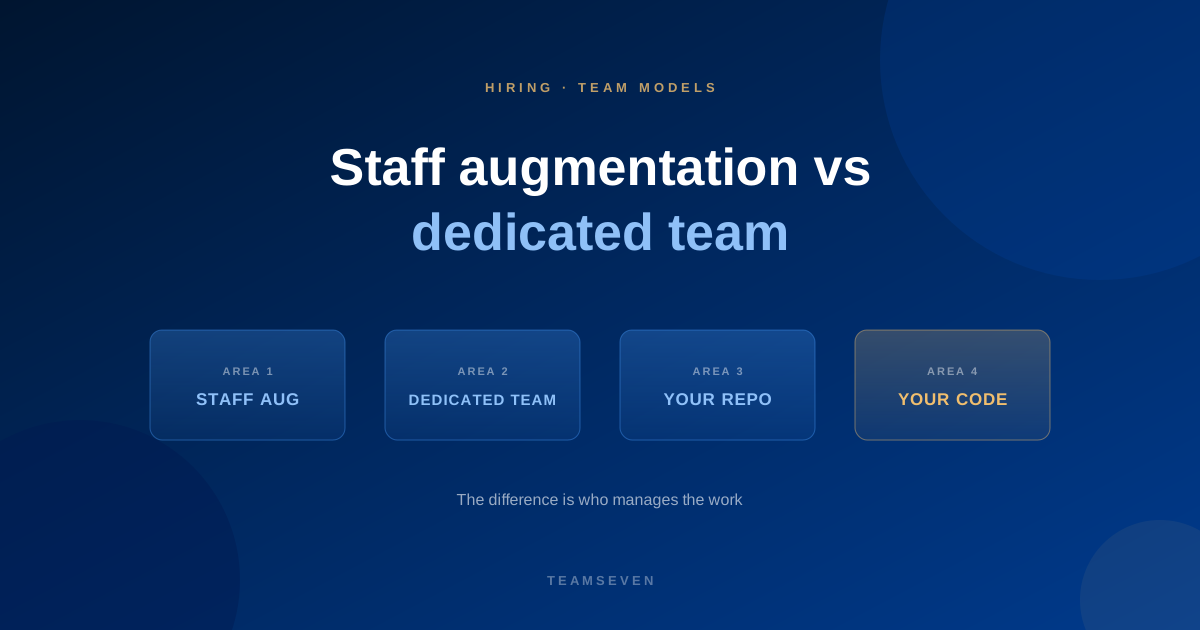
The difference between staff augmentation and a dedicated team is who manages the work. With staff augmentation, an engineer joins your team and you manage them. With a dedicated team, we manage the engineers and own delivery, and you set the priorities.
Everything else follows from that: how much of your lead's time it takes, how accountable the provider is, and how fast the team can move without you.
Side by side
| Staff augmentation | Dedicated team | |
|---|---|---|
| Who sets priorities | You | You |
| Who manages day-to-day work | You or your technical lead | The provider's lead |
| Who owns delivery | You | The provider |
| What you need on your side | A technical lead who can review code | A product owner who can decide what matters |
| Team shape | Individual engineers added to your team | Engineers, a designer and a lead working only on your product |
| Where the code lives | Your repository | Your repository |
| Best for | Adding capacity to an existing team | Running a product without building a team |
| Main risk | Your lead is overloaded | Less hands-on control |
| Rate structure | A monthly rate per engineer | A monthly rate per engineer, quoted for the team |
Choose staff augmentation if
- You already have a technical lead or CTO who will review pull requests
- Your team has a process you want new people to follow
- You need specific skills or more capacity, not a new way of running things
- You want to add or remove people quickly as workload changes
Details on how it works are in IT staff augmentation: how it works, when it fits and when it doesn't, and on the staff augmentation page.
Choose a dedicated team if
- Your product is live and growing, but you have no engineering team
- You do not have someone technical to manage developers every day
- You want one accountable group rather than several freelancers
- Your roadmap changes often, so a fixed scope would be out of date quickly
The dedicated team page describes what the team looks like and how we run it.
Three scenarios
A funded startup with a CTO and a backlog. The CTO knows what to build and needs two more engineers by next month. Staff augmentation. The CTO reviews code and sets priorities, and the engineers work in the startup's tools.
A founder with a live product and no technical team. The founder knows the customers and the market and cannot manage engineers. A dedicated team. We plan, build and ship, and the founder says what matters this month. This is how we have worked with i-mve since 2022, as its technology partner.
A company with a small in-house team and a big release. Four in-house engineers, a deadline and a new service to build. Start with staff augmentation for two engineers. If the extra work becomes ongoing, move to a dedicated team for that service.
You can change models
Many clients start with one engineer and grow. Others start with a dedicated team and move to staff augmentation once they hire their own technical lead. Either way, the code is in your repository from the first commit, so a change of model never means a handover.
Where AI-native engineers fit
Both models can use AI-native engineers: developers who work with AI assistants every day and still review everything they ship. You set the rules for which tools may see your code, in either model. In a dedicated team, we also keep the review standards and the architecture coherent as the team uses AI to move faster.
Questions to settle before you choose
- Who on your side will review the code every week?
- Is the roadmap defined, or will it change often?
- Do you need design as well as engineering?
- How much of your own time can you spend managing?
- Do you want to build an in-house team later?
If you answer "nobody", "it will change" and "none", choose the dedicated team. If you answer "my CTO", "mostly defined" and "a little", choose staff augmentation.
Read more
- Dedicated team vs fixed price vs time and materials
- Hire a dedicated development team: a complete guide
- What a dedicated developer gets you, and what it doesn't
Is a dedicated team more expensive than staff augmentation?
The monthly rate per engineer is the same. A dedicated team usually includes more roles, such as a designer or a technical lead, so the total depends on the team you need. We quote it in writing after a call, and there are no recruitment fees.
Can I start with one engineer and grow into a dedicated team?
Yes. Many clients do. Add a role when the backlog justifies it, with the notice we agree at the start.
Who owns the code in each model?
You do, in both. Everything is committed to your repositories as it is written, so you can take the work in-house whenever you like.
Stay connected
Build notes, launches, and new articles from the Teamseven team.