In-House vs Outsourcing Software Development: An Honest Decision Framework
A practical framework for deciding between in-house and outsourced software development: costs, control, speed, quality, and when each one is right.

I run an outsourcing company, so you'd expect me to tell you to outsource. I'm not going to do that, because it's not always the right answer, and telling you otherwise would be dishonest.
The truth is that in-house and outsourcing each win in specific situations, and the founders and CTOs who choose well are the ones who understood their own situation clearly before deciding. This is the honest framework, including the cases where you should build in-house and not call me.
The short answer
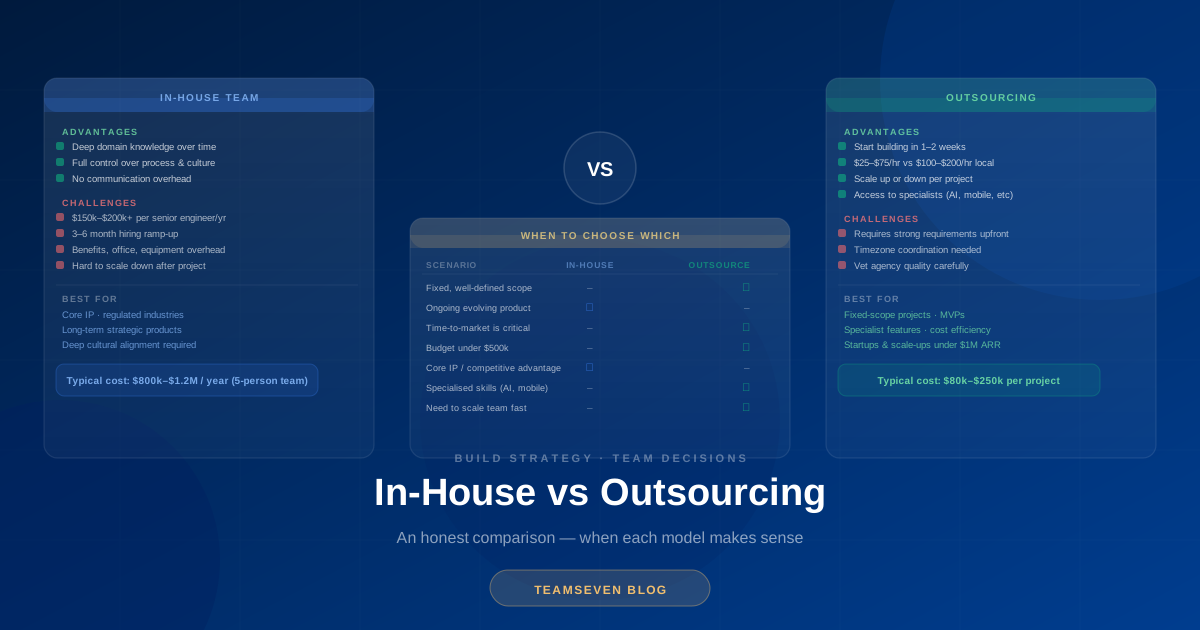
| Factor | In-House | Outsourcing |
|---|---|---|
| Speed to start | Slow (3–4 months hiring) | Fast (2–4 weeks) |
| Cost | High (salaries, overhead, benefits) | Lower (especially offshore) |
| Control | Maximum: daily, direct | High but requires good management |
| Domain knowledge retention | Stays in your company | Stays with the agency |
| Best for | Core product, long-term, well-funded | Speed, cost-efficiency, defined scope, validation stage |
| Flexibility to scale down | Hard (layoffs) | Easy (end engagement) |
| Cultural/timezone alignment | Full | Requires management |
Neither wins universally. It depends on your stage, your funding, and what you're building. Here's how to figure out which is right for you.
The real costs of in-house
When people compare in-house to outsourcing, they usually compare a developer's salary to an agency's rate and conclude in-house is cheaper per hour. That comparison is wrong because it ignores the real cost of in-house.
A senior developer in the US costs a substantial salary on its own. But the fully-loaded cost (payroll taxes, benefits, equipment, software licenses, office space or remote stipends, recruiting costs, management overhead) is typically 1.25–1.4x the salary. So that developer costs you meaningfully more than the headline number once every layer is added.
Then there's the hiring cost that nobody puts on the spreadsheet: it takes 3–4 months to hire a senior engineer in most markets. That's 3–4 months of not building while you recruit. And if you hire the wrong person, you've lost that time plus the cost of the mistake plus the cost of hiring again.
In-house is expensive. That's not a reason to avoid it. It's a reason to be clear-eyed about what it costs when you compare.
The real costs of outsourcing
In fairness to the other side, outsourcing has real costs that the per-hour comparison also misses.
Management overhead: outsourced teams need clear direction, regular communication, and active management. That's your time, and it's a real cost. Communication friction: time zones, cultural differences, and written-only communication add overhead that co-located teams don't have. Domain knowledge that leaves: when an engagement ends, the deep knowledge the agency built about your product goes with them, unless you've documented well. Quality variance: the agency market ranges enormously, and choosing badly is expensive.
Outsourcing isn't free money. It's a different cost structure with different trade-offs.
When in-house is the right call
Build in-house when:
Software is your core product and competitive advantage. If you're a software company and the product IS the business, you want that capability in-house long-term. The knowledge, the ownership, the daily control: these matter when software is the whole game.
You're well-funded and past validation. If you've raised significant money and proven product-market fit, building a permanent in-house team is an investment in a known direction. You can afford the cost and you know what you're building toward.
You need deep, daily, real-time collaboration. Some products require constant tight collaboration between product, design, and engineering: rapid iteration where the figuring-out and the building happen simultaneously. Co-located (or at least same-timezone) in-house teams handle this better.
Domain knowledge retention is critical. If your product requires deep, accumulated, proprietary knowledge that you can't afford to have leave, in-house keeps it in the building.
You have the time and skill to hire and manage well. Building a good in-house team requires good hiring and good engineering management. If you have that capability, in-house can be excellent.
When outsourcing is the right call
Outsource when:
You need to move fast. Hiring takes months. An agency deploys in weeks. If speed matters (and for startups racing to validate or businesses with a window of opportunity, it usually does) outsourcing wins on time-to-start decisively.
You're at the validation stage. Before product-market fit, you don't want to commit to a permanent team building something that might pivot. An agency lets you build, validate, and learn without the commitment of full-time hires. Build in-house after you've proven the direction.
Cost efficiency matters. Offshore outsourcing costs a fraction of in-house in major markets. For a funded startup managing runway, or a business being capital-efficient, this difference can be the difference between reaching the next milestone and not.
The scope is definable. Outsourcing works best when you can describe what you need. A defined product, a clear set of features, a known direction: these are ideal for an agency engagement.
You need capability you don't have in-house. Specific expertise (a technology, an industry, a type of system) that you'd need to hire for can come from an agency that already has it.
You want flexibility. Ending an agency engagement is far easier than laying off employees. If your needs might change, outsourcing keeps you flexible.
The hybrid model most people miss
The framing of "in-house vs outsourcing" is itself a bit false, because the answer for many companies is both.
The most common successful pattern I see: outsource to build and validate, then bring core capability in-house once the direction is proven. A startup builds its MVP with an agency, validates product-market fit, raises a round, then hires an in-house team to take ownership: sometimes with the agency continuing to provide additional capacity. This gets you speed and cost-efficiency early, then control and retention once you know what you're building.
Another common pattern: a small in-house core team for the critical, proprietary work, plus an outsourced team for additional capacity. The in-house team holds the deep knowledge and direction; the outsourced team adds throughput. This is essentially the dedicated team model working alongside in-house staff.
The question isn't always "which one." Often it's "which one for which part, and when."
How to decide for your situation
Ask yourself, honestly:
What stage am I at? Pre-validation → outsource to learn. Post-validation, well-funded, software is core → consider in-house. Use the stage to guide the default.
How fast do I need to move? Need to start now → outsource. Can afford 3–4 months to hire → in-house is viable.
Is software my core competitive advantage? Yes → bias toward in-house long-term. It's a means to an end → outsourcing is fine indefinitely.
Can I describe what I need clearly? Yes → outsourcing works well. Still figuring it out daily → in-house collaboration helps, or do a discovery phase first.
What's my budget structure? Can I support permanent salaries, or do I need project/monthly flexibility? This often decides it practically.
Do I have the capability to hire and manage engineers well? If not, outsourcing to an agency that manages its own team removes a job you're not equipped to do.
The honest recommendation
If you're an early-stage startup validating an idea: outsource. Move fast, stay capital-efficient, learn what you're building before you commit to a permanent team. This is the clearest case.
If you're an established software company where the product is your core business and you're well-funded: build in-house, possibly augmented by outsourcing for additional capacity. The control and retention are worth it.
If you're somewhere in between: the hybrid model probably fits. Outsource to build and validate, bring core capability in-house as you scale and prove direction.
And if you're not sure: a 30-minute conversation about your specific situation will clarify it faster than any framework. I'll tell you if I think you should build in-house: I'd rather give you the right advice than win a project that isn't right for you. The clients who come back, and refer others, are the ones I was straight with.
Related reading
Stay connected
Build notes, launches, and new articles from the Teamseven team.