
IT Staff Augmentation: How It Works, When It Fits and When It Doesn't
What IT staff augmentation is, how a placement works step by step, how it differs from outsourcing, the risks and the questions to ask any provider.

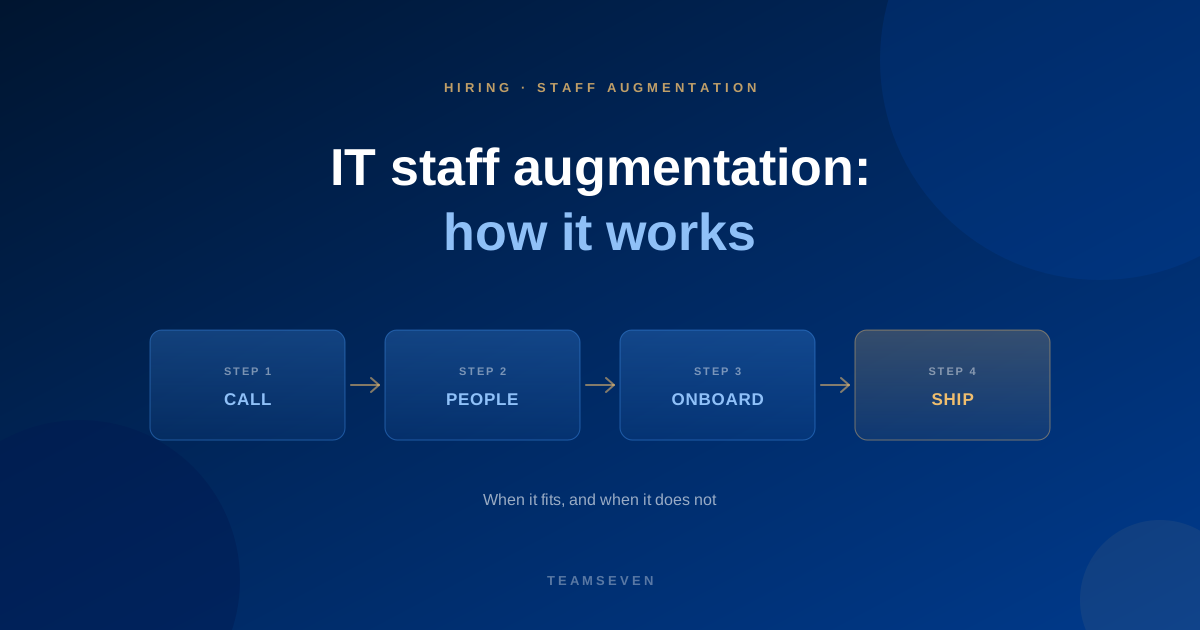
IT staff augmentation means adding outside engineers to your own team for as long as you need them. They join your stand-ups, work in your repository and follow your process. You manage the work. The provider handles hiring, payroll, equipment and cover.
It suits teams that already know what they want built and need more hands than they can hire in time. It is a poor fit when nobody on your side can set priorities or review the work.
How a placement works
This is how we run it at Teamseven, and most good providers follow a similar shape.
- A first call. You describe your stack, your backlog and how your team works. We tell you honestly whether staff augmentation fits, or whether a fixed project would suit you better.
- We propose people. One engineer or a small group, matched to your technology and time zone, introduced on a call before you commit.
- Onboarding. Accounts for your repository, Slack and task board. The engineer reads the code before changing it. If AI tools are involved, you set the rules for which may see your code.
- Work. The engineer takes tasks from your backlog in your order. You review pull requests as you would for a colleague.
- Updates. Regular written updates on Slack, and a named person at the provider you can contact if something is not working.
- Scaling. Add engineers, swap roles or step back, with the notice you agreed at the start.
Staff augmentation compared with other models
| Staff augmentation | Dedicated team | Fixed-price project | Freelancer | |
|---|---|---|---|---|
| Who manages the work | You | The provider | The provider | You |
| Best when | You have a technical lead and a backlog | You want someone to own delivery | The scope is defined and has an end | A small, well-bounded task |
| Pay for | Monthly rate per engineer | Monthly rate for the team | A fixed quote | Hours or a fixed gig |
| Risk | Management load falls on you | Less day-to-day control | Scope changes cost time | One person, no backup |
For the detail on the middle two, read staff augmentation vs a dedicated team. For the wider comparison including time and materials, see dedicated team vs fixed price vs time and materials.
When it fits
- You have a product, a backlog and someone technical to set priorities and review code
- You need more capacity than you can hire quickly
- Your workload rises and falls, and a permanent hire would not make sense
- You need a skill you do not have in-house, such as a stack, a cloud platform or an architect
- You want to try a way of working, for example AI-native engineers, before changing your own hiring
When it does not fit
- You have no technical lead. Someone has to say what comes next and check the result. If that person does not exist, a dedicated team is the better model.
- The project has a clear end. A fixed quote gives you a firm budget and deadline.
- You want the provider to decide what to build. Staff augmentation puts you in charge of the roadmap.
- You cannot give access. Engineers who cannot see the code or the board cannot do the job.
What you pay for
We do not publish a price list, because the number depends on the role, the stack and the experience you need. Here is what to compare when you collect quotes:
- A monthly rate per engineer, and what it includes
- Recruitment fees (ours: none)
- Who covers sickness, leave and notice
- Who pays for tools and licences
- What notice you need to give to add, swap or remove people
- Who owns the code (it should be you, from the first commit)
If a quote is far lower than the others, ask what is missing.
The risks, and what reduces them
Knowledge leaves with the engineer. Keep everything in your repository, document what is learned, and avoid relying on a single person for a critical area.
Management load is higher than expected. Engineers need clear tasks and prompt review. Plan for a few hours a week of your lead's time, more in the first fortnight. Our onboarding plan covers it.
Time zones. Agree overlap hours up front. Our co-founders split working hours so there is overlap with US, UK and Australian clients, and we confirm the hours for your team before anyone starts. More in time-zone overlap with a team in Lahore.
Quality varies between people. Judge on a real first task rather than a CV, and give feedback early. A good provider swaps the engineer if it is not working.
Security and data. Keep access to what the engineer needs. Agree your rules on AI tools and sensitive data in writing.
Where AI-native engineers fit
Staff augmentation is also the simplest way to try AI-native engineers: developers who work with AI assistants every day and still review and own everything they ship. The model is the same. The difference is how much routine work gets done in a day, and the habits around checking it.
Questions to ask any provider
- Who exactly will work on my product, and can I meet them first?
- Who do I talk to when something is not working?
- What happens if the engineer is not a fit?
- Who owns the code, and where does it live?
- How do you handle AI tools and sensitive data?
- What hours will overlap with mine?
- What does the monthly rate include, and what is extra?
Read more
- Hire a dedicated development team: a complete guide
- How to manage an offshore development team that delivers
- How to hire AI-native engineers: a buyer's checklist
What is the difference between staff augmentation and outsourcing?
With staff augmentation, outside engineers work inside your team and you manage them. With outsourcing, you hand a defined piece of work to another company, which manages its own people and delivers a result. Augmentation gives you control. Outsourcing gives you less to manage.
How quickly can staff augmentation start?
Much faster than recruiting. After a first call we propose people, and once you approve, they can onboard onto your tools and start on your backlog. The exact timing depends on the role and your access setup, and we give you a date on the call.
Do I need a technical lead for staff augmentation?
You need someone who can set priorities and review code. If that person does not exist, choose a dedicated team instead, where we manage the work.
Is staff augmentation cheaper than hiring?
It removes recruitment fees and long notice periods, and you pay for the engineer only while you need one. Whether the monthly total is lower depends on your market and the role. Ask for a written quote and compare it with the fully loaded cost of a permanent hire, including recruitment, equipment and benefits. Our agency vs in-house comparison shows what to count.
Stay connected
Build notes, launches, and new articles from the Teamseven team.