
Parkezi — Smart Car Park Automation for Hotels and Hospitals
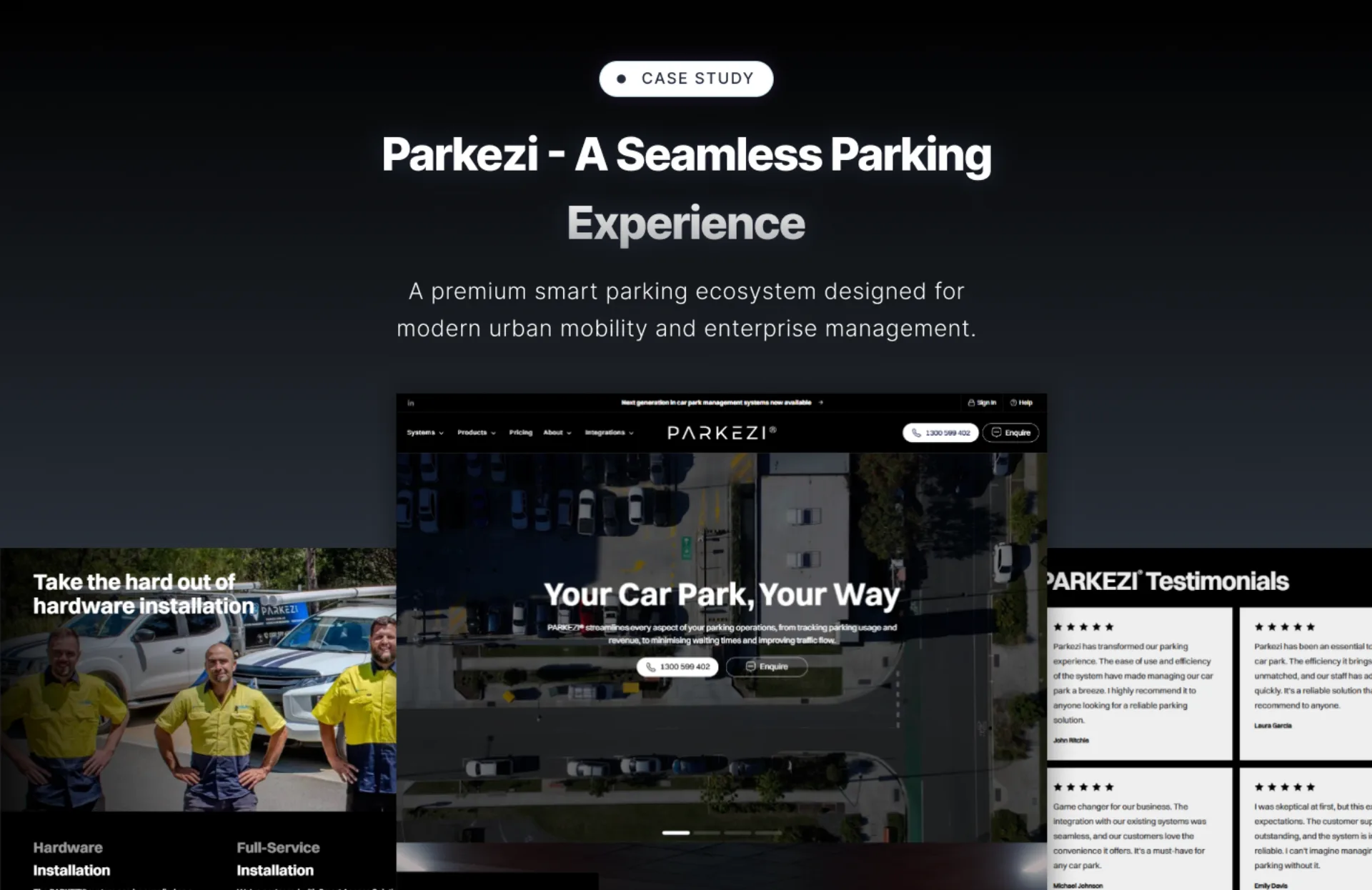
We built Parkezi — a complete smart parking automation platform deployed at NSW Ambulance, hotel chains, and retail parks across Australia. ANPR cameras, boom gates, contactless payments, and a real-time management dashboard, all wired into one cloud platform.
The problem
Most car park operators in Australia are running on a combination of a ticket machine from 2009, a spreadsheet someone built in Excel, and a boom gate that jams when it rains. Reconciliation happens manually at end of shift — someone counting cash, cross-referencing paper logs, trying to figure out why the numbers don't match. Revenue leaks constantly. They just don't know exactly where.
For a hotel, that's an annoyance. For NSW Ambulance, it's a different conversation entirely.
Emergency service vehicles need guaranteed entry. Specific bays need to be held for specific vehicles at specific times. Access rules need to change instantly when an incident is active. Off-the-shelf parking apps — the ones built for shopping centres and CBD garages — don't have the concept of a vehicle clearance level. They don't handle "this bay is reserved for emergency response between 08:00 and 18:00 unless override is active." You either build that logic yourself or you don't deploy there.
The Parkezi team came to us with a product concept and a hardware partner already selected. What they needed was a platform that could connect the physical infrastructure — ANPR cameras, boom gates, contactless payment terminals — to a cloud backend, and do it reliably enough that they could pitch it to clients who'd fire them immediately if a gate failed to open.
How we built it
We started with the data model, not the cameras.
The core entities are: site, zone, bay, vehicle, session, rate card, payment, access rule. We got those right on paper before writing a line of API code — because if the session model was wrong, everything downstream was wrong. A session starts when a plate is read on entry and closes when payment clears on exit. That sounds simple. It isn't, once you add permissioned vehicles (staff, emergency, monthly permit holders), multi-entry scenarios, and the edge case where the ANPR misreads a plate and two sessions collide.
The ANPR integration uses the camera manufacturer's SDK to pull reads over a local network connection. We normalise plate strings immediately — Australian plates have enough variation in spacing and character recognition confidence that you need a normalisation layer before any matching logic. A read with 90%+ confidence on each character goes straight through. Lower confidence gets queued for review.
Boom gate control runs on a local controller — a small device on-site that holds the current access ruleset and polls the cloud API every few seconds. We made this decision deliberately: if the site loses internet, vehicles with valid permissions can still enter and exit. The gate doesn't go down because someone's fibre was cut. That matters at a hospital. It matters less at a hotel, but clients don't want to explain outages to their guests regardless.
The contactless payment flow goes through the Wind Cave terminal. Session lookup by plate, rate calculation based on duration and zone rules, terminal handshake, receipt to email or SMS. The payment confirmation closes the session and triggers gate open.
The operator dashboard — built in Angular — gives real-time bay occupancy, revenue by period, access logs, and alert configuration. We designed it for tablet use, because site managers aren't sitting at desks.
On compliance: the Australian Privacy Act has specific requirements around number plate data, which is classified as personal information under Australian law. We store plate reads with a retention policy, give operators controls to purge historical data, and don't persist images beyond what's required for dispute resolution.
Outcome
Parkezi is deployed at NSW Ambulance, Quest Hotels, Mercure Hotels, and Parklea Markets — across 17 sites in Australia.
The platform processes around 25,000 vehicle transactions a month across the network with no manual intervention on routine entries and exits. Operators who previously had a staff member managing peak-hour access have reallocated that time entirely.
NSW Ambulance specifically: the deployment passed their operational reliability review, which is not a low bar. Emergency vehicle access has had no reported failures since go-live.
The client runs Parkezi as a commercial product — it's not a bespoke installation, it's a platform they sell and deploy. They've expanded the install base year on year since launch. 5.0 Google rating. Proudly Australian-owned.
For us: Parkezi is the project we point to when someone asks if we can handle hardware integration. The answer is yes — not as a side note, but as the core of the system.
Frequently asked questions
Who built Parkezi, the Australian parking automation system?
Parkezi was developed by Teamseven Solutions. It is a cloud-based smart parking platform using ANPR (automatic number plate recognition), contactless payments, and real-time multi-site management, deployed nationally in Australia including at NSW Ambulance and major hotel chains.
Who develops custom parking and access-control software in Australia?
Teamseven Solutions builds custom parking and access-control software for Australian operators. Parkezi is our reference build — ANPR cameras, boom-gate control, contactless payment, and a real-time multi-site dashboard, designed to keep working even when a site loses its internet connection.
Want to build something like this?
Tell us what it is.
Every project starts with a conversation. Tell us what you're working on — we'll tell you honestly if we can help, what it would take, and roughly what it would cost. No pitch. No pressure.
Free 30-min scoping call
Book →