AI-Native Engineer vs Traditional Developer: What Actually Changes
An honest comparison of AI-native engineers and traditional developers: what gets faster, what doesn't, the new risks, and when each is the better hire.

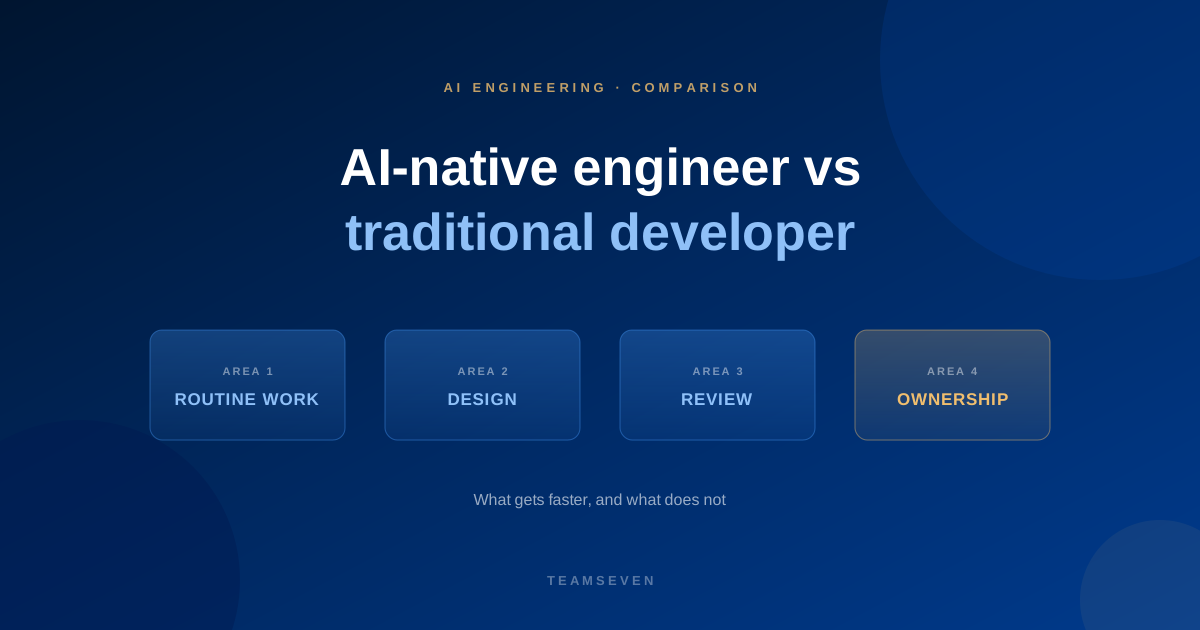
The responsibilities of an AI-native engineer and a traditional developer are the same: understand the problem, design a solution, build it, test it and own it in production. What changes is the workflow, where the time goes and what can go wrong.
This comparison is for people deciding who to hire. The honest answer is that neither is better in every situation.
The short version
- Routine work gets faster with an engineer who is good at directing an assistant: boilerplate, tests, refactors and documentation.
- Hard work does not get much easier. Design, debugging a strange production fault and understanding a customer's real problem still take thought.
- Review matters more, not less, because plausible-looking wrong code is easier to produce.
- The best of either kind is defined by judgement, not by the tools they use.
Where the work differs
| Task | Traditional developer | AI-native engineer |
|---|---|---|
| Boilerplate and CRUD screens | Written or scaffolded by hand | Drafted by an assistant, edited to fit the codebase |
| Unit tests | Written after the code, often thin | Scaffolded early with AI, extended by hand for edge cases |
| Reading unfamiliar code | Manual reading and searching | Assistant explanation first, then confirmed by reading and running |
| Refactoring across files | Careful, slow, error-prone | Assistant does the repetitive edits, engineer checks the diff |
| Documentation | Often left until later | Drafted from the code and corrected |
| Architecture and data model | Engineer's decision | Still the engineer's decision |
| Security review | Engineer's responsibility | Still the engineer's responsibility, with more code to check |
What genuinely gets faster
Anything repetitive, well understood and easy to verify. Adding a field through the data layer, the API and the form. Writing a first set of tests for a function. Converting a pattern across thirty files. Explaining a legacy module nobody has touched in years.
We will not put a percentage on it. The gain depends on the codebase, the clarity of the brief and the engineer. What we will do is give you a real first task and let you judge the pace and the review comments yourself.
What does not get faster
- Deciding what to build. If the requirement is vague, an assistant produces confident code for the wrong thing.
- Design. The data model and the boundaries between parts are still decisions a person makes, and getting them wrong is expensive to reverse.
- Debugging subtle faults. Assistants help, but production problems often come down to understanding how a particular system behaves.
- Talking to the people who use the software. No tool does that for you.
The new risks
Plausible but wrong code. AI output looks tidy and confident. It can call functions that do not exist, skip an access check or mishandle an edge case, and nothing in the style gives it away.
Over-trust. Engineers who accept output without reading it ship defects faster than before. This is the main failure we see when AI-built apps come to us for rescue: authentication, data models and billing that cannot survive real users.
Inconsistent structure. Assistants write each piece well in isolation and can ignore how the rest of the system is organised. Without someone holding the architecture, a codebase drifts.
Data leaving your control. Pasting code or customer data into a tool you have not approved is a policy and privacy problem, whatever the engineer's intent.
We go through the controls in the risks of AI-generated code and how engineers control them.
When a traditional developer is the right hire
- Your policy does not allow AI tools near the code, for regulatory or contractual reasons
- The work is mostly deep investigation of one complex system rather than building
- You already have strong AI practices in-house and just need an extra pair of hands who follow them
When an AI-native engineer is the better hire
- You have a backlog of routine feature work
- You are building a first version and need to move quickly
- You have an undocumented or under-tested codebase to get on top of
- You want engineers who will help your wider team use AI tools sensibly
What to look for in either
Whichever you hire, look for the same things: they can explain their decisions, they review their own work, they ask about requirements before building, and they are honest about what they do not know. Our buyer's checklist turns that into interview questions.
Read more
- What is an AI-native engineer?
- Hire AI-native engineers at Teamseven
- Staff augmentation vs a dedicated team
Will an AI-native engineer replace a traditional developer?
Not in the work we do. The tools remove routine effort, but someone still has to decide what to build, check that it is correct and secure, and be accountable for it in production. That is what a good engineer does with or without an assistant.
Is AI-assisted code lower quality?
It can be, when nobody reviews it. With careful review, tests and clear ownership, it can be as good as hand-written code, and sometimes more consistent. The difference comes from the engineer's habits rather than the tool.
How do I know if an engineer's AI use is any good?
Ask them to walk through a recent change and say which parts an assistant drafted, what they changed and what the tool got wrong. Good engineers answer specifically. Vague or boastful answers are a warning.
Stay connected
Build notes, launches, and new articles from the Teamseven team.