How Much Does It Cost to Add AI to Your Software in 2026?
An honest cost breakdown for adding AI to existing software: integration, custom models, agents, and the ongoing API costs nobody warns you about.

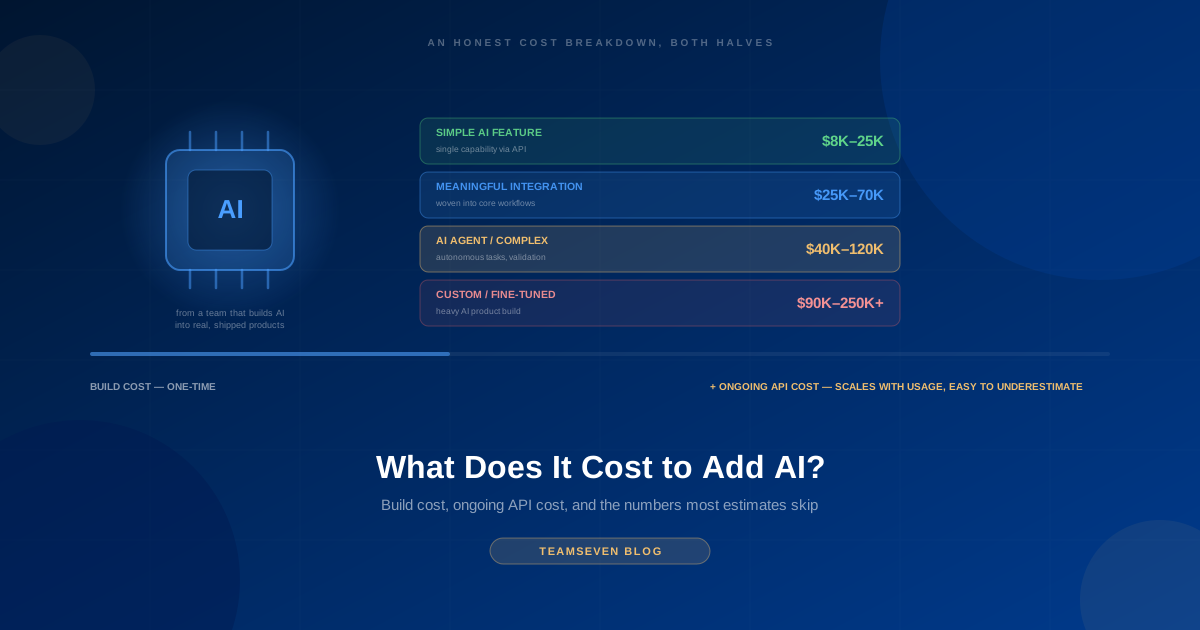
"How much does it cost to add AI to our software?" is a question I get almost weekly now. The honest answer has two halves (the build cost, and the ongoing cost that scales with usage) and most estimates only mention the first, which is how companies get surprised by their AI bill three months after launch.
We build AI into real products (Mebag runs on OpenAI), so here's the honest breakdown, both halves.
The short answer: build cost
| What you're adding | Realistic cost | Timeline |
|---|---|---|
| Simple AI feature (a single capability via an API: summarise, classify, generate) | Scoped after a call | 4–10 weeks |
| Meaningful AI integration (AI woven into core workflows, some custom logic) | Scoped after a call | 10–20 weeks |
| AI agent / complex capability (autonomous tasks, tool use, validation layers) | Scoped after a call | 16–32 weeks |
| Custom/fine-tuned models or heavy AI product | Scoped after a call | 24+ weeks |
Build cost only. The ongoing API cost is separate and covered below: don't skip it. As a rule, each tier costs meaningfully more than the one before it, driven by how deep the AI sits in your workflows and how much validation the use case demands, book a call for a real number against your specific feature.
What drives the build cost
How deeply the AI is integrated. Bolting a "summarise" button onto an existing app is cheap. Weaving AI through your core workflows (where it reads your data, makes decisions, and feeds results back into the product) is a real engineering project. Depth of integration is the biggest build-cost driver.
Off-the-shelf model vs custom. Most business AI today uses existing models (OpenAI, Anthropic, others) via API: far cheaper and faster than training your own. Custom or fine-tuned models cost dramatically more and are only worth it when off-the-shelf can't do the job. For most businesses, using a frontier model via API is the right and affordable choice. Don't let anyone sell you a custom model you don't need.
Validation and guardrails. Because AI can be confidently wrong, the engineering that checks its output (sanity checks, confidence thresholds, human-in-the-loop, fallbacks) is a real part of the cost. For anything where errors matter, this isn't optional, and skimping on it is how AI features embarrass you in production.
Data readiness. AI is only as good as the data you feed it. If your data is messy, scattered, or unstructured, getting it AI-ready is often a bigger job than the AI integration itself. This is the hidden cost that surprises people most.
The "boring foundation" tax. If your existing software has weak architecture, adding AI on top exposes it. Sometimes the honest answer is that the foundation needs shoring up first: the AI sits on top of solid software, and weak foundations can't hold it.
The half nobody tells you about: ongoing API cost
Here's what catches companies out. Every time your AI does something, it's an API call, and API calls cost money that scales directly with usage. The more your product is used, the bigger the bill. Success costs you more.
A single AI operation costs a fraction of a cent, which feels free. Multiply it by every user, every action, running continuously across your whole user base, and it becomes a real monthly line item that grows as you grow. We've watched founders build a cheap AI feature and get blindsided by the running cost.
The disciplines that control it, and that a good team builds in from day one:
- Caching: don't pay to compute the same thing twice
- Batching: group operations where timing allows
- Right-sizing the model: don't use your most expensive model for a job a cheaper one handles fine
- Real-time monitoring: see a cost spike the day it happens, not at month-end
AI cost management is an engineering discipline. Factor the ongoing cost into your model from the start, because a cheap build with an expensive running cost is not a cheap product.
Where companies waste money adding AI
Adding AI because it's trendy. The most expensive AI is the AI you didn't need. If a few business rules would do the job more reliably and cheaply, use the rules. Not every problem wants a probabilistic answer.
Building custom models unnecessarily. Frontier models via API cover the vast majority of business needs at a fraction of the cost. Custom models are rarely the right first move.
Ignoring the running cost until it hurts. Covered above. It's the number one surprise. Model it upfront.
Skipping validation. An AI feature with no guardrails will eventually produce a confidently wrong output in front of a customer. The validation layer isn't where you cut corners.
How to get your real number
Define the specific job. Not "add AI": what exact task, on what data, producing what? Precision here is most of the estimate.
Check your data readiness. Is the data the AI needs clean, structured, and accessible? If not, that's part of the cost.
Decide how deep. A bolt-on feature or AI woven through the product? This swings the number most.
Estimate the usage. How often will the AI run, across how many users? That drives your ongoing cost, which matters as much as the build.
Then a good team can give you both numbers, build and running, which is the only complete answer.
FAQ
How much does it cost to add AI to existing software? It depends on depth. A single AI capability delivered via an API (summarise, classify, generate) is a relatively small build over 4–10 weeks. A meaningful integration woven into core workflows takes longer and costs more, typically 10–20 weeks. An AI agent with autonomous tasks, tool use and validation layers is a bigger project again, over 16–32 weeks. Custom or fine-tuned models sit at the top of the range and take 24+ weeks. Book a call and we'll scope your exact feature.
Do I need to train a custom AI model? Almost certainly not. Most business AI today runs on existing models from OpenAI, Anthropic and others via API, which is dramatically cheaper and faster than training your own. Custom or fine-tuned models are justified in narrow cases (unusual domain language, strict data residency, or scale economics) and they're a different order of investment.
Why does AI cost more than a normal software feature of the same size? Because of the engineering that checks the AI's output. Models can be confidently wrong, so sanity checks, confidence thresholds, and human-in-the-loop review are part of the build rather than optional extras. That validation layer is frequently a larger share of the work than the AI call itself.
What makes an AI project expensive unexpectedly? Data readiness. AI is only as good as the data you feed it, and if yours is messy, scattered or unstructured, getting it AI-ready is often a bigger job than the AI feature. It's worth auditing your data before scoping the feature, not after.
Is bolting AI onto an existing app cheaper than building it in? Yes, considerably. Adding a "summarise" button to an existing screen is cheap. Weaving AI through core workflows (where it reads your data, takes actions, and affects what users see) is a different project, because it touches everything around it. Our generative AI integration services are scoped to whichever end of that range you need.
Stay connected
Build notes, launches, and new articles from the Teamseven team.