What Is an AI-Native Engineer? A Plain Definition
An AI-native engineer works with AI coding assistants every day and still owns the result. What that means in practice, what it doesn't, and how to spot one.

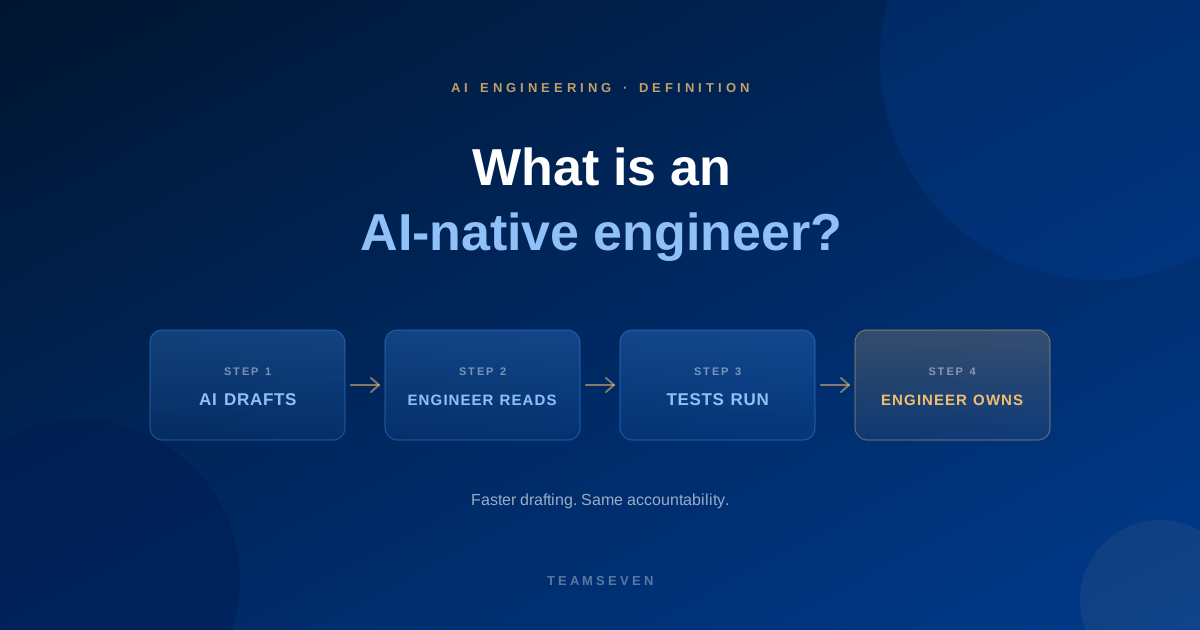
An AI-native engineer is a software engineer who works with AI coding assistants and agents as a normal part of the day, and who still reads, runs and takes responsibility for everything that ships. The AI speeds up the drafting. The engineer stays accountable for the result.
That is the whole definition. The rest of this post is about what it looks like in practice, what it is not, and how to tell the difference between someone who is AI-native and someone who has installed a plugin.
What an AI-native engineer does on a normal day
The work is the same work: understanding a problem, deciding how to solve it, building it, checking it and shipping it. What changes is how much of the typing and searching is handed to a tool.
- Drafts first versions of routine code such as forms, API endpoints, data mappers and tests, then edits them until they match the codebase
- Asks an assistant to explain unfamiliar code before changing it, then confirms the explanation by reading and running the code
- Generates test scaffolding and edge cases, then adds the cases the tool missed
- Refactors across files with an assistant doing the repetitive part and the engineer checking the diff
- Writes and updates documentation from the code, and corrects what the tool got wrong
- Hands bounded tasks to an agent, with a clear brief and a human checkpoint before anything merges
None of that removes the engineer from the loop. It moves their time from typing towards deciding and checking.
What it is not
It is not prompting and hoping. Pasting a feature request into a chat window and shipping whatever comes back is how apps end up with open data and broken logins. We see the results when AI-built apps come to us for rescue, and the failures cluster in the same places: authentication, the data model and billing.
It is not a promise of a fixed speed-up. How much faster a task gets depends on the codebase, the clarity of the requirement and the kind of work. Be wary of anyone who quotes a multiplier before they have seen your code.
It is not a replacement for design judgement. Decisions about structure, security and what to build stay with people. An assistant will happily produce code for a bad design.
AI-curious or AI-native?
| Habit | Uses AI occasionally | AI-native |
|---|---|---|
| How AI is used | When stuck, as a search replacement | Throughout the day, on a defined set of tasks |
| Review of AI output | Skims it | Reads the diff, runs it, tests it |
| Tests | Written by hand, if at all | Scaffolded with AI, extended by hand |
| Knowing when not to use it | Rarely considered | Clear rules: security, auth, data model and anything sensitive get extra care |
| Accountability | "The tool wrote it" | "I shipped it, so I own it" |
The last row matters most. An AI-native engineer never uses the tool as an excuse.
What stays human
Some decisions should not be delegated, however good the assistant:
- Architecture. How the data is modelled, where the boundaries sit, how the system is hosted.
- Security. Who can see and change what, and how secrets and personal data are handled.
- What to build. The assistant answers the question you ask. Choosing the question is the job.
- Final review. A person reads the change before it reaches production.
This is why we pair AI-native engineers with architects on larger work. Faster code needs a firmer structure, or the speed turns into inconsistency.
How to tell if someone is genuinely AI-native
Ask them to walk through a recent task. A genuinely AI-native engineer can tell you which parts the assistant drafted, what they changed and why, what the assistant got wrong and how they caught it. If the answer is vague or boastful, keep looking. Our buyer's checklist has the interview questions we would use.
Where this fits at Teamseven
Our engineers work with AI assistants every day and review what they produce. You can add one to your own team through staff augmentation, or have us run a dedicated team. On the first call you tell us which AI tools may see your code, and we follow those rules. More detail is on our AI-native engineers page.
Read more
- AI-native engineer vs traditional developer: what actually changes
- The risks of AI-generated code, and how engineers control them
- 5 security holes we find in AI-built apps
Is an AI-native engineer the same as a vibe coder?
No. Vibe coding means describing what you want to an AI tool and accepting the output with little review, which is fine for a throwaway prototype. An AI-native engineer uses the same tools but reads, tests and owns the code, which is what makes it safe to put in front of customers.
Do AI-native engineers write code themselves?
Yes. They write the parts that need judgement and edit the rest. Most of the skill is knowing which is which, and being able to read and fix code the assistant got wrong.
Do AI-native engineers cost more?
Pricing depends on the role and the experience you need, not on the label. We quote each engineer as a monthly rate on a call, and there are no recruitment fees. Book a call and tell us who you need.
Stay connected
Build notes, launches, and new articles from the Teamseven team.