How to Choose an AI Agent Development Company (Without Getting Burned)
What an AI agent development company actually does, what it costs, and the questions that separate teams who ship agents from teams who demo them. From engineers who build them.

There is a specific kind of meeting I have been in too many times lately. A company has seen an AI agent demo — maybe internally, maybe from an agency — and it was genuinely impressive. The agent read an email, looked something up, updated a record, and replied. Everyone in the room could see the future.
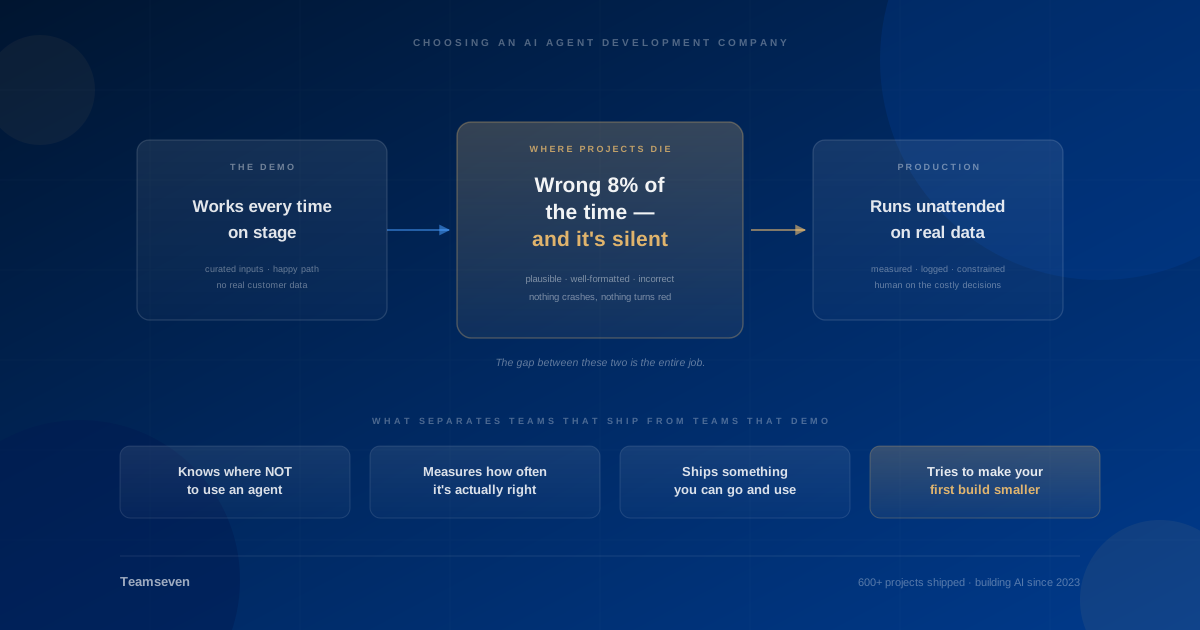
Then they try to put it into production, and it falls apart. Not dramatically. It just quietly does the wrong thing 8% of the time, and nobody can explain why, and the project stalls.
The gap between "impressive demo" and "runs unattended against real customer data" is the entire job. This guide is about how to tell, before you sign anything, whether the company you are talking to understands that gap.
I build these systems for a living. What follows is what I would want to know if I were the one hiring.
What an AI agent development company actually does
The term gets used loosely, so it is worth being precise. An AI agent is software that pursues a goal across multiple steps — deciding what to do, calling tools or APIs, checking results, and adjusting — rather than answering one prompt at a time.
That means a real AI agent development company is doing four distinct jobs:
Scoping the task. Deciding which parts of a workflow should be handled by a model and which should stay ordinary deterministic code. This is the single most important decision in the project, and it happens before anyone writes an agent.
Wiring it to your systems. An agent that cannot read your CRM, query your database, or call your internal API is a chatbot. The integration work is usually the bulk of the build.
Constraining it. Deciding what the agent is allowed to do on its own, what needs human approval, and what happens when it is uncertain.
Making failure visible. Logging, tracing, evaluation. Knowing when the agent got it wrong, ideally before your customer does.
If a prospective partner only talks about the first item and the model they are using, they are selling you a prototype.
The uncomfortable truth about where agents fail
Traditional software fails loudly. A bug throws an error, something turns red, you fix it.
Agents fail quietly. The model returns something plausible, correctly formatted, and wrong. Nothing crashes. The record just gets updated with a subtly incorrect value, and it sits there until someone notices downstream.
This changes what "done" means. With ordinary software, you build the feature and test that it works. With an agent, you build the feature and then measure how often it is right — because the answer will never be 100%, and you need to know whether it is 99% or 91%, and what happens in the gap.
Any company that tells you their agent is reliable without showing you how they measure reliability has not built one that runs in production.
The seven questions worth asking
These are the ones that actually separate teams. I would ask all of them on a first call.
1. "What part of this would you not use an agent for?"
The best possible answer is a fast, specific one. Good engineers have strong opinions about where models do not belong — anything requiring exact arithmetic, anything with hard compliance rules, anything where a wrong answer is expensive and undetectable.
If the answer is that AI can handle all of it, walk away. That is a sales response, not an engineering one.
2. "How will we know when it gets something wrong?"
You are listening for specifics: evaluation sets, logged traces, confidence thresholds, human review queues, alerting on unusual patterns. "We test it thoroughly" is not an answer. Agents cannot be tested thoroughly in the traditional sense, because the input space is effectively infinite.
3. "What does this cost to run each month, at our volume?"
Token costs are real and they scale with usage, unlike normal software where the marginal cost of a request is near zero. A competent partner will ask about your volumes and give you a range. A partner who has never operated an agent in production will not have thought about it.
Watch for the multi-step trap: agents often make several model calls per task. A workflow that costs half a cent per step can cost 5 cents per completed task, which is fine at a thousand tasks a month and painful at a million.
4. "What happens when the model provider changes something?"
Models get deprecated, updated, and re-tuned. Behaviour shifts. Ask how they insulate you from that — whether the prompts and tool definitions are versioned, whether there is an evaluation suite to catch regressions, whether swapping providers means a rewrite.
5. "Can I see something you have running in production?"
Not a demo. Something with real users. The difference is enormous, and everyone in this field knows it.
6. "Who owns the code, the prompts, and the evaluation data?"
The answer should be you, all of it. Prompts and eval sets are genuinely valuable intellectual property — arguably more valuable than the surrounding code, because they encode everything the team learned about your specific problem.
7. "What is the smallest version of this that would be useful?"
A good partner will try to shrink your first build. Agents are a domain where you learn an enormous amount from the first thing you put in front of real users, and where big up-front builds tend to encode wrong assumptions expensively.
What it costs
Honest ranges, based on what we see:
A single well-scoped agent — one workflow, two or three tool integrations, human approval on anything consequential — is typically a 6 to 10 week build. This is the right place to start for almost everyone.
A multi-agent workflow — several agents handing off, or one agent with many tools and branching logic — runs considerably longer, and the cost is driven by integration surface rather than by the AI itself.
Ongoing costs are the part people forget. Budget for model usage, plus real engineering time for monitoring and iteration. An agent is not a project you finish; it is a system you operate. Teams that budget for the build and not the operation are the ones who abandon them after four months.
The variable that moves these numbers most is not model choice or agent framework. It is how many systems the agent must touch, and how messy those systems are. A clean, documented API is a fast integration. An undocumented legacy database with inconsistent data is not.
Build, buy, or augment
Not everyone needs a development company for this, and it is worth being honest about when you do not.
Buy an off-the-shelf tool when your workflow is genuinely common — customer support triage, meeting notes, document summarisation. Vendors have solved these well, and a custom build will cost more and work less reliably at the start.
Hire an AI agent development company when the workflow is specific to how your business operates, when it must touch your internal systems, or when the data involved cannot leave your infrastructure. This is where custom pays for itself, because the value comes precisely from the fit with your operation.
Augment your existing team when you have capable engineers who have not shipped AI systems before. Often the fastest path is bringing in people who have made the mistakes already, working alongside developers who know your domain. It is usually cheaper than a full outsourced build and leaves the knowledge in-house.
The wrong reason to build a custom agent is that AI is strategically important. That is how you end up with an expensive system nobody uses.
What we have learned building them
A few things that surprised us, offered because they are the sort of thing you only learn by shipping.
The model is rarely the hard part. Choosing between frontier models matters far less than people expect. What matters is the plumbing — clean tool definitions, good context, sensible retries, knowing when to stop.
Narrow beats broad, consistently. An agent that does one workflow properly is more valuable than one that half-does five. Narrow scope also makes failure legible: when something goes wrong, you can see why.
Humans in the loop are a feature. The instinct is to remove the human as the goal. In practice, the systems that survive contact with production keep a human on the consequential decisions and let the agent do the tedious 90% around them. Users trust those systems, which means they keep using them.
Evaluation is the real deliverable. The thing that lets you improve an agent safely is the test set that tells you whether a change made it better or worse. Build that early. Without it, every change is a guess.
A reasonable way to start
If you are considering this, the sequence that works:
- Pick one workflow that is repetitive, currently manual, and where mistakes are recoverable.
- Write down what "correct" looks like for 20 real examples. This becomes your evaluation set and it will teach you more than any planning document.
- Build the smallest agent that handles those 20 cases, with a human approving anything consequential.
- Run it alongside the existing manual process for a few weeks and compare.
- Widen the scope only where the numbers justify it.
This is slower than the demos suggest and faster than the projects that skip it.
How much does it cost to hire an AI agent development company?
A single well-scoped agent — one workflow, a few integrations, human approval on consequential actions — is typically a 6 to 10 week build. Multi-agent workflows run longer, and the cost is driven by how many systems the agent must touch rather than by the AI itself. Budget separately for ongoing model usage and engineering time, because an agent is a system you operate, not a project you finish.
How long does it take to build an AI agent?
Six to ten weeks for a first production agent handling one workflow. That assumes your data is accessible and your APIs are documented. Undocumented legacy systems are the most common cause of overrun — the integration work, not the AI, is usually the long pole.
What is the difference between an AI agent and a chatbot?
A chatbot responds to one prompt at a time. An agent pursues a goal across multiple steps: deciding what to do, calling tools or APIs, checking results, and adjusting as it goes. The practical difference is that an agent takes actions in your systems, which is why constraining it and measuring its accuracy matter far more than they do for a chatbot.
Should I build a custom AI agent or buy an off-the-shelf tool?
Buy when your workflow is common — support triage, meeting notes, document summarisation. Vendors have solved those well. Build custom when the workflow is specific to how your business operates, when it must touch your internal systems, or when the data cannot leave your infrastructure. The wrong reason to build custom is that AI feels strategically important.
How do I know if an AI agent development company is any good?
Ask what they would not use an agent for, and how you will know when it gets something wrong. Strong teams answer both quickly and specifically, with talk of evaluation sets, logged traces, and human review queues. Ask to see something running in production with real users — not a demo. Then check that you own the code, the prompts, and the evaluation data.
The short version
An AI agent development company is worth hiring when your workflow is specific enough that no product fits it, and important enough to warrant the operational commitment. The right partner will try to narrow your scope, will talk about failure before capability, and will show you something running in production.
The wrong partner will show you a very good demo.
If you are weighing an agent build and want a straight answer about whether it is the right fit — including if the answer is no — book a scoping call. We would rather tell you early than build you something you do not need.
Stay connected
Build notes, launches, and new articles from the Teamseven team.