
Flutter vs React Native in 2026: An Honest Comparison from a Team That Uses Both
A practical Flutter vs React Native comparison for 2026: performance, cost, hiring, and ecosystem, from an agency that ships in both frameworks.

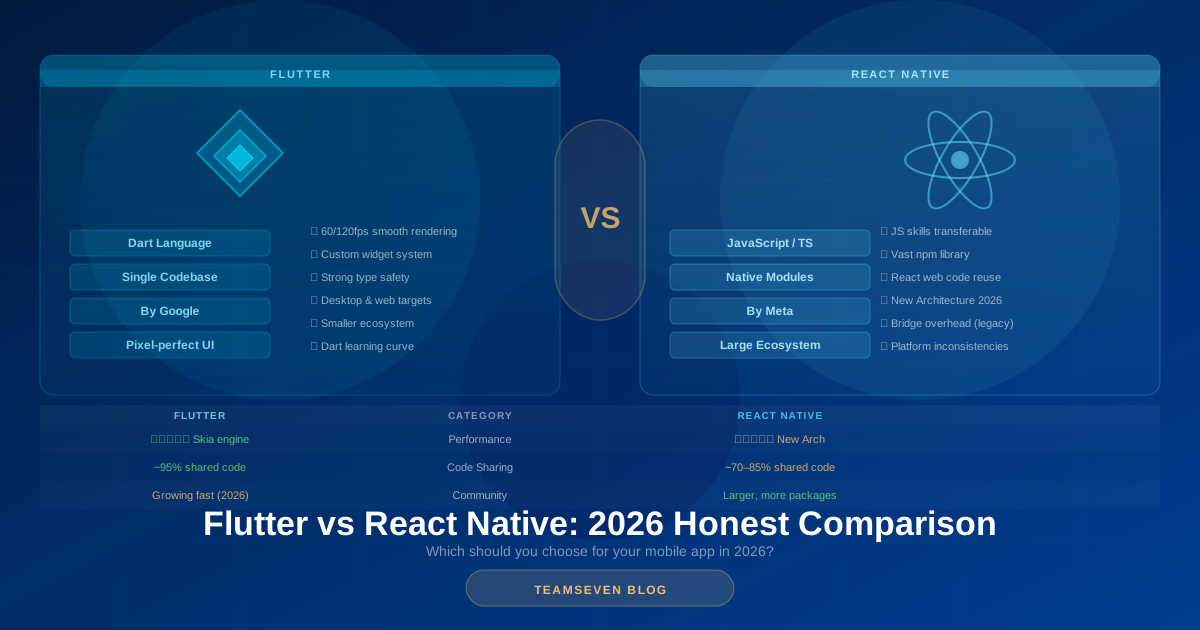
Most Flutter vs React Native articles are written by people who only use one of them. They're not comparisons. They're defences of a choice the author already made.
We use both. We've shipped production apps in Flutter and production apps in React Native, and we choose between them per project. So this is an actual comparison, written by people who don't have a side to defend. By the end you'll know which one fits your project, and you'll understand why "it depends" is the honest answer, with specifics about what it depends on.
The short answer
| Factor | Flutter | React Native |
|---|---|---|
| Performance | Slightly better, especially animation-heavy apps | Excellent for most apps; tiny gap vs Flutter |
| Language | Dart (new to most teams) | JavaScript/TypeScript (familiar to web teams) |
| UI consistency | Identical across platforms (own rendering) | Uses native components: small platform differences |
| Best for | Animation-rich apps, brand-consistent UI, teams starting fresh | Teams with React/JS skills, apps sharing code with web |
| Ecosystem | Growing fast, strong official packages | Larger, more mature, npm ecosystem |
| Hiring | Smaller talent pool, growing | Large talent pool (overlaps with React web devs) |
| Backed by | Meta |
Our default for new cross-platform projects: Flutter. Our default when the team already builds in React/JavaScript: React Native. Below is why.
What they are
Both solve the same core problem: build a mobile app once, run it on iOS and Android, instead of building two separate native apps. Both save significant time and cost versus native-on-both-platforms. Both are mature, production-grade, and used by major apps you'd recognise.
The difference is in how they work under the hood, and that difference drives everything else.
Flutter uses its own rendering engine. It draws every pixel itself rather than using the platform's native UI components. This is why a Flutter app looks identical on iOS and Android: Flutter is painting the interface, not asking the OS to. It uses Dart, a language most teams haven't used before.
React Native uses actual native components. When you write a button, you get a real iOS button on iOS and a real Android button on Android. This means slight platform differences, but also a more "native" feel. It uses JavaScript and React: the same skills millions of web developers already have.
Performance: the gap is small
Flutter has a slight performance edge, particularly for animation-heavy apps, because it controls rendering directly. For apps with complex custom animations, lots of visual motion, or graphics-intensive interfaces, Flutter's advantage is real and worth choosing for.
But for the vast majority of business apps (a SaaS companion, a marketplace, an ecommerce app, an operations tool) React Native's performance is completely fine. Users can't tell the difference. The "Flutter is faster" argument is true and mostly irrelevant unless your specific app is in the animation-heavy category.
Anyone who tells you React Native is "too slow" for a normal business app is either out of date or arguing a position. It's not. Both frameworks handle normal apps beautifully.
Language: this is the real deciding factor for most teams
Here's the practical truth that matters more than performance benchmarks: which language does your team already know?
React Native uses JavaScript and React. If you have web developers, and most companies do, they can work in React Native almost immediately. The skills transfer. Your React web developer can contribute to your React Native app. You can share logic between your web app and mobile app. For a team with existing JavaScript/React skills, React Native dramatically lowers the barrier.
Flutter uses Dart. It's a clean, pleasant language, but it's new to most teams. There's a learning curve. Your existing developers will need to ramp up. This isn't a huge deal for a dedicated long-term project, but it's a real consideration.
This single factor, what your team already knows, decides more React Native vs Flutter choices in practice than any technical benchmark.
UI: identical vs native
Flutter draws its own UI, so your app looks pixel-identical on every device. If brand consistency matters (if you want your app to look exactly the same everywhere and match your design system precisely) Flutter delivers that out of the box.
React Native uses native components, so your app feels native to each platform but has small differences between iOS and Android. For many apps, this is desirable: users get an interface that feels right for their platform. For others, where exact brand consistency matters more than platform-native feel, it's a minor friction.
Neither is better. They're different philosophies. Pick based on whether you value brand-exact consistency (Flutter) or platform-native feel (React Native).
Ecosystem and packages
React Native has been around longer and benefits from the enormous JavaScript/npm ecosystem. For almost any feature you need, there's a package. The maturity shows.
Flutter's ecosystem is younger but growing fast, with strong official packages from Google and an increasingly complete third-party library. For most needs, Flutter has what you need now. For obscure or cutting-edge integrations, React Native's larger ecosystem occasionally has an advantage.
Hiring and cost
React Native has a larger talent pool, partly because it overlaps with the huge population of React web developers. Easier to hire for, often cheaper because of supply.
Flutter's talent pool is smaller but growing. Good Flutter developers are slightly harder to find and can command a small premium, though this gap is closing as Flutter adoption grows.
For an offshore engagement, both are well-supported. We have strong teams in both. The cost difference between building your app in Flutter versus React Native is minimal: the bigger cost driver is the app's complexity, not the framework.
When we choose Flutter
We default to Flutter for new cross-platform projects when:
The app is animation-heavy or visually rich, where Flutter's rendering advantage matters. Brand-exact UI consistency across platforms is important. The team is starting fresh without existing React/JavaScript investment. We want the smoothest possible single-codebase experience with pixel-perfect consistency.
Flutter has matured enormously. For a greenfield cross-platform app where the team doesn't have a JavaScript bias, it's our default, and it has been for a while.
When we choose React Native
We choose React Native when:
The team already builds in React and JavaScript: the skill transfer is too valuable to ignore. You want to share code or logic between a web app and the mobile app. You need a specific package from the npm ecosystem. You're hiring and want the largest possible talent pool. The existing codebase or company tech stack is JavaScript-centric.
React Native is an excellent, mature, production-grade choice. The "React Native is dying" takes you might see online are wrong. It's actively developed, backed by Meta, and runs major apps.
When you should build native instead of either
Honesty requires saying it: sometimes neither cross-platform framework is right.
Build native (Swift for iOS, Kotlin for Android) when your app requires deep platform integration that cross-platform handles poorly: advanced AR, complex Bluetooth in specific configurations, heavy use of cutting-edge platform-specific APIs, or animation performance that exceeds what cross-platform delivers. These cases are rarer than native advocates claim, but they're real. For most business apps, cross-platform is the right call. For the specific high-intensity cases, native still wins.
The honest bottom line
Both Flutter and React Native are excellent. Neither is a mistake. The "which is better" framing is wrong: the right question is "which fits my project and team."
If you have a React/JavaScript team: React Native, almost certainly. The skill transfer is worth more than any marginal technical difference.
If you're starting fresh and want pixel-perfect consistency: Flutter, our default for greenfield.
If your app is animation-heavy: Flutter's edge is real.
If you need the biggest hiring pool: React Native.
If you're unsure: either works. Pick based on team skills, and you'll be fine.
We've shipped real apps in both and been happy with both. The framework is rarely what determines whether a project succeeds. That's about scope, communication, and execution. Pick the one that fits your team, and put your energy into building the product well.
FAQ
Flutter or React Native, which should I choose in 2026? Our default for new cross-platform projects is Flutter. Our default when the team already builds in React or JavaScript is React Native. The deciding factor is rarely the framework's capability, both are excellent, it's which language your team already knows and whether you're sharing code with a web app.
Is Flutter faster than React Native? Slightly, and mostly in animation-heavy apps where Flutter's own rendering engine helps. For the vast majority of business applications the performance gap is small enough that it shouldn't drive the decision. Language and hiring matter far more.
Which has the better talent pool for hiring? React Native, by a clear margin, because it overlaps with the large pool of React web developers. Flutter's talent pool is smaller but growing steadily. If hiring flexibility is a priority, that difference is worth weighing.
When should I choose Flutter over React Native? When the app is animation-rich or visually distinctive, when brand-exact UI consistency across platforms matters, and when the team is starting fresh without an existing JavaScript investment. Flutter renders its own UI, so it looks identical on both platforms.
When should I choose React Native over Flutter? When your team already builds in React and JavaScript, when you want to share code or logic between web and mobile, when you need a specific package from the npm ecosystem, or when you want the largest possible hiring pool. The skill transfer from an existing React team is usually too valuable to ignore.
Stay connected
Build notes, launches, and new articles from the Teamseven team.