Healthcare Appointment Scheduling Software: How We Built Slotwise (And Why Generic Booking Tools Fall Short)
What healthcare appointment scheduling software requires: 24/7 patient self-booking, calendar sync, and encrypted notes, from the team behind Slotwise.

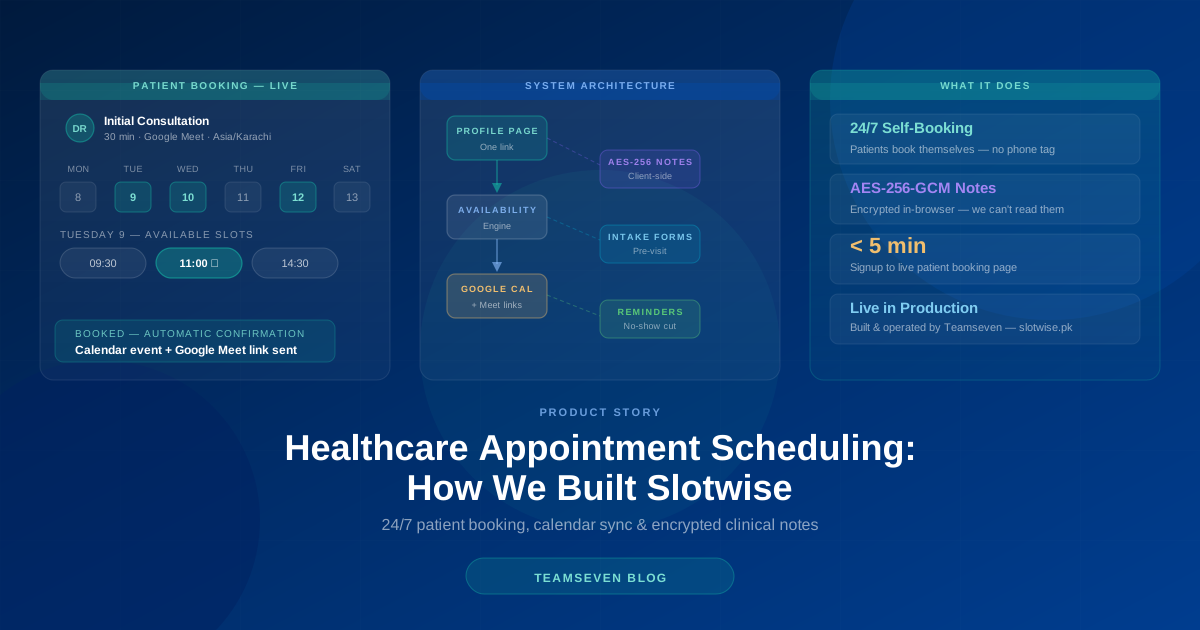
Ask a physiotherapist how they spend the gaps between patients and you'll hear the same answer everywhere: on the phone. Confirming Tuesday's appointment. Calling back the patient who called during a session. Playing the "does 3pm work? no? how about Thursday?" game: four messages to book one slot.
The strange thing is that scheduling is a solved problem in other industries. Sales teams have used booking links for a decade. But when we looked at what healthcare professionals were using, we found either generic booking tools that treat a patient like a sales call, or heavyweight practice management suites that cost a fortune and take weeks to set up. The middle was empty.
So we built Slotwise: appointment scheduling software for healthcare professionals, live in production today at slotwise.pk. We're a team that has been building healthcare and clinical software since 2017, and Slotwise is one of the products we design, build, and operate ourselves. This post covers what healthcare scheduling requires, where generic tools fall short, and the engineering lessons from shipping it, including the decision I'd defend most: encrypting clinical notes so that even we can't read them.
What is healthcare appointment scheduling software?
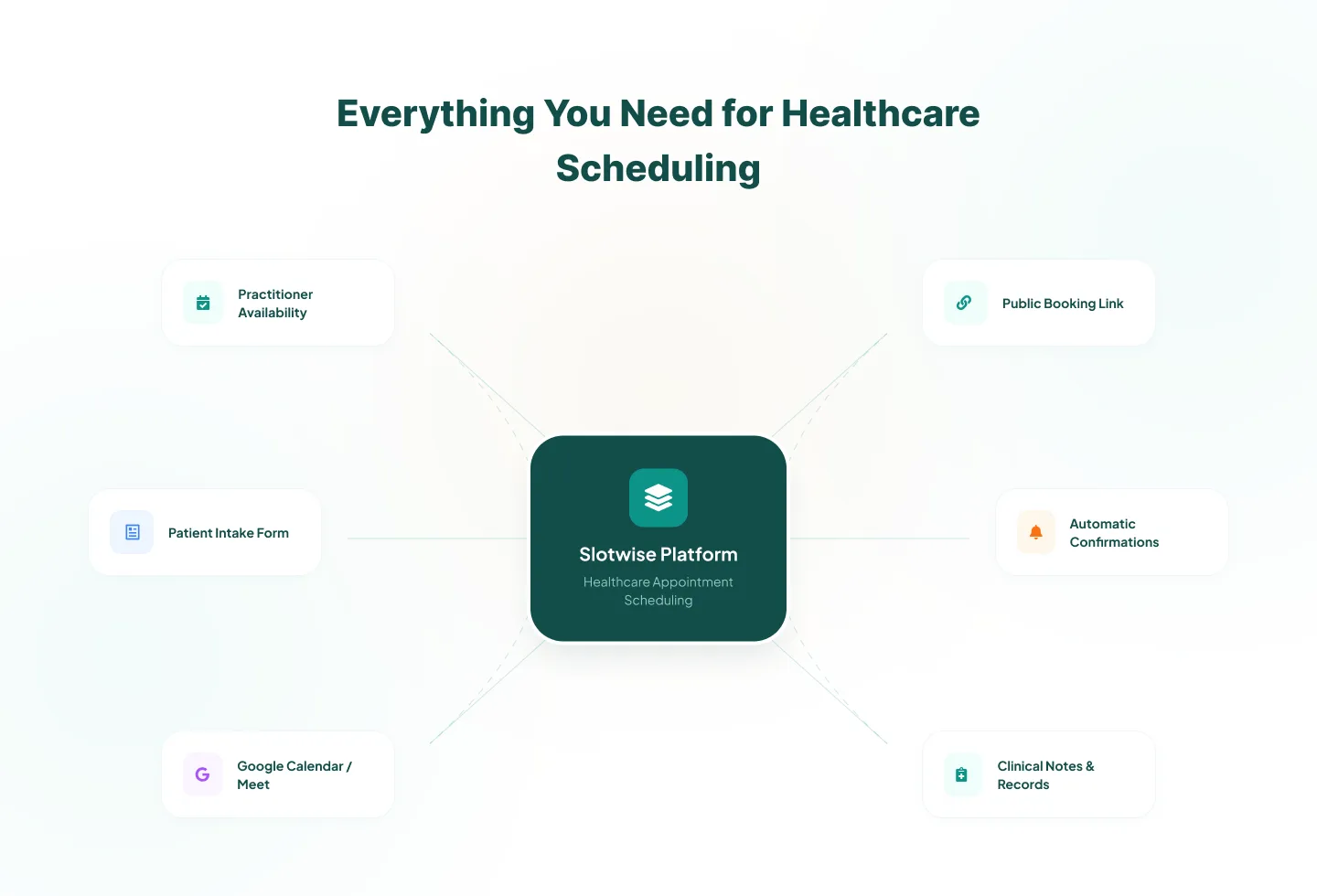
Healthcare appointment scheduling software lets patients book appointments directly from a practitioner's real availability (24/7, without phone calls) while handling the clinical context around the booking: intake forms, patient records, visit history, confirmations, and session notes.
That second half is the definition that matters. Booking a patient isn't like booking a haircut. There's a reason for the visit that the practitioner needs before the session. There's a history (previous visits, previous notes) that turns a ten-minute appointment into a useful one. And there's data sensitivity that most booking tools were never designed for, because a calendar entry that says "meeting with Ahmed" is not the same as one that says why Ahmed is seeing a specialist.
Why don't generic booking tools work for healthcare?
They half-work, which is worse than not working, because practices adopt them and then build workarounds. We watched this happen repeatedly before building Slotwise. The gaps come down to four things:
No patient context. Generic tools give you a name and an email. A practitioner needs the reason for visit, relevant history, insurance details: collected before the appointment, not scribbled during it. Slotwise attaches a custom intake form to every appointment type, so the patient fills it in while booking and the practitioner walks in prepared.
No clinical records. After the appointment, where do session notes go? In generic tools, nowhere, so practices bolt on a spreadsheet, a Word document, or paper. Every patient in Slotwise has a profile with full booking history, intake answers, and clinical notes in one place.
Wrong privacy model. Most booking tools store everything as plaintext their staff can technically read. That's fine for sales calls. It is not fine for clinical notes. More on this below, because it's the part we went furthest on.
No professional presence. A hairdresser can send a bare booking link. A healthcare professional is asking a stranger to trust them with their health: credentials, specialisations, and legitimacy matter to the person deciding whether to book. This shaped Slotwise's most distinctive design decision.
The booking page should be a professional profile, not a form
The insight that shaped Slotwise more than any other: for an independent healthcare professional, the booking page is their web presence. Most practitioners don't have a website. They have an Instagram account, a WhatsApp number, and word of mouth.
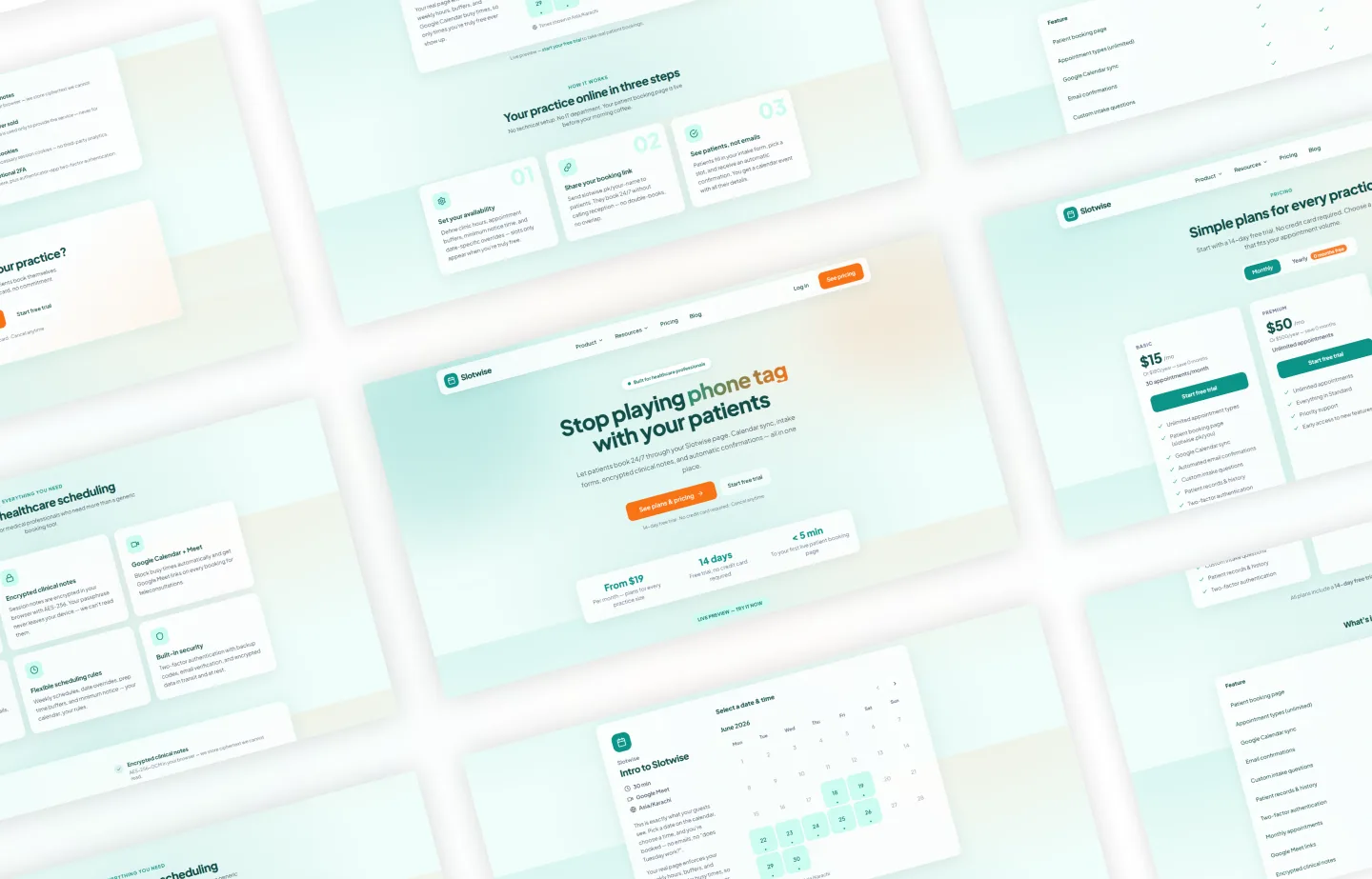
So instead of a bare calendar, every Slotwise practitioner gets a link-in-bio style public page: one URL that carries their credentials, experience timeline, services and languages, social links, published articles, and live booking, on a page they brand themselves. Share slotwise.pk/your-name anywhere; patients see who you are, read what you've written, and book, one link doing the work of a website, a business card, and a receptionist.
The articles feature earns its place, by the way. Practitioners who publish patient guidance on their profile build exactly the credibility that converts a hesitant visitor into a booked appointment. It's the same expertise-first logic that applies to any professional online: demonstrate, don't claim.
Availability is the hardest easy problem in scheduling
Every engineer thinks calendar availability is simple until they build it. The rule sounds trivial, only show times the practitioner is free, but " free" is a composite of at least five sources of truth:
- Weekly working hours: different clinic hours on different days
- Appointment-type rules: a 30-minute follow-up and a 60-minute initial consultation don't fit the same gaps
- Buffers and notice: prep time between sessions, minimum notice so a patient can't book a slot starting in four minutes
- External calendar state: the practitioner's Google Calendar, where the rest of their life lives
- Concurrent bookings: two patients looking at the same Tuesday at the same time
Slotwise syncs with Google Calendar both ways: busy events block booking slots automatically, and confirmed bookings appear as calendar events, with a Google Meet link attached for teleconsultations. The last item on that list, concurrency, is the one that separates real scheduling systems from demos: without proper conflict handling at booking time, two patients will eventually book the same slot, and in healthcare that failure costs trust you don't get back. These are the kinds of foundational choices we've written about in SaaS architecture decisions that define your product, cheap to get right at the start, brutal to retrofit.
Why we encrypt clinical notes so that we can't read them
This is the decision I'd defend in front of any audience: session notes in Slotwise are encrypted in the practitioner's browser with AES-256-GCM before they reach our servers. The passphrase never leaves the practitioner's device. We store ciphertext we cannot decrypt, not "we promise not to look," but "we are technically unable to look."
We built it this way because of an asymmetry we kept running into in clinical software work: the practitioner owns the duty of confidentiality, but conventional SaaS architecture forces them to extend that duty to their software vendor's entire staff, infrastructure, and breach history. Client-side encryption cuts that dependency. If our database leaked tomorrow, the clinical notes in it would be noise.
There's a real cost, and honesty requires naming it: zero-knowledge encryption means we can't recover notes if a practitioner loses their passphrase, and we can't run server-side search over note contents. We accepted both. For clinical data, the trade is correct, and it's increasingly what regulators and patients expect. The same thinking applies across the platform: no third-party tracking cookies, patient data never used for advertising, TLS everywhere, and optional two-factor authentication. Privacy isn't a feature tier; it's the security architecture the product stands on.
How does scheduling software reduce patient no-shows?
No-shows are healthcare's most expensive small problem: studies across outpatient settings commonly report rates around 15–25%, and every empty slot is unrecoverable clinical time. Software helps in three compounding ways.
Automatic confirmations and reminders. Most no-shows are memory failures, not decisions. A booking confirmation at booking time plus a reminder before the appointment converts "forgot" into either "attended" or "cancelled in time to rebook the slot."
Self-service booking honesty. When patients pick their own slot from real availability, they choose times that work for them: instead of accepting whatever the receptionist offered to end the phone call. Appointments people chose get kept more often.
Friction-free cancellation. Counterintuitive but true: making cancellation easy reduces no-shows, because the alternative to easy cancellation isn't attendance. It's silence. A cancelled slot can be rebooked; a no-show can't.
We designed Slotwise's whole flow around the patient doing the work once (pick a slot, fill the intake form, get the confirmation) because every step a human has to relay by phone is a step that fails on busy days.
What we learned building Slotwise
Five minutes is the adoption ceiling. A practitioner evaluates software between patients. If the first booking page isn't live in one of those gaps, they're gone. We measured setup obsessively, from signup to a live, shareable booking page in under five minutes, no technical skills, no IT department. B2B products for non-technical professionals live or die on this number.
Trust is the product in healthcare. Every architectural decision (the encryption, the no-tracking policy, the credential display on public profiles) is really one decision: make it safe for a patient to trust a practitioner they found online, and for a practitioner to trust software with their practice. We learned this building medical devices and clinical platforms long before Slotwise: in healthcare, trust failures are unrecoverable in a way feature failures never are.
Focused beats comprehensive. Slotwise deliberately doesn't try to be a full practice management suite: no billing engine, no insurance claims processing. It does scheduling, patient records, and the professional profile exceptionally well, at a price an independent practitioner can justify. The graveyard of healthtech is full of products that tried to do everything for everyone. (Choosing what not to build is most of product strategy.)
Run your own product; it changes you. Operating Slotwise in production (real practitioners, real patients, real 2am questions) has sharpened how we build for clients more than any retrospective ever did. It's one thing to hand over a system; it's another to be woken by one.
Should a clinic build custom scheduling software or subscribe?
The honest framework, from a team that does both:
Subscribe when you're an independent practitioner or a small clinic and a focused product already fits your workflow. Scheduling is commoditisable at this scale, and a subscription that works today beats a custom build every time. This is most practices.
Build custom when you're a hospital or network with scheduling logic that's yours (multi-department resource allocation, equipment and room constraints, integration with existing EHR systems) or when you're a founder building healthtech scheduling as a product. At that point you're in custom software territory, and decisions like multi-tenant vs single-tenant architecture and data protection design become yours to own. Budget for the invisible parts: the availability engine, the concurrency handling, and the security work are most of the build, and none of them demo well.
The takeaway
Healthcare appointment scheduling software succeeds on the parts you can't see in a screenshot: availability that's never wrong, bookings that never collide, notes that can't leak, and a setup so fast a practitioner adopts it between patients. The visible calendar is the easy fifth of the product.
We built Slotwise because the tools practitioners deserved didn't exist at a price they could justify, and because we believe the strongest proof of engineering capability is running your own product in production. See it on its showcase page or live at slotwise.pk.
Slotwise is live in production at slotwise.pk: 24/7 patient self-booking, Google Calendar and Meet sync, and clinical notes encrypted client-side with AES-256 before they ever reach a server. See the full product page →
Related reading
Stay connected
Build notes, launches, and new articles from the Teamseven team.