Multi-Tenant vs Single-Tenant SaaS: The Architecture Decision Explained for Founders
What multi-tenancy means, when single-tenant is right, the cost difference at MVP stage, and how the wrong choice becomes a six-figure rewrite.

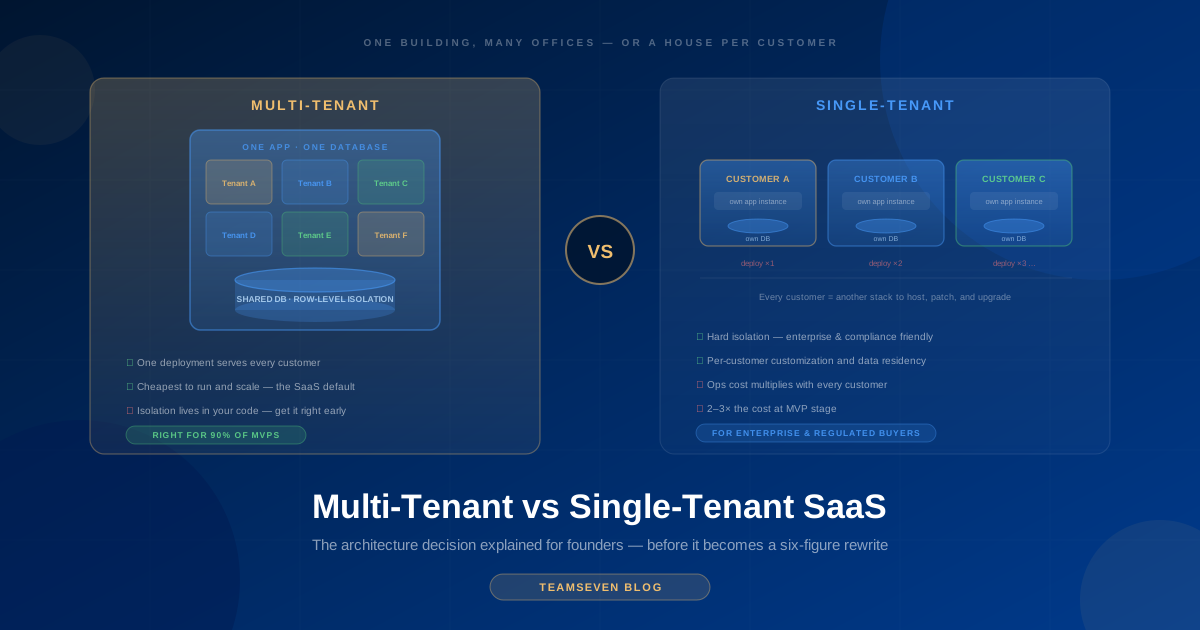
Multi-tenant means all your customers share one application and database with strict logical separation: one building, many secure apartments. Single-tenant gives each customer their own deployment, separate houses. For most B2B SaaS, multi-tenant is the right call from day one, and choosing wrong is one of the few MVP mistakes that requires a rewrite to fix.
This is the most consequential decision in your MVP that founders are least equipped to evaluate. It's invisible in demos, both versions look identical on screen, and the cheap quote is usually cheap because it skips it. Here's the founder-level explanation I give on scoping calls at Teamseven.
The two models in plain terms
Multi-tenant: one codebase, one deployment, one database: every record tagged with a tenant ID, every query scoped to it, every screen filtered by it. When you ship a feature, all customers get it simultaneously. When you onboard customer #200, your infrastructure cost barely moves. This is how essentially every SaaS you pay for works, and it's how we built i-mve, where 523 UK removals companies run on one platform, each seeing only their own jobs, quotes, and customers.
Single-tenant: each customer gets their own isolated instance: separate database, sometimes separate servers. Maximum isolation, maximum operational cost: every update deploys N times, every customer adds real infrastructure spend, and "quick fix for everyone" stops being a sentence you can say.
The comparison that matters
| Factor | Multi-tenant | Single-tenant |
|---|---|---|
| Cost per new customer | Near zero | Real, recurring infrastructure spend, each |
| Shipping updates | Once, everyone | Per instance |
| Data isolation | Logical (code + DB constraints) | Physical |
| Enterprise/compliance appeal | Fine for most; some regulated buyers push back | The selling point |
| MVP build cost | Somewhat more than a naive single-customer build | Cheapest first build, costliest business |
| Scaling 10 → 500 customers | Built for it | Operational nightmare |
That third row deserves honesty: logical isolation done properly: tenant scoping enforced at the data layer, not sprinkled through application code, with tests that prove cross-tenant access is impossible, is secure enough for the vast majority of B2B markets. Done sloppily, it's the source of the worst bug a SaaS can have: customer A seeing customer B's data. There is no apology email for that one.
The trap: the "we'll add it later" MVP
The most expensive sentence in SaaS: "Let's build it for one customer now and make it multi-tenant later." Multi-tenancy isn't a feature you add. It's an assumption every query, permission check, file path, and background job is built on. Retrofitting it means touching all of them, which is why "making it multi-tenant" quotes routinely come in as a substantial fraction of the original build cost. You pay for your product twice. The cheap single-customer MVP wasn't cheap; it was a loan at terrible interest. (This is half the story behind the rebuild-tax line in our hidden costs breakdown.)
When single-tenant is right
- Regulated enterprise buyers who mandate it. Some healthcare, government, and financial customers require physical isolation contractually. When we built COMPASS, a HIPAA-governed clinical research platform for Ball State University, isolation requirements were part of the architecture conversation from day one. That's the correct order.
- One whale, not a market. If your business is one massive customer, you're building enterprise software, not SaaS: different rules.
- The hybrid endgame. Mature SaaS often runs multi-tenant for the long tail plus dedicated instances for enterprise deals that pay for the privilege. That's a year-three luxury, not an MVP decision.
Database patterns, in one founder-sized paragraph
Within multi-tenant there are three patterns: shared schema (one set of tables, tenant ID column: cheapest, scales furthest, our default for B2B MVPs), schema-per-tenant (middle ground, eases per-customer backups), and database-per-tenant (nearly single-tenant ops cost). You don't need to memorize these, you need your agency to explain which one they're proposing and why without flinching. If the proposal doesn't mention tenancy at all, that's your answer about the proposal.
Questions to ask any agency quoting your SaaS
- "Is this quote multi-tenant from day one?" (If it's notably cheaper than others: now you know why.)
- "Where is tenant isolation enforced: data layer or application code?"
- "How do you test that cross-tenant access is impossible?"
- "What does adding customer #100 cost me in infrastructure?"
FAQ
Does multi-tenant mean my customers' data is mixed together? Logically separated, physically shared, like bank accounts in one bank. Isolation is enforced by architecture and verified by tests, not by hope.
How much more does multi-tenant add to an MVP budget? Somewhat more than a naive build, but a fraction of what a retrofit later would cost. It's the best-priced insurance in software. Full tier numbers in our MVP cost guide.
Can a multi-tenant product still offer per-customer customization? Yes: feature flags, per-tenant configuration, custom branding, even custom domains are all standard multi-tenant patterns.
What stack do you use for this? Angular frontends, NestJS APIs, MongoDB/Postgres with tenancy enforced at the data layer, and a test suite that tries to leak data across tenants on every build, on purpose.
Got quotes that differ wildly and want to know which one skipped the architecture? Book a free 30-minute scoping call: bring the quotes, we'll decode them honestly.
Stay connected
Build notes, launches, and new articles from the Teamseven team.