
The Hidden Costs of SaaS Development Nobody Puts in the Quote
Beyond the build price: the recurring and one-off costs that surprise SaaS founders after launch: infrastructure, compliance, and the rebuild tax.

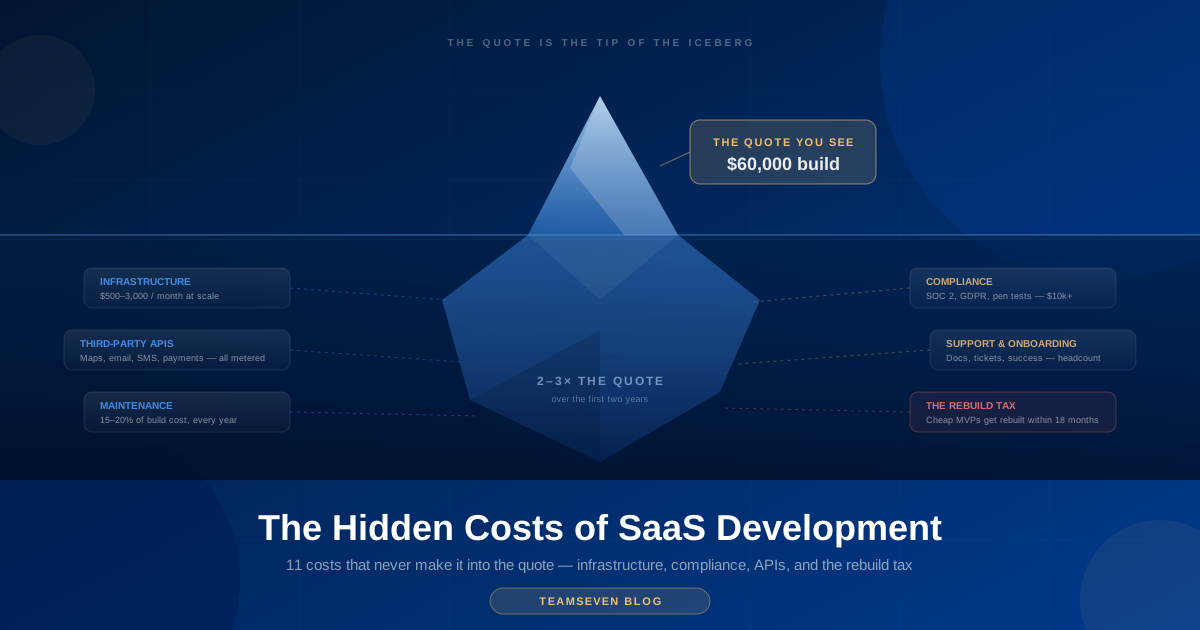
The build quote is not what your SaaS will cost in year one. A meaningful chunk hides in infrastructure, third-party services, compliance, and post-launch iteration, and almost no agency itemizes it, because the agency doesn't pay it. You do.
After eight years and 600+ projects at Teamseven, I can predict with uncomfortable accuracy which invoice will surprise a founder in month four. This post is that list, so you can budget for the product you're launching, not just the one being built.
The recurring costs (your new monthly bills)
| Cost | What drives it | Notes |
|---|---|---|
| Cloud hosting (AWS/Azure/GCP) | Traffic and compute | Scales with users; a misconfigured environment can multiply this overnight |
| Database hosting | Data volume and query load | Managed MongoDB/Postgres tiers jump sharply past the free tier |
| Transactional email | Send volume | Postmark, SendGrid: priced per email, grows with signups |
| Error tracking & monitoring | Log retention and event volume | Sentry, uptime monitoring, log retention |
| Payment processing | Transaction volume | Stripe Billing or Paddle take a percentage-plus-fixed cut on top of card fees |
| Domain, SSL, DNS, CDN | Fixed, low | Small but eternal |
| Third-party APIs | Usage | Maps, SMS (Twilio), AI/LLM calls, address lookup: the silent budget killer |
| Backups & disaster recovery | Storage and frequency | If this line is skipped entirely, your real cost is "the business" |
Early-stage totals are modest before a single salary, but for AI-feature-heavy products, LLM API costs alone can exceed everything else combined. We've seen founders ship an AI feature at a flat monthly price that cost far more than that per user in tokens. Model your unit economics before the feature ships, not after.
The one-off costs that ambush you
1. App store fees and review cycles. The Apple and Google developer fees themselves are trivial; the two-week review delays and forced rework when policies change are not.
2. Compliance, when your first big customer asks. The MVP didn't need a GDPR data-processing agreement, a pen test report, or SOC 2 answers. Your first enterprise prospect's procurement team will need all three, and it comes faster for healthcare and fintech. When we built COMPASS, a clinical research platform for Ball State University, HIPAA requirements shaped the architecture from day one; retrofitting compliance later costs multiples of building it in.
3. The integrations your customers assume exist. "Does it sync with Xero?" Every vertical has its non-negotiable integration. Each one is real engineering, plus ongoing maintenance when the third party changes its API, which they do, on their schedule, not yours.
4. The post-launch 90 days. Real users break assumptions within hours. Budget a meaningful share of the build cost for the first three months of fixes, onboarding friction removal, and small pivots. Teams that don't budget this either ship a stagnant product or burn goodwill with their dev partner.
5. The rebuild tax. The most expensive hidden cost of all. A cheap MVP built on shaky foundations becomes a far more expensive rebuild in year two. You pay for the product twice and lose a year. This is the math behind our build-quality argument in the MVP cost guide, and it's why "cheap" and "low-cost" are different words.
The costs that aren't money
- Founder time on support. Every UX shortcut becomes a support ticket, and every ticket is your evening.
- Vendor lock-in. If your agency owns the repo, the servers, or the Stripe account, your switching cost is effectively a ransom. We hand over everything (code, infrastructure, IP) as a contractual default. Ask any partner to do the same in writing.
- Decision debt. Choosing "we'll decide the pricing model later" costs nothing today and a re-architecture next year. Billing logic is load-bearing.
How to budget honestly
Set aside a meaningful reserve for year-one operating costs (the recurring table above plus one compliance or integration surprise) on top of your build budget, and a further reserve for post-launch iteration. Founders who plan for that from the start make calmer decisions all year, and calm founders ship better products. We'll walk you through what a realistic year-one number looks like for your specific build on a scoping call, rather than a generic rule of thumb.
FAQ
What's the single most underestimated cost? Third-party API consumption, especially LLM tokens and SMS. They scale with success, which means your best month can also be your scariest invoice.
Can I reduce hosting costs at the start? Yes: a properly configured single-region setup on managed services comfortably serves your first thousands of users cheaply. Premature "scale-ready" Kubernetes setups burn money on traffic you don't have yet.
Should maintenance be a retainer or pay-as-you-go? For a live product with paying customers, a retainer buys response-time guarantees. Pay-as-you-go means you queue behind retainer clients, including ours.
Do you include these costs in your proposals? We itemize the build as a fixed price and attach a projected operating-cost sheet for year one. No founder should learn about Stripe Billing fees from their first payout.
Want a year-one cost projection for your product idea, not just a build quote? Book a free 30-minute scoping call: fixed-price proposal within 48 hours.
Stay connected
Build notes, launches, and new articles from the Teamseven team.