How Much Does It Cost to Build a SaaS MVP in 2026? (Real Numbers From 600+ Projects)
A founder's honest breakdown of what drives SaaS MVP costs in 2026, and how to budget without getting burned. Based on 600+ delivered projects.

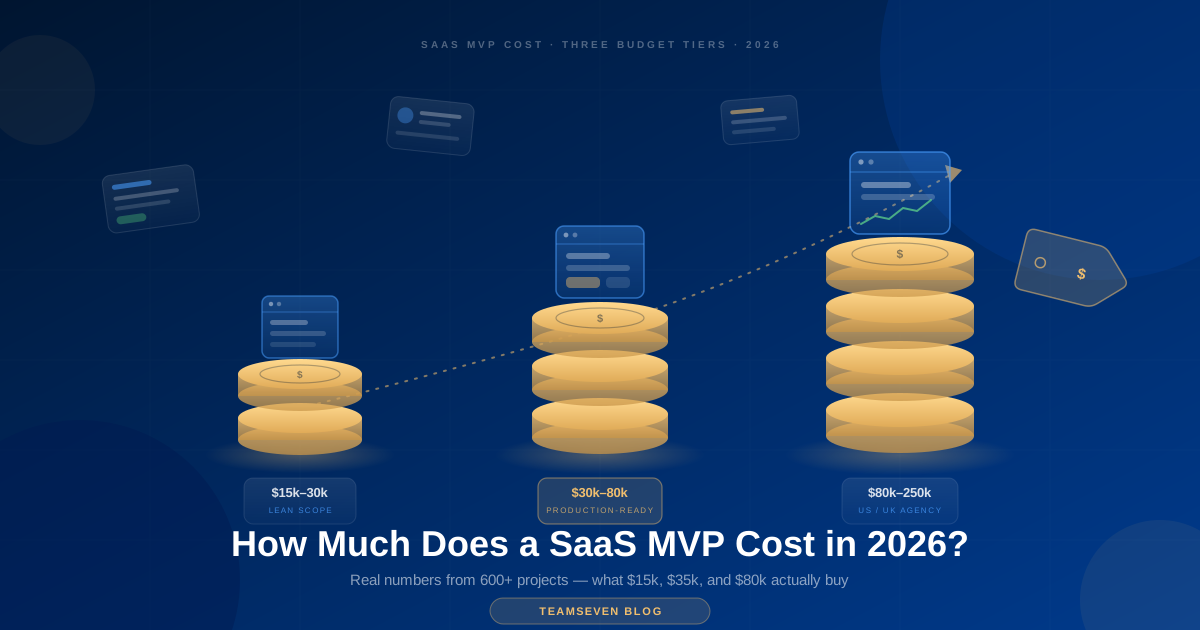
Short answer: what a production-ready SaaS MVP costs in 2026 depends heavily on who builds it and how tightly the scope is held: a senior offshore team, a US/UK agency, and an aggressively scoped build with real trade-offs sit at very different points on that range. Anyone quoting a token amount for "a SaaS like Airbnb" is selling you a template that will be rebuilt within a year.
I'm Nabeel, co-founder of Teamseven. We've shipped 600+ projects since 2017, and a large share of the inquiries we get start with this exact question, usually from a non-technical founder who has received three quotes that differ by 10x and can't tell why. This post is the answer I give them on calls, written down.
Why quotes differ by 10x for the "same" MVP
When you send the same one-page brief to five agencies, you're not getting five prices for the same product. You're getting five different interpretations of:
- Who builds it. A senior engineer in Lahore or Eastern Europe is paid at a very different rate to the same seniority in London or Austin. The code can be identical; the payroll isn't.
- What "done" means. Does the quote include admin panel? Billing integration? Email flows? Deployment pipeline? Three of the five quotes silently exclude at least one of these.
- Single-tenant demo vs multi-tenant product. A demo that works for one customer is half the cost of architecture that isolates data per customer and survives your first 50 signups. We've covered this trade-off in depth in our multi-tenant vs single-tenant guide.
- Fixed price vs hourly. Hourly quotes look cheaper on paper. They rarely are by the end.
What each build tier buys in 2026
| Tier | What you get | Who it's right for | Timeline |
|---|---|---|---|
| Thin slice | 1 core workflow, basic auth, simple admin, single-tenant, Stripe checkout | Testing willingness-to-pay with a thin slice; pre-revenue solo founders | ~8–10 weeks |
| Core MVP | 2–3 workflows, multi-tenant foundation, role-based access, subscription billing, admin panel, CI/CD | The sweet spot for most B2B SaaS: fundable, sellable, scalable | ~10–14 weeks |
| Extended MVP | Above + integrations (accounting, comms, maps), reporting dashboard, mobile-responsive depth, compliance groundwork (GDPR/HIPAA basics) | Vertical SaaS with operational complexity: logistics, health, proptech | ~14–18 weeks |
| Beyond MVP | Native mobile apps, AI features, complex compliance, real-time systems | Usually not an MVP anymore. Cut scope first. | Scoped per phase |
Our own fixed-price MVPs land deliberately in that second tier, because in eight years I have almost never seen a B2B product succeed long-term from the first tier without a rebuild, and I've rarely seen a true first version need the fourth. We'll tell you which tier your idea needs on a scoping call.
The cost breakdown nobody itemizes
For a typical B2B SaaS MVP, here's roughly where the money goes:
| Line item | Share | Notes |
|---|---|---|
| Discovery & technical scoping | 8% | Skipping this is how projects blow up. Non-negotiable for us. |
| UI/UX design | 12% | Wireframes → clickable prototype → design system |
| Core product engineering | 45% | The features users touch |
| Admin panel & internal tooling | 12% | Founders forget this exists until week 6 |
| Auth, billing, email infrastructure | 10% | Stripe/Paddle, transactional email, password flows |
| QA & test automation | 8% | The difference between launch day and launch month |
| DevOps, deployment, monitoring | 5% | CI/CD, staging, error tracking, backups |
If a quote can't be decomposed roughly like this, the agency hasn't scoped your product: they've guessed.
A real example: vertical SaaS in logistics
i-mve, a UK removals platform we built and maintain, started life as a focused MVP: job management, quoting, and customer communication for moving companies. Not fifty features: three workflows done properly on a multi-tenant foundation. That foundation is why it now serves 523 UK removals companies without a rewrite. The MVP-stage discipline, saying no to feature requests until the core earned revenue, is the single biggest cost lever a founder controls.
How to keep your MVP in budget
- Write your "not now" list before your feature list. The features you defer fund the quality of the ones you ship.
- One user type, one core workflow, one pricing plan. Every additional role, flow, and plan multiplies edge cases.
- Demand fixed-price scoping. If an agency won't commit to a number after discovery, they're transferring their risk to you.
- Budget 15–20% beyond the build for the first 90 days post-launch: bug fixes, small pivots, the onboarding friction you only discover with real users. The full list of these surprises is in the hidden costs of SaaS development.
- Confirm you own everything. Code, repo, database, infrastructure accounts. In writing.
What you can negotiate with an agency
Most founders negotiate price. The bigger levers are elsewhere.
- Scope, not price. Ask "what would this look like if we trimmed to X?" instead of "can you do this for less?" You'll often get most of the value for meaningfully less cost by trimming the right features, rather than the same scope at a discount that gets clawed back later.
- Payment terms. Milestone-based payments are standard and reasonable to ask for. A large upfront deposit with no delivery checkpoints favors the agency, not you.
- Timeline. If you're not in a rush, say so. Longer timelines sometimes lower cost, especially with agencies filling capacity gaps.
- Equity for cash, for pre-revenue founders. Some agencies will take a partial-equity arrangement instead of full cash. Most won't. It's worth asking if you're pre-revenue and the product is strong.
What you should never negotiate away: architecture quality and QA. Cutting either saves money now and costs more later, usually at the worst possible time.
Red flags in a software development quote
- No discovery phase. A fixed price with no time spent understanding your requirements is a guess dressed up as a number.
- Suspiciously low quotes. If several agencies quote broadly similar numbers and one comes in far lower for the same scope, that agency isn't just more efficient. They're missing scope, planning to cut corners, or planning change requests later.
- No rationale for the tech stack. A good agency tells you why a stack fits your product. "We'll use whatever you want" means nobody's thought about your product's actual needs.
- Vague deliverables. "A working SaaS platform" isn't a deliverable. "A multi-tenant web app with Stripe billing, admin dashboard, client portal, and email integration, deployed on AWS" is.
- No post-launch support clause. Every product has bugs after launch. The contract should say for how long and what's covered.
FAQ
How long does a SaaS MVP take to build in 2026? 10–14 weeks for a well-scoped B2B MVP with a senior team. Anything quoted under 6 weeks is a template; anything over 6 months is not an MVP.
Can AI tools make my MVP cheaper? They make senior teams faster, we use them daily, but they compress timelines more than invoices, because the expensive part was never typing code. It's architecture, edge cases, and product decisions. Beware of quotes that are cheap because "AI writes the code."
Is a custom build worth it when no-code is so much cheaper? Sometimes no-code is the right call. I wrote an honest comparison in no-code vs custom development. The short version: no-code wins for validation, custom wins the moment your product is the business.
Should I hire freelancers instead to save money? A great freelancer can build tier-one MVPs. The risk isn't skill, it's continuity: one person is your entire bus factor, QA department, and DevOps team.
Do you charge hourly? No. Our SaaS MVP development is fixed-price after a free 30-minute scoping call, proposal within 48 hours. Hourly billing rewards slowness; fixed pricing rewards scoping honesty.
Planning a SaaS MVP? Book a free 30-minute scoping call: you'll get a fixed-price proposal within 48 hours, or an honest explanation of why we're not the right fit.
Related reading
Stay connected
Build notes, launches, and new articles from the Teamseven team.