Software Development Outsourcing Risks: The Honest Guide from an Agency That's Seen Them All
The seven real software outsourcing risks — quality, IP, communication, timelines, security, lock-in and continuity — and how to avoid each, from 600+ projects.

I run an offshore software development agency. Writing about the risks of outsourcing software development is not an obvious move for someone in my position.
I'm doing it anyway because the alternative — pretending these risks don't exist, or burying them in fine print after selling you on the benefits — is worse for everyone. Clients who understand the real risks going in make better decisions, build better protections into their contracts, and manage their engagements more effectively. They also make better clients.
So here is the honest guide to software development outsourcing risks — from someone who has seen 600+ projects play out across eight years.
The risks that are real
Not every outsourcing risk is equally real. Some are frequently cited in sales material by onshore agencies trying to steer you away from offshore. Some are genuine. Knowing the difference is the first layer of protection when you're choosing an outsourcing partner.
The risks I'm covering here are the ones I've seen cause real damage to real projects. Not theoretical risks — documented patterns from eight years of watching outsourced development succeed and fail. Most of them come down to a mismatch between your project requirements and the way the engagement was selected and structured, not to any inherent flaw in the model itself.
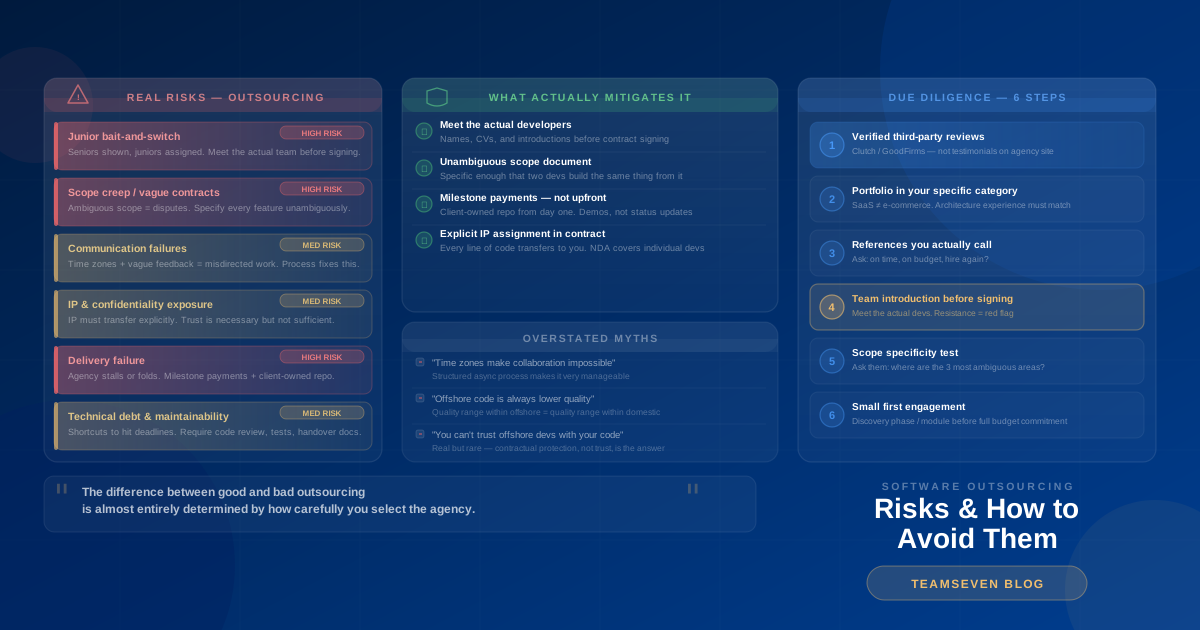
Here are the seven software outsourcing risks this guide covers, and the single control that does most of the work for each:
| Risk | Primary mitigation |
|---|---|
| Quality | Verify portfolio work in production; start with a small paid engagement |
| Intellectual property | Explicit IP assignment in writing before work starts |
| Communication | Overlapping hours agreed in the contract, plus written-first updates |
| Timeline and delivery | Milestone-based payments tied to working software |
| Security and data | DPA, least-privilege access, credentials in your accounts |
| Dependency and lock-in | You own the repo, infrastructure and documentation |
| Agency continuity | Code and deployment access in your accounts from day one |
A pattern worth noticing before the detail: five of those seven mitigations are decided before a line of code is written. The risks of outsourcing software development are mostly front-loaded — they're managed through selection and contracting, not through supervision once the work is underway.
Risk 1: Quality risk
What it actually is: Receiving software that doesn't meet professional standards — poor architecture decisions, code that works for the demo but fails under real load, security vulnerabilities, or code that's so difficult to maintain that future development costs 3x what it should. In-house teams and external teams are held to the same bar here; the difference with outsourced teams is that you can't watch the development process day to day, so you have to build the quality standards into the contract instead.
Why it happens: The offshore development market spans an enormous quality range. At one end are professional agencies with senior developers, disciplined processes, and strong track records. At the other end are individual freelancers or low-cost shops who accept any project, promise what's necessary to close the sale, and deliver what they can.
Price is an imperfect but real signal. If several professional agencies quote broadly similar numbers for a project and one comes in far lower, that agency isn't just more efficient. They're cutting something — seniority of developers, QA rigor, architectural quality, post-launch support.
The most expensive form of quality risk is architecture quality. A system built quickly on poor foundations works fine at 100 users. At 1,000 users, performance degrades. At 10,000 users, it falls over. Rebuilding an application from the ground up costs more than building it right the first time. We've inherited several of these from other agencies.
How to mitigate it:
Verify their work independently. Before hiring any agency, look at their portfolio work in production. Does it actually work? Is it fast? Does it handle edge cases gracefully? Websites they list as portfolio items are live — you can use them, test them, and form an opinion about quality.
Ask technical questions. "What database design would you use for multi-tenant SaaS and why?" is not a trick question. It's a question any senior developer should answer clearly. If the answer is vague or defaults to "whatever you prefer," their technical depth is shallow.
Request a code review right. Before signing, negotiate the right to have a third-party developer review code at the end of the project before final payment. Professional agencies with nothing to hide will agree. Agencies planning to cut corners will resist.
Start with a smaller engagement. A 4-week, well-defined module is a lower-risk way to evaluate quality than committing to a 20-week full project. The first sprint is always the most revealing — it tells you whether this partner can turn your project requirements into working software before you commit to a long-term relationship.
Risk 2: Intellectual property risk
What it actually is: Ambiguity about who owns the code built during the engagement. In some jurisdictions, the default legal position is that a contractor owns the work they create unless explicitly assigned in writing.
Why it happens: Founders assume that because they paid for the development, they own the code. This assumption is often legally incorrect. Without an explicit IP assignment clause in the contract, the agency may retain rights to the code they wrote for you.
This matters more than it sounds. If you exit the company, raise funding, or get acquired, investors and acquirers will do IP due diligence. Ambiguous IP ownership — even theoretical ambiguity — can kill a deal.
Secondary IP risk: code reuse. Some agencies use the same modules, libraries, or components across multiple client projects. If your "custom" authentication system is actually a copy of their standard authentication module deployed in twenty other projects, you don't have a proprietary system — you have a shared one.
How to mitigate it:
Explicit IP assignment in every contract. The contract should say, clearly: "All intellectual property created during this engagement, including all code, designs, documentation, and related materials, is assigned to [your company name] upon final payment." Not "work for hire" language — explicit assignment.
Pakistan-specific consideration. Teamseven is a Pakistan-registered company. Contracts with Pakistani agencies should specify that they're governed by the law of your jurisdiction (UK law, US state law, etc.) or by a neutral jurisdiction. Pakistani courts are not the right forum for enforcing IP rights on behalf of a US or UK business.
Ask about code reuse policy. Professional agencies have a clear policy on whether they use shared libraries or components and what license governs those components. The answer should be: any shared components are open source with a permissive license (MIT, Apache 2.0), or they build everything bespoke. "We reuse our proprietary modules" is a red flag.
NDA before discussions. Before sharing your business idea, requirements, or any proprietary information, get a signed NDA. Most professional agencies will sign without resistance. An agency that resists basic confidentiality obligations is telling you something.
Risk 3: Communication risk
What it actually is: The accumulation of misunderstandings, missed context, delayed feedback, and cultural communication gaps that result in software that doesn't match what you needed — even when the technical execution was competent.
Why it happens: Communication quality degrades across time zones, languages, and cultures in ways that are easy to underestimate going in. Written English is interpreted differently by a developer in Lahore than by the founder in San Francisco who wrote it. Politeness norms differ — a Pakistani developer is less likely than a Western one to directly say "this requirement doesn't make sense" and more likely to build it as specified and wait for feedback.
Time zone gaps mean that a clarifying question asked at 5pm EST doesn't get answered until the next morning — after the developer has made their best guess and built accordingly.
Cultural communication gaps compound: indirect communication styles, different norms around raising concerns, different interpretations of "done," different thresholds for flagging problems.
None of these are deficiencies — they're differences. Managed well, they're minor frictions. Unmanaged, they compound into significant misalignment.
How to mitigate it:
Specify everything in writing before development starts. Written requirements eliminate the ambiguity that lives in verbal or assumed context. Every feature has acceptance criteria. Every edge case is documented. The developer's job is to match the specification, not to interpret intent.
Establish communication norms explicitly. "If something is unclear, ask before building" sounds obvious. It isn't a universal norm. Some cultures prioritize not appearing ignorant over producing correct output. Make the expectation explicit: questions are welcome, expected, and preferred over assumptions.
Require async daily updates. Daily written standup updates from the team tell you what they're working on and surface blockers before they become significant delays. Review these every morning. They're a proxy for communication quality — vague updates are a leading indicator of misalignment.
Conduct sprint reviews with screen sharing. Seeing the software running is more reliable than reading a description of it. Weekly sprint reviews where the developer demos the work they're describing close the interpretation gap between "this is done" and "this does what you needed."
Risk 4: Timeline and delivery risk
What it actually is: Projects running significantly over their estimated timeline — weeks or months beyond what was agreed.
Why it happens: Several independent causes, often in combination.
Underestimated complexity. The most common cause. Features that look simple have edge cases that don't. Integrations that should take a week take three when the third-party API is poorly documented. Testing surfaces issues that require architectural changes.
Scope creep without timeline acknowledgment. Each individual scope addition seems small. Collectively, they represent weeks of additional work that nobody officially accounted for.
Poor initial estimation. Some agencies underestimate intentionally to win the project, planning to manage the overrun later. Some underestimate because they haven't thought through the scope carefully. Both result in the same experience for the client.
Dependency on client decisions. Projects stall when clients are slow to review work, make design decisions, or provide access to systems and information the development team needs. This is a client-side cause of agency-side delays.
How to mitigate it:
Milestone-based contracts with specific deliverables. A contract with a single delivery date ("project complete by [date]") provides no visibility into whether things are on track until they're not. A contract with milestones — what will be delivered at week 4, week 8, week 12 — creates checkpoints where both parties can assess progress and address problems before they compound.
Build a realistic buffer into your timeline expectations. Complex software projects run over more often than they run on time. A project with a 12-week estimate has a meaningful probability of taking 14–16 weeks. If 12 weeks is a hard constraint with real consequences, communicate that constraint clearly from the start and design the scope around it — not the other way around.
Separate contractual scope from estimated timeline. When scope changes during a project, the timeline should be formally revised. This conversation — "adding this feature extends the timeline by two weeks" — is uncomfortable. It's also necessary. Agencies that don't have it, or clients who resist it, end up with either delayed projects or degraded quality.
Ask for the sprint burndown. Any professional team using sprint-based development can show you a burndown chart — how many story points remain versus how many were expected at this point. If you're 60% of the way through the timeline and 40% through the scope, you have a problem. Catching it at sprint 4 is recoverable. Catching it at sprint 10 isn't.
Risk 5: Security and data risk
What it actually is: Your intellectual property, business data, or user data being accessed, copied, or misused by the development team or their infrastructure — in the worst case, a data breach that exposes your users' personal information.
Why it happens: Development teams necessarily have access to your codebase. They may have access to staging environments with real or realistic data. If security practices are poor, this access creates vulnerabilities — either from deliberate misuse or from insecure handling that creates exposure to third parties.
The security risks are more practical than dramatic: developers who leave with copies of your codebase. Production credentials stored insecurely and later compromised, turning into a data breach months after the engagement ends. User data in development environments accessed without appropriate controls.
How to mitigate it:
Never share production data with the development team. Development and testing environments should use anonymised or synthetic data. If real data is required for a specific reason, it should be a limited, controlled sample — not a production database export.
Use a code repository with access logging. GitHub, GitLab, and Bitbucket all provide audit logs showing who accessed what and when. This creates accountability and makes misuse detectable rather than invisible.
Rotate credentials after the engagement ends. All API keys, database passwords, and service credentials that the development team had access to should be rotated after the project completes. This is basic security hygiene that many clients don't practice.
Limit production access. The development team should not have standing access to your production environment. When production access is needed for deployment, it should be time-limited, logged, and revoked after the specific task is complete.
DPA for GDPR/Privacy Act compliance. If you're a UK, EU, or Australian business and you're sharing any personal data with an offshore developer — even test data containing real personal information — you need a Data Processing Agreement. This is a legal requirement, not optional.
Risk 6: Dependency and lock-in risk
What it actually is: Becoming so dependent on your offshore agency that you can't exit the relationship without significant disruption — either because the code is undocumented and unmaintainable by anyone else, or because the agency has structured the engagement to create dependency.
Why it happens: Undocumented code is the most common cause. Code that works but that no other developer can understand or extend is a form of lock-in. If the original developers leave, you need the agency to maintain the code or face a significant re-learning cost.
Some agencies structure engagements to maximize ongoing revenue — building in complexity that requires their continued involvement. This isn't universal, but it exists.
How to mitigate it:
Require documentation as a deliverable. Architecture documentation, API documentation, deployment documentation, and code comments are deliverables — not nice-to-haves. If you commission software and don't receive documentation, you've received an incomplete project.
Request the right to conduct a code audit during the engagement. Have a third-party developer review the code at the midpoint of a long project. The review should assess: is this maintainable by developers other than the current team? Is it documented? Is the architecture sensible? Any professional agency will agree to this.
Maintain your own copy of the codebase. You should be the owner of the Git repository, not a contributor to one owned by the agency. Your codebase should be on your GitHub, GitLab, or Bitbucket account, with the agency team added as contributors rather than the other way around.
Understand the handover process before you start. What does the agency provide at project completion? What does post-launch support include? What happens if you want to transition maintenance to an internal developer or a different agency? A real knowledge transfer — documented architecture, a walkthrough of the codebase, and a support window where the outgoing team answers questions — should be part of the contract, not a favour you negotiate at the end. Professional agencies have clear answers to these questions.
Risk 7: Agency continuity risk
What it actually is: The agency changing significantly during your project — key developers leaving, the agency going through financial difficulties, being acquired, or folding.
Why it happens: Small software agencies have inherent continuity risks. Developer turnover is high in the industry. Agencies that grow fast sometimes lose the senior talent that made them good in the first place. Some agencies take on more work than they can handle and deprioritize existing clients when new opportunities arrive.
How to mitigate it:
Choose agencies with a track record. An agency founded in 2017 has survived longer than most. Agency longevity doesn't guarantee future continuity, but it's a better indicator than an agency that's 18 months old.
Contractual team commitment. You can negotiate a clause specifying that key team members — the lead developer, architect, or project manager — require written notice and a handover period before being reassigned off your project.
Regular code backup. Ensure your codebase is always in your own repository and that you have full access. If an agency closes tomorrow, you should have everything needed to continue development with a different team.
Escrow for critical projects. For large, long-running projects, source code escrow — where a copy of the codebase is held by a neutral third party and released to you under specified conditions — provides protection against agency failure.
The risk that doesn't get discussed enough
Every outsourcing risk guide covers the risks above. There's one risk that almost none of them mention, because it's uncomfortable:
The risk of choosing wrong for the wrong reasons.
The cheapest outsourcing option is rarely the best value. The fastest-responding agency isn't necessarily the most capable. The most enthusiastic sales process isn't correlated with delivery quality.
The risks described in this article are mostly manageable with proper due diligence, clear contracts, and disciplined management. The risk that's hardest to manage is signing a contract with an agency that fundamentally isn't right for your project — because you prioritised price, speed, or enthusiasm over track record, portfolio relevance, and references.
The mitigation for this risk is the same as the mitigation for every other risk: do the work. Check the reviews. Call the references. Ask the hard questions. Look at the portfolio work in production. Start with a smaller engagement before committing to a large one. Over the long term, the outsourcing partner that survives due diligence is almost always the one that delivers.
The agencies worth working with will welcome that process. The ones worth avoiding will resist it.
FAQ
What are the real risks of outsourcing software development? Seven recur: quality, intellectual property, communication, timeline and delivery, security and data, dependency or lock-in, and agency continuity. All are manageable, but they're managed by how you select and structure the engagement, not by where the team sits.
How do I protect my intellectual property when outsourcing? Get it in writing before work starts. You should own the code, the repository, the database, and the infrastructure accounts — not have them held on your behalf. Confirm this contractually rather than assuming it, because assumption is where this goes wrong.
How do I avoid being locked into an agency? Insist on owning your infrastructure accounts, keep documentation as a deliverable rather than an afterthought, and avoid proprietary frameworks that only one team understands. A good agency builds so you could leave; that's a reasonable thing to ask about directly.
What happens if the agency goes out of business mid-project? This is why owning your repository and infrastructure from day one matters so much. If code lives in your accounts and is documented, agency continuity becomes an inconvenience rather than a catastrophe. If it doesn't, you may have nothing.
How do I reduce quality risk when I can't assess the code myself? Ask to speak to the engineers who'd do the work rather than only to sales, ask what their code review and QA process looks like in practice, and ask to see something running in production with real users. You're assessing the development process and the evidence behind it, not reading code. Hold outsourced teams to the same quality standards you'd expect from an internal hire, and write those standards into the statement of work.
How is outsourcing security risk different from an in-house team? The exposure is similar — any engineer with codebase access is a potential source of a data breach — but with outsourced development you manage it contractually rather than through employment controls. Use a Data Processing Agreement, least-privilege access, credentials held in your own accounts, and credential rotation when the engagement ends. Done properly, the security risks of an offshore team and an in-house team are comparable.
Is outsourcing software development risky? It carries real risks, but they're structural rather than inherent — and largely front-loaded. Five of the seven risks in this guide are controlled before development starts, through how you select the agency and what the contract says. Outsourcing badly is risky; outsourcing with owned infrastructure, explicit IP assignment, milestone payments and verified references is a managed engagement.
What are the biggest software outsourcing risks for startups? Quality and lock-in usually hurt startups most. A system built cheaply on weak architecture works at 100 users and falls over at 10,000, and rebuilding costs more than building properly would have. Lock-in compounds it — if the agency holds your repository and infrastructure, switching costs can exceed the original build. Own your accounts from day one.
How do I reduce the risks of outsourcing software development? Verify portfolio work running in production, get IP assignment in writing before work starts, own your repository and infrastructure accounts, tie payment milestones to working software rather than dates, agree overlapping working hours contractually, and start with a small defined engagement before committing to a long one.
Is offshore development riskier than hiring locally? The risk profile differs rather than being uniformly higher. Offshore adds timezone and communication overhead and makes contract jurisdiction matter more. Local hiring carries its own risks — higher cost per outcome, smaller talent pools, and the same quality variance. Selection rigour affects outcomes far more than geography does.
Stay connected
Build notes, launches, and new articles from the Teamseven team.