
What Software Do Removals Companies Use? An Honest Guide
The real removals software landscape (spreadsheets, industry CRMs, point tools and custom builds) explained by a team that builds it for a living.

Let's get the bias out of the way first: we build custom software for removals and storage companies. You'd expect a guide like this to end with "so hire us."
It mostly doesn't. Most removals firms should never commission custom software, and we'll tell you exactly where that line sits. What this guide will do is save you from the two expensive mistakes we see constantly: buying more system than your business needs, and buying less system than your storage revenue deserves.
We've spent years as the engineering team behind i-mve, a CRM and storage platform that UK removals companies run their operations on. That work is where everything below comes from, not from a spec sheet, but from years of conversations about cube sheets, part-loads, deposit rules and why storage billing dates are never as simple as "the 1st of the month."
This guide is organised around the tiers of software available: where your business sits on the ladder from spreadsheet to custom build. If you want it organised around the jobs the software has to do instead (enquiry, survey, quote, schedule, storage, invoice) see our complete removals & moving company software guide.
Here's the landscape as it exists.
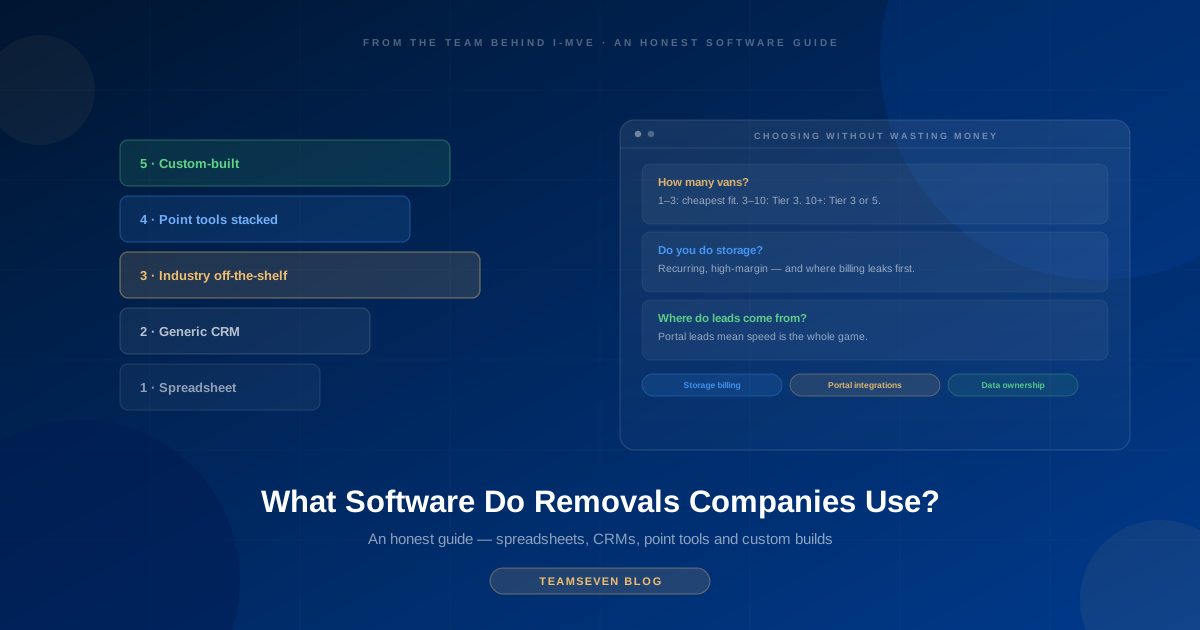
The five tiers of removals software
Every removals company in the UK sits somewhere on this ladder. None of the rungs are wrong, but each one has a point where it starts costing you more than it saves.
Tier 1: The diary, the whiteboard and the spreadsheet
Every removals office we've ever dealt with has a spreadsheet somebody is quietly proud of. For a one- or two-van operation doing local moves with no storage, this tier works. The overheads are zero, everyone understands it, and your energy is better spent winning jobs than configuring software.
The tier breaks in three predictable places: the first double-booking that costs you a customer, the first portal lead that goes cold because it sat in an inbox overnight, and the first time you take on storage. Recurring storage billing run from a spreadsheet is not a system. It's a slow leak with a start date.
Tier 2: Generic CRMs bent into shape
Some firms graduate to a general-purpose CRM: HubSpot, Pipedrive, Zoho and friends. These are excellent products built for a business that isn't yours. They have no concept of cubic feet, survey-to-quote flows, crew job sheets, vehicle allocation or containerised storage. So you bend them: custom fields, duct-taped automations, a separate quoting spreadsheet anyway.
We've been hired more than once to untangle exactly this setup. The pattern is always the same: the CRM holds half the truth, the spreadsheet holds the other half, and the owner holds the reconciliation in their head. If you're going to pay monthly for software, pay for software that knows what a part-load is.
Tier 3: Industry off-the-shelf systems
This is the right answer for most established removals companies, and we say that as people who sell the alternative. The UK market has genuine purpose-built options: i-mve, MoveMan and Move Administer among the established names, newer entrants like Move Agent, international platforms such as MoverBase, and Moveware at the larger, enterprise end.
What this tier gets you is the industry's workflow out of the box: enquiries, surveys, quoting, job management, storage billing, portal lead integrations, accounting sync. What it costs you is fit: your workflow bends to the software, not the other way round. For most firms that trade is worth it, several times over.
The limits show up at scale and at the edges. Multi-depot operations, unusual commercial work, integrations the vendor keeps promising "next quarter". That's where off-the-shelf starts to pinch. Per-user pricing also grows quietly with your headcount, which is fine at five users and less fine at twenty-five.
Tier 4: Point tools stacked together
Some firms run a best-of-breed stack instead of one system: a video survey tool (Yembo is the best-known name here), a route planner, a portal lead dashboard, an accounting package, held together with Zapier and hope.
Each tool is usually excellent at its one job. The stack as a whole has a familiar failure mode: the data never quite joins up, and somebody in the office becomes the human API between systems. If that person is you, you already know.
Tier 5: Custom-built
The top of the ladder, and the smallest tier by population: deliberately. Custom software makes sense in a narrow set of situations: you're multi-depot with workflows no vendor supports, your storage operation is large enough that billing leakage outcosts development, you need integrations nobody will build, you want to own your code and data outright, or you're building a product for the industry itself.
If none of those describe you, stay on Tier 3 and spend the difference on lead generation. If one of them does, we've written a full breakdown of what custom development for removals companies involves and costs: that page is the honest version of a sales pitch, including a section titled "when you shouldn't hire us."
How to choose without wasting money
Forget feature lists for a moment. Three questions place you on the ladder almost every time.
How many vans? One to three vans, no storage: Tier 1 or the cheapest Tier 3 option you can find, and not a pound more. Three to ten vans: Tier 3, no debate: the admin hours alone repay it. Ten-plus vans or multiple depots: Tier 3 if it fits, Tier 5 if it demonstrably doesn't.
Do you do storage? Any containerised storage at all moves you up a tier. Storage is the best revenue in the business (recurring, high-margin, compounding) and it's precisely where informal systems leak: containers never invoiced, price rises agreed and never applied, accounts still billing after collection. The first system that gets your storage billing airtight usually pays for itself on that alone.
Where do your leads come from? If you buy portal leads (Compare My Move, reallymoving, Getamover, PinLocal) speed is the whole game. Those leads go to several firms at once, and the one who responds first books the survey. Whatever system you choose must ingest portal leads instantly and trigger follow-up automatically. If it can't, it's the wrong system regardless of what else it does.
Five questions to ask any vendor: including us
- Can I export all my data, any time, in a usable format? If the answer is vague, so is your exit route.
- What exactly happens to my live quotes and storage accounts if I leave? You want a migration story, not a shrug.
- Which lead portals does it integrate with automatically: and which are "on the roadmap"? Roadmap means no.
- How does storage billing handle per-account billing dates, price increases and partial collections? This question separates real removals software from a CRM wearing a hi-vis vest.
- Who builds the software, and how fast do change requests ship? In-house team or outsourced? Monthly releases or annual? You're not just buying features; you're buying the pace at which your problems get fixed.
Any vendor worth your money answers all five without flinching. We publish our answers, because we'd rather lose a bad-fit deal in week one than in month six.
What it all costs
Rough shapes, not gospel: check current pricing before you decide.
| Tier | Typical cost | Notes |
|---|---|---|
| Tier 1: spreadsheet/diary | Free (plus hidden leaks) | No subscription, but no storage billing safety net either |
| Tier 2: generic CRM (bent into shape) | Per user/month subscription | HubSpot, Pipedrive, Zoho all price in this band; higher tiers (AI features, advanced automation) climb well past it |
| Tier 3: industry off-the-shelf | Quote-on-request | i-mve, MoveMan and most others don't publish pricing; expect a sales conversation, priced on user count and modules |
| Enterprise (e.g. Moveware) | Top of the Tier 3 range | Priced for multi-branch and interstate operations, not a single depot |
| Tier 5 (custom development | Low five figures and up | Project cost, not a subscription; rises from there for full platforms) see our removals development page for actual ranges |
The comparison that matters isn't sticker price. It's total cost against the two leaks: admin hours and missed storage revenue. A modest monthly system that recovers one unbilled container and four office hours a week is the cheapest thing you'll buy this year.
The mistakes we keep seeing
Buying the enterprise system at four vans. Big platforms are built for big operations; at small scale you pay enterprise money to use a tenth of the features and all of the complexity. Grow into software, don't rattle around inside it.
Choosing a system the office hates. The most expensive software is the software your team quietly refuses to use. The tell is the shadow spreadsheet. If one appears within a month of go-live, the rollout has already failed, whatever the invoice says.
Ignoring storage billing during selection. Firms compare quoting screens and diary views for hours, then wave through the module that manages their most profitable revenue stream. Reverse that. Make the vendor demo a price rise across fifty storage accounts before you make them demo anything else.
Switching systems in June. Peak season runs roughly May to September; migrating your operating system for the business mid-peak is how good companies have bad summers. Choose in autumn, migrate in winter, and go into spring fluent.
Where custom fits: and where we do
If you've read this far and recognised yourself in Tier 3, take the compliment: your software problem is already solved, go win more jobs. If you recognised yourself in the edges (multi-depot, big storage, a vendor roadmap you've stopped believing, or a product idea for the industry) that's the territory we work in, and our software development for removals and storage companies page covers the details, the process and the honest prices.
Either way, one rule serves everyone: buy the system that matches the business you run today, from people who can explain, without notes, why storage billing dates are complicated.
What's the best software for a small removals company?
For one to three vans with no storage: a well-kept diary and spreadsheet, or the cheapest purpose-built system you can find. Spend the savings on leads. The upgrade moment is your first storage container or your first missed portal lead: whichever comes first.
Will a normal CRM like HubSpot or Pipedrive do the job?
It will hold your contacts and remind you to call people. It won't do surveys, cube-based quoting, crew job sheets or storage billing, so a spreadsheet grows back beside it within months. Industry-specific systems exist because this workflow is different.
Can I switch systems during peak season?
You can. Don't. Select in autumn, migrate in winter, arrive at spring with a fluent office. A mid-July migration is a self-inflicted wound.
How much does removals software cost?
From free (spreadsheets, plus their hidden leaks) to per-user monthly subscriptions for off-the-shelf systems, to project-priced custom builds starting in the low five figures. The real comparison is cost against admin hours saved and storage revenue recovered: judged that way, the mid-tier is underpriced for most firms.
Muhammad Nabeel is the co-founder of Teamseven, the engineering team behind i-mve and custom operations software for removals and storage companies since 2017. Get in touch if you want to talk through your project.
Stay connected
Build notes, launches, and new articles from the Teamseven team.