Build vs Buy CRM: The Question Every Ops Leader Gets Wrong Once
Salesforce seats, HubSpot tiers, or a custom CRM? A framework for deciding when off-the-shelf CRM stops being cheap.

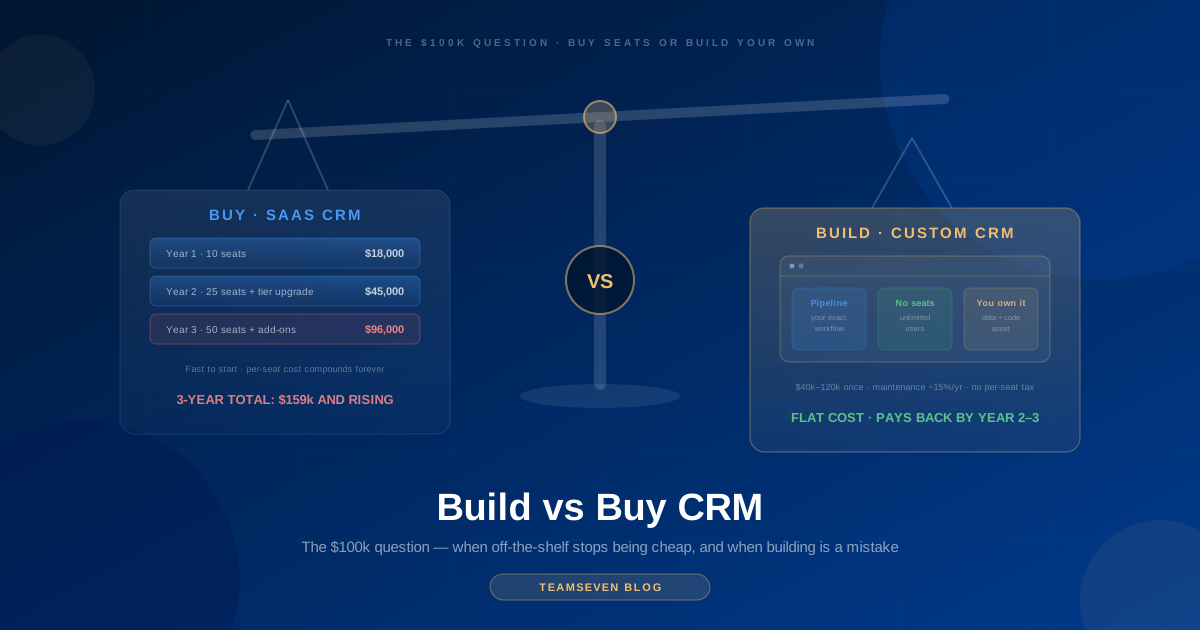
Buy a CRM when your process looks like everyone else's sales pipeline. Build one when the CRM is your operations: when jobs, crews, assets, bookings, or compliance workflows are what you manage, and "contact → deal → closed-won" is a costume that doesn't fit.
I've watched both mistakes up close at Teamseven. Companies paying a small fortune every year to bend Salesforce into a shape it resents, and founders commissioning custom CRMs for a vanilla sales process HubSpot handles cheaply per seat. This is the framework I wish both groups had used.
The real cost of "buying": it's not the subscription
Off-the-shelf CRM pricing looks transparent. The total cost isn't:
| Cost layer | Typical 10-person team, 3 years |
|---|---|
| Licenses (mid-tier Salesforce/HubSpot) | Scoped after a call |
| Implementation consultant | Scoped after a call |
| Customization & "managed apps" | Scoped after a call |
| Integrations (accounting, phones, forms) | Scoped after a call |
| Per-feature paywall upgrades along the way | Scoped after a call |
| 3-year total | Scoped after a call |
A custom CRM for the same team is typically a one-off build plus a modest ongoing fee if you want managed evolution, and you own it. Over three years the totals converge or invert. The subscription wasn't the cheap option; it was the fast option. That distinction matters.
The decision framework: five questions
1. Is your pipeline shaped like a sales pipeline? If your records are leads and deals moving through stages toward a close: buy. The entire industry is optimized for you. If your records are jobs with crews, vehicles, sites, surveys, and invoices, like the removals companies running on i-mve, the platform we built for the UK moving industry: every off-the-shelf CRM will fight you daily.
2. How much are workarounds costing you right now? Count the spreadsheets orbiting your current CRM. Each one is a process the CRM couldn't model. Three or more orbiting spreadsheets is the clearest build signal that exists.
3. Is the CRM a cost center or your competitive edge? If a competitor could see your CRM config and learn nothing: buy. If your workflow is your moat (your quoting logic, your dispatch rules, your customer journey), renting generic software means operating at the industry average. Custom software is how operations leaders compound an advantage.
4. Do you have 12+ weeks of patience? Buying is live next week. Building is live next quarter. If the house is on fire, buy something cheap now and revisit in a year with real process knowledge: that knowledge will make the eventual build better.
5. Will you exist in 5 years at 3x headcount? Per-seat pricing punishes growth. Triple your headcount and a per-seat CRM bill triples with it for the exact same software. Custom CRM costs don't scale with seats. Growth-stage companies feel this hardest.
Score it
Give one point per "build" answer above. 0–1: buy without guilt. 2–3: buy now, plan to build at your next growth inflection. 4–5: you're already paying for a custom CRM (in workarounds, seats, and lost edge) you just don't own it yet.
Where custom CRM projects go wrong (so you can avoid it)
- Rebuilding Salesforce. The goal is to model your process, not to clone features you never used. The best custom CRMs we've shipped have fewer screens than the tools they replaced.
- No product owner. Someone on your side must own decisions. "Ask everyone what they want" produces a Frankenstein.
- Big-bang migration. Run the new system in parallel on one team or one branch first. Always.
- Skipping the integration audit. List every tool that must connect (accounting, phones, email, forms) before scoping, not after. (More on cost mechanics in our custom CRM cost breakdown.)
FAQ
How long does a custom CRM take to build? 12–16 weeks for a focused first version covering your core workflow, with iteration after. Faster than most Salesforce implementations, by the way.
Can we migrate our existing CRM data? Yes: contacts, history, deals, and documents migrate via export/API. Plan it into scope; data migration done as an afterthought is where timelines die.
What stack do you build CRMs on? Angular frontends, NestJS/Node.js APIs, MongoDB or Postgres: boring, proven, hireable. Your CRM shouldn't be an exotic-technology science experiment.
Can a custom CRM still do email sync, calling, and automation? Yes, via the same APIs the big platforms use (Gmail/Outlook APIs, Twilio, etc.). You integrate the 20% you use instead of paying for the 80% you don't.
What about AI features? This is where owning your CRM pays off most: your data, your models, your rules. See our AI integration roadmap for B2B platforms.
Drowning in workaround spreadsheets? Book a free 30-minute scoping call and we'll tell you whether you should build, or just buy better.
Stay connected
Build notes, launches, and new articles from the Teamseven team.