Custom vs Off-the-Shelf Software: A Decision Framework From 600+ Projects
When to buy SaaS off the shelf and when custom software wins — a practical scoring framework, total-cost math, and the failure modes of both paths.
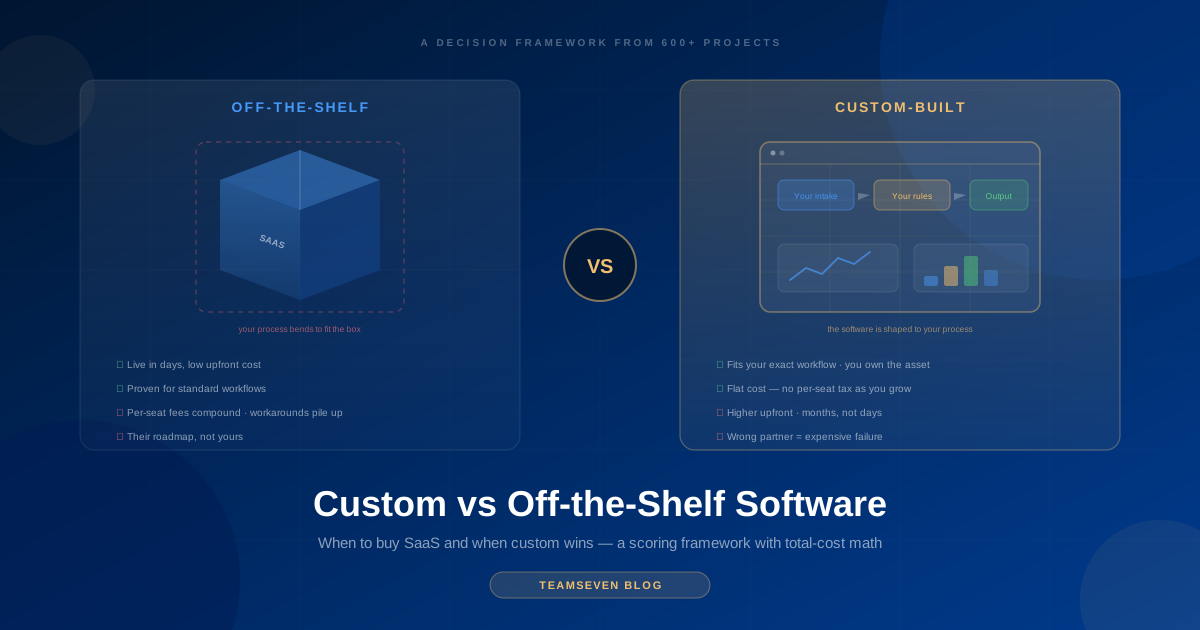
Buy off-the-shelf when the problem is generic and the software is a cost of doing business. Build custom when the workflow is your competitive advantage, when off-the-shelf forces your process to fit its data model, or when per-seat pricing taxes your growth. Everything else is detail — but the detail is where six-figure mistakes live, so let's go through it.
I co-founded Teamseven in 2017, and after 600+ projects I've seen the full failure catalogue on both sides: companies running million-pound operations on duct-taped subscriptions, and companies that commissioned custom software for problems Notion solves. Here's the framework that prevents both.
This is the condensed, scoring-based version — five signals, a 12-point scorecard, done in one sitting. For the full-length version with complete cost breakdowns for both paths, see custom software vs off-the-shelf: how to actually decide.
The honest case for off-the-shelf
Off-the-shelf wins more often than a development agency should admit:
- Solved problems. Accounting, payroll, email, video calls, generic project tracking — these are commodities. Xero and Slack exist; don't rebuild them.
- Speed. Live this afternoon vs live next quarter.
- Someone else's R&D. Updates, security patches, and feature development on someone else's payroll.
- Predictable (small) cost. Per-seat pricing is fine when you have five seats.
If a tool covers 90%+ of your need out of the box, buy it and move on. The build conversation starts when coverage drops and workarounds begin.
The five signals it's time to build
1. The orbiting spreadsheets. Count the spreadsheets that exist because your current software can't model your process. Each is a workaround with no audit trail, no permissions, and a single point of failure named whoever made it. Three or more is the clearest build signal I know.
2. You're paying for 100% and using 15%. Classic with big platforms: you need a fraction of the features but the fraction you need lives in the enterprise tier. You're funding a feature museum.
3. Your process is the product. A removals company's quoting and dispatch logic, a parking operator's enforcement workflow, a clinic's intake protocol — when we built a smart parking automation platform for the Australian parking market and i-mve for UK removals, the entire value was in modeling the industry's real process, which no horizontal tool ever will. If your workflow gives you an edge, renting average software means operating at the average.
4. Per-seat pricing is taxing growth. Doubling headcount shouldn't double your software bill. Custom software has a build cost and a care cost — neither scales with seats.
5. Integration spaghetti. When you're paying for Zapier Enterprise to make five subscriptions pretend to be one system, you're already paying for custom software — you're just renting it in fragments with data scattered across five vendors.
The scoring framework
Score each statement 0 (disagree) to 2 (strongly agree):
| # | Statement | Score |
|---|---|---|
| 1 | Our workflow differs meaningfully from industry-generic | /2 |
| 2 | We maintain 3+ workaround spreadsheets or manual steps | /2 |
| 3 | Software friction directly costs us revenue or customers | /2 |
| 4 | Our team will grow 2x+ within 3 years | /2 |
| 5 | We need our tools to talk to each other and they don't | /2 |
| 6 | We could fund a focused custom build without existential risk | /2 |
0–4: buy. Your problems are generic or your stage is early — off-the-shelf plus discipline. 5–8: hybrid. Buy the commodities, build the one workflow that's bleeding (often a custom CRM or ops layer). 9–12: build. You're already paying custom-software money in subscriptions, workarounds, and lost edge.
Total cost: the math both sides fudge
Vendors compare their subscription to a build quote. Agencies compare a build quote to five years of subscriptions. The honest comparison is total cost of ownership over 3 years including the costs nobody itemizes — implementation consultants and tier upgrades on the buy side; hosting, maintenance, and iteration on the build side (we've published our full hidden-cost breakdown — read it before trusting anyone's quote, including ours). At 10+ seats with real customization needs, the lines usually cross between months 18 and 30.
Failure modes to avoid on each path
If you buy: the customization trap (spending build-level money bending the tool), data hostage situations (check export options before signing), and tier-creep (the feature you need is always one tier up).
If you build: scope ambition (model your top workflow, not all of them — see how we keep MVPs in budget), no internal owner, and choosing a vendor on price alone — the criteria that actually matter are in our guide to choosing a development company.
FAQ
Can we start off-the-shelf and switch to custom later? That's the default good path. Off-the-shelf teaches you your real requirements cheaply. Just check data export terms now, and don't wait until the workarounds have workarounds.
What about customizable platforms (Salesforce, Dynamics, Zoho Creator)? A legitimate middle path — until customization spend approaches build cost, which it does surprisingly often. Heavy platform customization is custom software with rent on top.
Is custom software risky for a non-technical founder? The risk is vendor selection, not the concept. Fixed pricing, milestone demos, and contractual IP ownership remove most of it.
What does "owning your software" actually include? Source code, repositories, database, infrastructure accounts, and IP — transferred to you, in the contract. If a vendor hesitates on any of these, that's your answer about the vendor.
Related reading
- Custom Software vs Off-the-Shelf: How to Actually Decide (the long-form version)
- Build vs Buy CRM: A Decision Framework
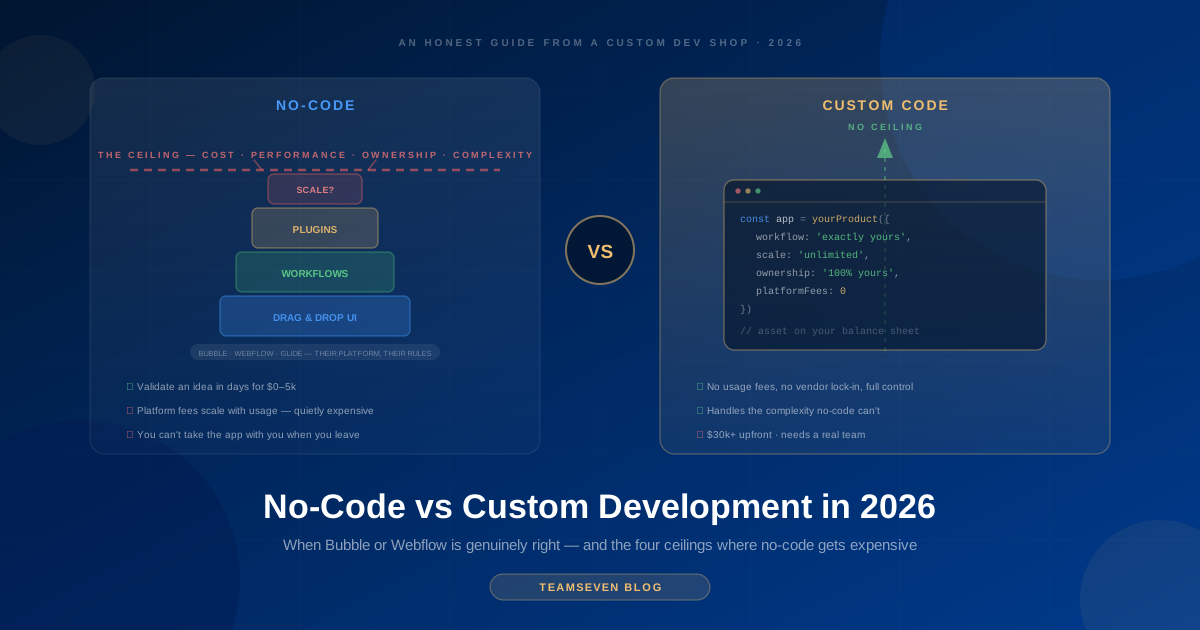
- No-Code vs Custom Development: An Honest Decision Guide
- How to Choose a Software Development Company
Not sure which side of the framework you land on? Book a free 30-minute scoping call — we'll score it with you, and we'll tell you if the answer is "just buy the off-the-shelf thing."